
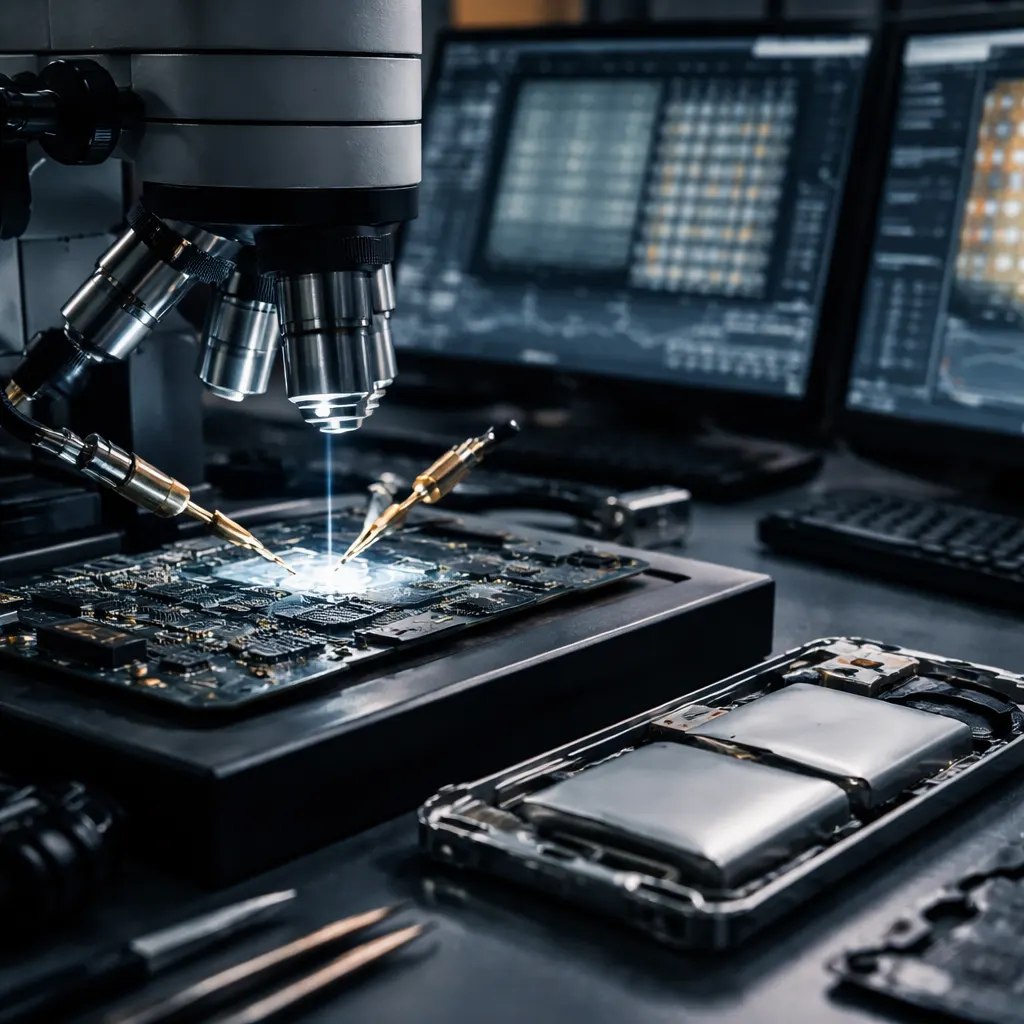
San Francisco-based startup Niobia is tackling a critical problem in semiconductor and battery manufacturing: helping engineers identify why production failures happen in minutes instead of days. According to TechCrunch's October 13 report, the company deploys AI-powered agents directly onto factory equipment to catch microscopic defects and analyze their root causes through a chatbot interface. The startup, a finalist at TechCrunch Disrupt 2026, aims to serve what co-founder Gaurav Jha describes as a multibillion-dollar market spanning major chip and battery producers worldwide.
Niobia's system places AI agents on production lines using self-contained GPUs mounted straight onto manufacturing machinery, functioning similarly to sensors. These agents can detect flaws as small as pinholes, including scratches, according to the report. The company's software then consolidates all production data in a single location, allowing engineers to query a chatbot about what caused specific failures and investigate the underlying issues. The AI runs on open source models that Niobia has further trained using battery and chip research data, which enables the system to recognize tiny imperfections that might otherwise go unnoticed.
Co-founders Jha and Harveen Kaur both hold PhDs in chemistry and have professional experience at chipmakers and battery manufacturers, giving them direct exposure to the sector's challenges. "Every product around you, like glasses or shoes, slippers, wallets, and headphones — these processes touch every single part of it," Jha told TechCrunch. The company currently focuses on three specialized manufacturing processes: film coating, electroplating (coating surfaces with metal via electric current), and fluidized bed reaction (a chemical process suspending solid particles in gas or liquid). Jha noted that while Niobia's work is "extremely niche," it operates behind the scenes powering products most consumers never think about.
The speed Niobia offers matters because chips and batteries rank among the world's most essential products while facing growing supply shortages, the report explains. As manufacturers develop and refine their technologies, problems inevitably emerge during research and development. Engineers then spend days or longer determining solutions before restarting production lines. Each defect or error can cost millions of dollars and push back manufacturing schedules. Niobia chose open source models largely because customers refuse to send proprietary information to public AI clouds where it might train external models, according to Jha. "None of our customers want their proprietary data to go to the cloud, even if we tell them it's safe," he said. The company also addresses cybersecurity concerns given the high-stakes competition among rival nations to advance in battery and chip technology—Niobia lets customers hold their own encryption keys so the startup can't decrypt client data.
Looking ahead, the company wants its technology to become more autonomous, with the ultimate goal of building fully self-driving factories for customers. For now, Niobia presented its vision at TechCrunch Disrupt on October 13 in San Francisco, competing against 19 other startups in the Startup Battlefield competition running through October 15. The startup's bet is that reducing diagnostic time from days to minutes can fundamentally change how the world's most advanced manufacturers handle the costly mistakes that slow innovation. The approach reflects a broader shift where specialized industrial AI increasingly competes on trust and data sovereignty rather than raw technical capability, and where reducing downtime by even hours can justify significant investment in narrow-use software that most people will never see.