
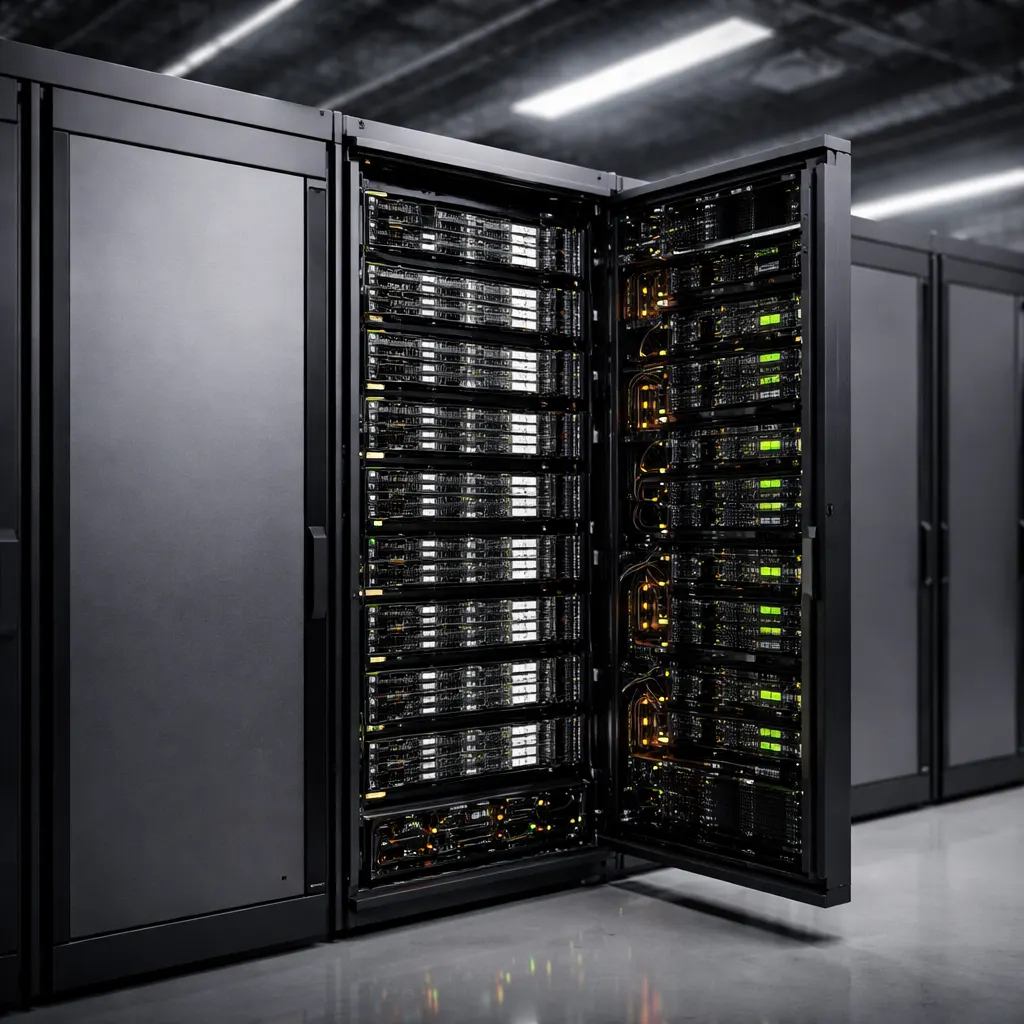
AMD has launched Helion, an open rack design that allows infrastructure partners to customize CPU and GPU resources for customers' agentic AI workloads. The design, announced Oct. 12, is a rack-scale reference blueprint based on an Open Compute Project specification. It's built to help hyperscalers and enterprise customers construct infrastructure for AI agents that carry out tasks, run code and handle complex workflows.
AMD detailed two example setups. The first configuration deploys sixth-generation AMD EPYC processors in a CPU-only rack with capacity for as many as 32,768 CPU cores, targeting hyperscalers that require dedicated computing power for agent execution while AI model inference runs on separate infrastructure. The second configuration blends AMD EPYC CPU nodes, AMD Instinct MI350P GPU nodes and general-purpose computing resources in a single rack, aimed at enterprises that want to operate agentic AI workloads on an integrated platform. The blueprint supports both air-cooled and liquid-cooled versions, enabling system builders to adapt deployments to their data center environments and power needs. AMD is also adding a token router that channels agents' model requests across frontier and open-source models, which could help organizations orchestrate access to different models within an agentic AI system.
According to AMD, the design builds on the company's Helios rack-scale platform, extending its open infrastructure approach to workloads that demand substantial CPU capacity alongside, or in place of, GPU acceleration. The company says Helion configurations are under development with ecosystem partners and are scheduled for availability in November 2026. AMD plans to contribute the Helion specification to OCP for further development and adoption, and is providing a reference design that hardware manufacturers and system integrators can use to build their own implementations. AMD has backing from Cisco, Dell Technologies, Hon Hai Technology Group, Hewlett Packard Enterprise, Lenovo, QCT, Supermicro and Wiwynn, whose roles span networking, servers, storage, rack integration, cooling and manufacturing.
The report explains that agentic AI systems create demand for computing resources beyond the GPUs used to run large AI models because they break tasks into steps, execute code, call tools and coordinate actions rather than simply generate responses. Helion's CPU-only configuration addresses that need by separating agent execution from model inference, which could make it easier for hyperscalers building services around large numbers of agents to allocate computing resources to each part of the workload rather than rely on a single infrastructure design. However, the 32,768-core figure describes the rack's maximum capacity, not a guarantee of performance for every agentic workload, with actual results depending on software, memory, networking and how efficiently applications use the available processors.
For enterprise channel partners, Helion creates an opportunity to build AI infrastructure offerings around customers' actual workloads rather than sell accelerator hardware alone, with system integrators able to help businesses determine how much CPU capacity they need for agent execution, where GPU acceleration makes sense and how to fit the equipment into existing data centers. Dell says deployments can be extended with PowerRack networking and storage, while Supermicro intends to bring Helion to market through its Data Center Building Block Solutions. For resellers, managed service providers and IT consultants, the commercial opportunity could extend to infrastructure assessment, system integration, deployment and ongoing support. Before committing to customer delivery dates, partners should confirm vendor-specific configurations, pricing, lead times and support responsibilities, and workload testing should establish whether the proposed CPU-GPU mix meets the customer's performance needs within available power and cooling capacity. The shift toward CPU-focused agent infrastructure may test whether enterprises are ready to rethink data center allocation in ways that challenge GPU-first procurement habits. Partners who can translate workload requirements into cost-justified configurations will likely capture more of the deployment opportunity than those still selling hardware by raw specifications.