
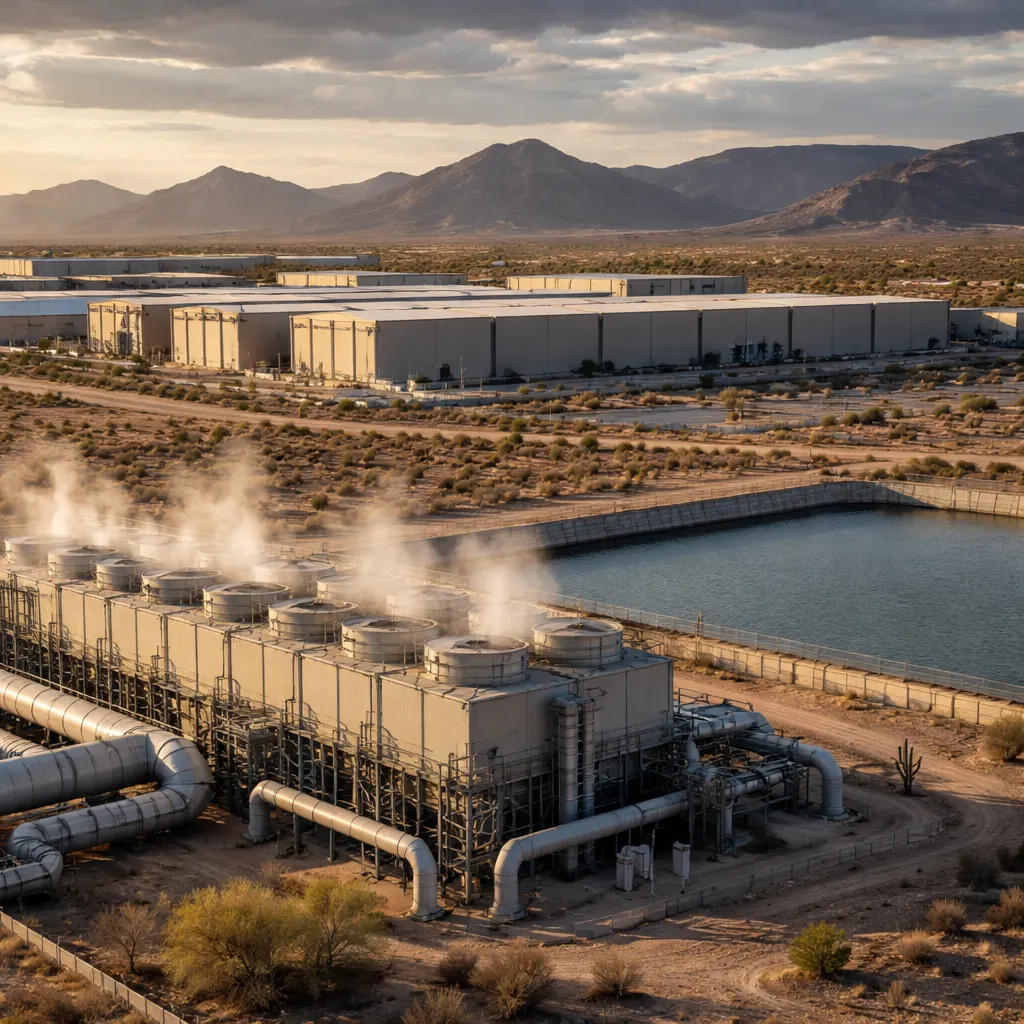
Taiwan Semiconductor Manufacturing Company's Arizona facilities consume nearly 5 million gallons of water daily from Phoenix's municipal supply, yet face little organized resistance, according to a feature report by The Verge. In stark contrast, proposed hyperscale data center developments across the state—some using far less water—have sparked a surprisingly bipartisan grassroots rebellion that's halted projects and forced policy changes. The divergence reveals how communities weigh industrial water consumption against economic benefits, particularly as Arizona prepares to lose nearly 30 percent of its Colorado River allocation.
TSMC's Arizona operation has injected $265 billion into the state economy—what the company calls the largest foreign direct investment in U.S. history—and created more than 3,500 permanent positions, the report details. The chip manufacturer recycles 60 to 65 percent of water flowing through its first fab and plans to reach 90 percent reuse by 2028. By comparison, Google's data center in The Dalles, Oregon uses about 1.5 million gallons daily—roughly one-third of TSMC's consumption. Yet proposed data centers in Tucson and Marana have drawn crowds exceeding 1,000 protesters to public meetings, with residents successfully blocking annexations and forcing developers to abandon water-cooling systems. Project Blue, a 600-megawatt Beale Infrastructure data center near Tucson, sparked particular fury despite requesting just 31 million gallons annually for construction—a fraction of the 11 billion gallons one Saudi-owned alfalfa farm consumed in 2023.
Christine Mackay, Phoenix's economic development chief who courted TSMC to Arizona, told The Verge her office evaluates "the economic value of a gallon of water." She explained that industrial water use can generate substantial regional benefits or contribute nothing, and in her assessment, TSMC has more than earned its allocation. The report notes that 55 TSMC suppliers have opened Arizona facilities, creating an ecosystem that's pushed average hourly wages in metro Phoenix from $22.85 a decade ago to $33.48 today. Sarah Porter, director of Arizona State University's Kyl Center for Water Policy, emphasized the distinction between semiconductor manufacturing and industries like golf courses, which consumed 41 billion gallons in 2020 with most water lost to evaporation. TSMC's ability to recycle the majority of its water differentiates it from traditional Arizona industries, Porter said.
The backlash against data centers stems partly from their minimal job creation—Project Blue promised just 200 permanent positions—and their association with artificial intelligence during a period of widespread skepticism about the technology's societal impact. According to the report, the No Desert Data Center Coalition frames its opposition around surveillance concerns and immigration enforcement, though water remains the galvanizing issue. Tucson responded to public pressure by imposing some of the city's strictest development regulations on data centers, while Pima County enacted a 120-day moratorium on new projects. Agriculture consumes roughly 70 percent of Arizona's water while contributing just 0.4 percent of state GDP, yet residents direct their anger at data centers. One factor may be timing: AI executives' warnings about job displacement and existential risk have coincided with data center proposals, creating associations that didn't exist when TSMC arrived in 2020.
Arizona's opposition illustrates how communities increasingly demand that water-intensive industries deliver tangible economic transformation, not just tax revenue and infrastructure promises. Tucson has banked enough treated groundwater to sustain residents for an estimated 47 years, and locals insist that reserve should serve families rather than enrich distant tech companies, rallying around the slogan "Not One Drop for Data." Even as Beale moves forward with Project Blue—switching to air cooling and proceeding despite Tucson's refusal to annex the land—the county hired an economic developer with a $150,000 salary to attract foreign investment resembling TSMC's model. The broader calculation, backed by voices like Mackay and Porter, holds that semiconductor manufacturing's job creation and supplier ecosystems justify water use that agricultural operations far exceed without comparable returns. For industries seeking desert footholds, demonstrating employment density and regional economic integration now matters as much as water efficiency claims—perhaps more.