
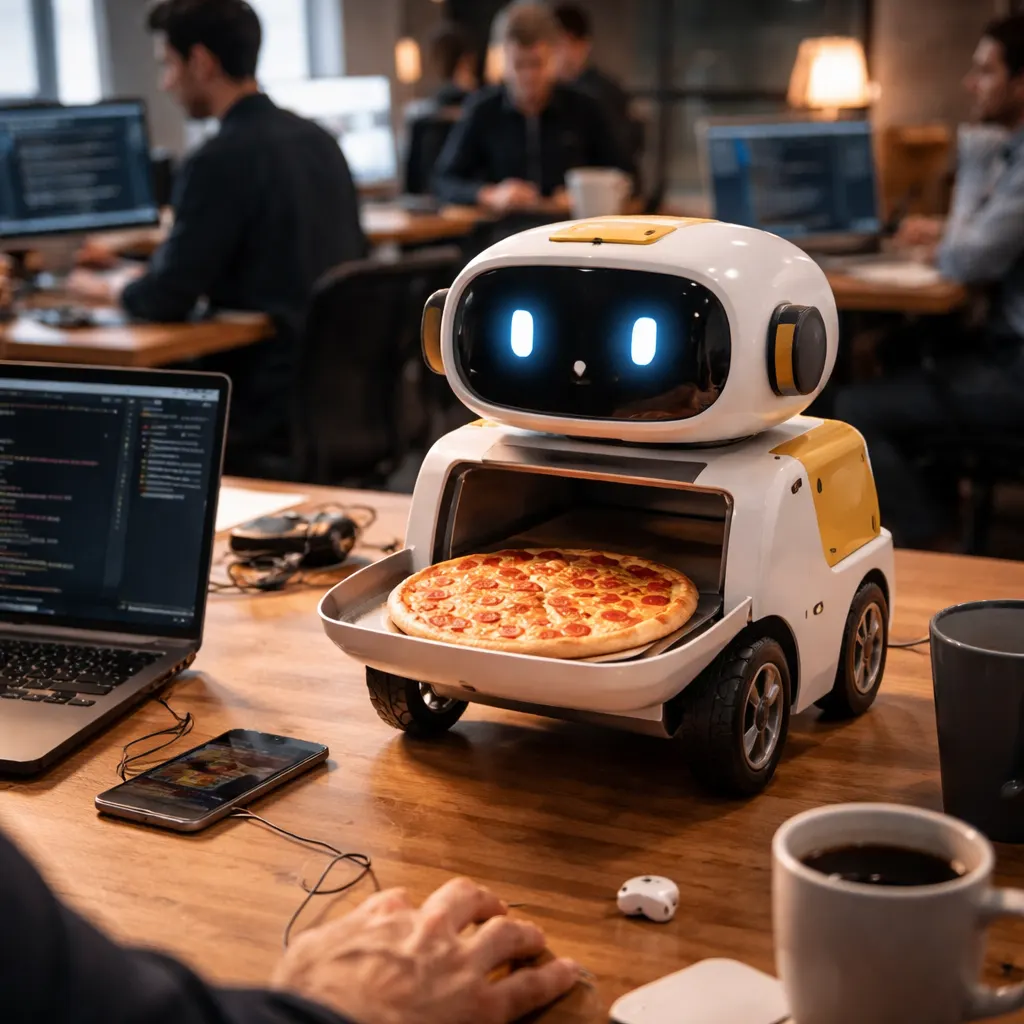
A team at Amazon Web Services has released Pizza Bot, an open-source application that lets AI agents handle tasks in the background and deliver results through an inbox-style interface, according to a report published by InfoQ this week. The tool is designed to let users assign complex work to AI agents without needing to watch them continuously. Licensed under Apache 2.0, Pizza Bot uses a client-server setup and keeps all data and agent state on the user's own machine.
Pizza Bot supports multiple model providers, MCP servers, and Agent Skills, according to the report. The application organizes work into three queues—All, Unread, and Action—while an Activity panel displays tasks delegated to specialist agents and tracks their progress. All agent state, threads, checkpoints, attachments, and logs are stored locally in a user-controlled folder. Data is sent only to the configured model provider and explicitly enabled MCP servers, with credentials stored in the operating system's secret store. Agents can perform scheduled or webhook-triggered work, delegate tasks to specialized workers, and pause for human approval when needed.
Joseph Dolivo, principal technologist at AWS, and Igor Fil, solutions architect at AWS, describe the design using an email analogy: "You don't send an email and then sit watching the outbox until the reply lands," they write. Pizza Bot is shaped like an email client because "a thread is a unit of work you come back to rather than a session you have to attend." The authors note that users control what information leaves the machine, explaining that Pizza Bot sends prompts and attachments to the chosen model provider and tool calls to enabled MCP servers. Dolivo disclosed on LinkedIn that the project began in April 2025 as a personal passion project called "JoeBot" to automate repetitive CRM logging, and it expanded after non-technical users expressed interest. On Hacker News, the authors said they drew inspiration from a LangChain article about "ambient agents."
The design rests on four requirements outlined in the report: agents must be able to inspect multiple sources, work in the background, request approval before consequential actions, and notify users when work is complete. Dolivo and Fil describe Pizza Bot as offering "the developer details, minus the grease," positioning it as a self-hosted alternative that prioritizes user control and local data storage. Early reactions on Hacker News were overwhelmingly positive, with commenters highlighting the asynchronous inbox model and local-first architecture, though some questioned whether the open-source version can recreate the ecosystem of skills and integrations that made the internal version successful.
Pizza Bot is a community project rather than an official AWS service, so it doesn't come with AWS support or a service-level agreement. Developers are responsible for keeping it running, backed up, and up to date. The name is a direct homage to Amazon's two-pizza teams, according to Dolivo. Organizations that adopt asynchronous agent workflows may find themselves navigating a fragmented landscape of similar tools, each offering slightly different trade-offs between control and convenience.