
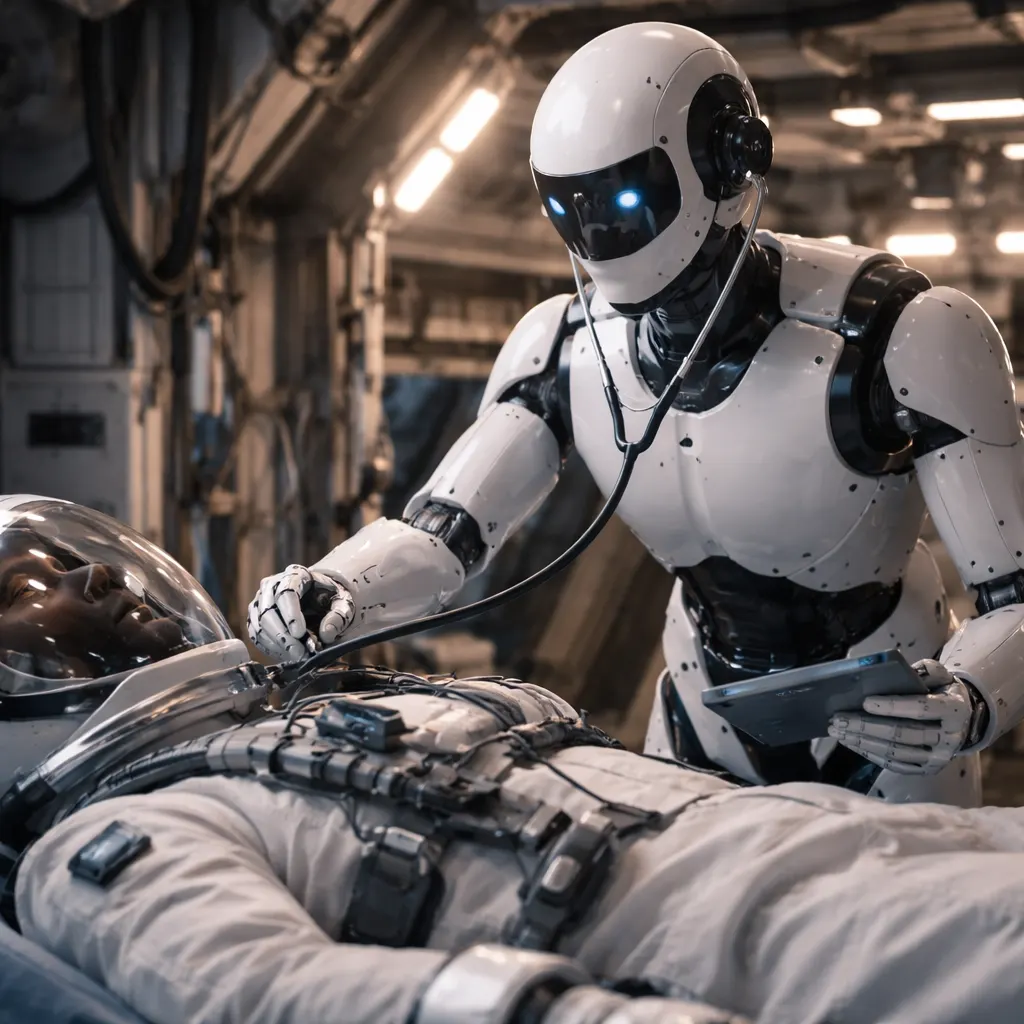
Google is partnering with NASA to create a robotic medical assistant designed to help astronauts on deep-space missions where communication delays can reach up to 44 minutes, according to a Tuesday blog post from the company's public sector vice president Jim Kelly. The initiative brings together Google's public sector division with NASA's Human Research Program, the Johnson Space Center's robotics team, and the Jet Propulsion Laboratory to develop a machine capable of assisting with medical tasks, cargo handling, and routine maintenance. The robotic system builds on an AI-powered medical decision-support tool the two organizations have been developing since last year.
The project expands the Crew Medical Officer Digital Assistant, or CMO-DA, which is already undergoing evaluation on ground-based versions of computers used aboard the International Space Station, the report states. CMO-DA runs on RamaLama, an open source local AI tool supported by Red Hat, and is built to evaluate medical issues locally rather than relying on Earth-based communications. The robot is envisioned as a versatile payload handler that can manage cargo, logistics, and equipment when medical assistance isn't needed, then shift to supporting a human crew medical officer when health issues arise. In early laboratory tests using DeepMind's MuJoCo physics simulator, the system achieved an 85 percent success rate in tasks involving locating and moving a medical bag.
Kelly explained that the robot would function as an extra set of hands rather than a standalone medical officer, operating through simple voice instructions under direct astronaut supervision. In one potential scenario, if an astronaut experiences severe back pain possibly caused by kidney stones, the robot could retrieve and prepare an ultrasound machine, leaving the crew medical officer to interpret the scan and determine treatment, according to the blog post. The robot might also handle routine health monitoring tasks such as capturing basic vitals or simple ultrasounds under strict guidance from a human medical officer. Kelly noted that on a future Mars mission, astronauts could face round-trip communication delays reaching 44 minutes, making real-time medical guidance from Earth nearly impossible.
The initiative addresses a critical challenge for deep-space exploration: crew members will need to handle medical emergencies without immediate support from ground control, the report explains. The communications lag means astronauts can't wait for Earth-based doctors to diagnose problems or guide procedures, making locally run AI models essential. The robot's design as a multi-purpose assistant reflects another constraint: lean crews on long missions can't afford specialized equipment that only serves one function. By handling cargo organization and equipment maintenance between medical tasks, the system maximizes its value to a small team. JPL is adapting satellite situational-awareness tools originally created to track objects in orbit, repurposing them to help the robot navigate three-dimensional spaces inside spacecraft.
The project remains at the proof-of-concept stage, with early laboratory demonstrations completed but no confirmation yet of a fully integrated, space-ready robot. NASA declined to provide specifics, telling the outlet only that it's working on various AI projects for its missions and assessing them with partners for future applications. Kelly's ultimate goal is a robotic system that can execute a variety of tasks through voice commands while remaining under astronaut supervision and control at all times. The prospect of self-sufficient crews capable of handling their own medical emergencies without real-time Earth support could determine whether missions to Mars and beyond become feasible. Organizations investing in autonomous systems for extreme environments may find that the hardest technical challenge isn't building the intelligence, but ensuring humans remain in command when stakes couldn't be higher.