
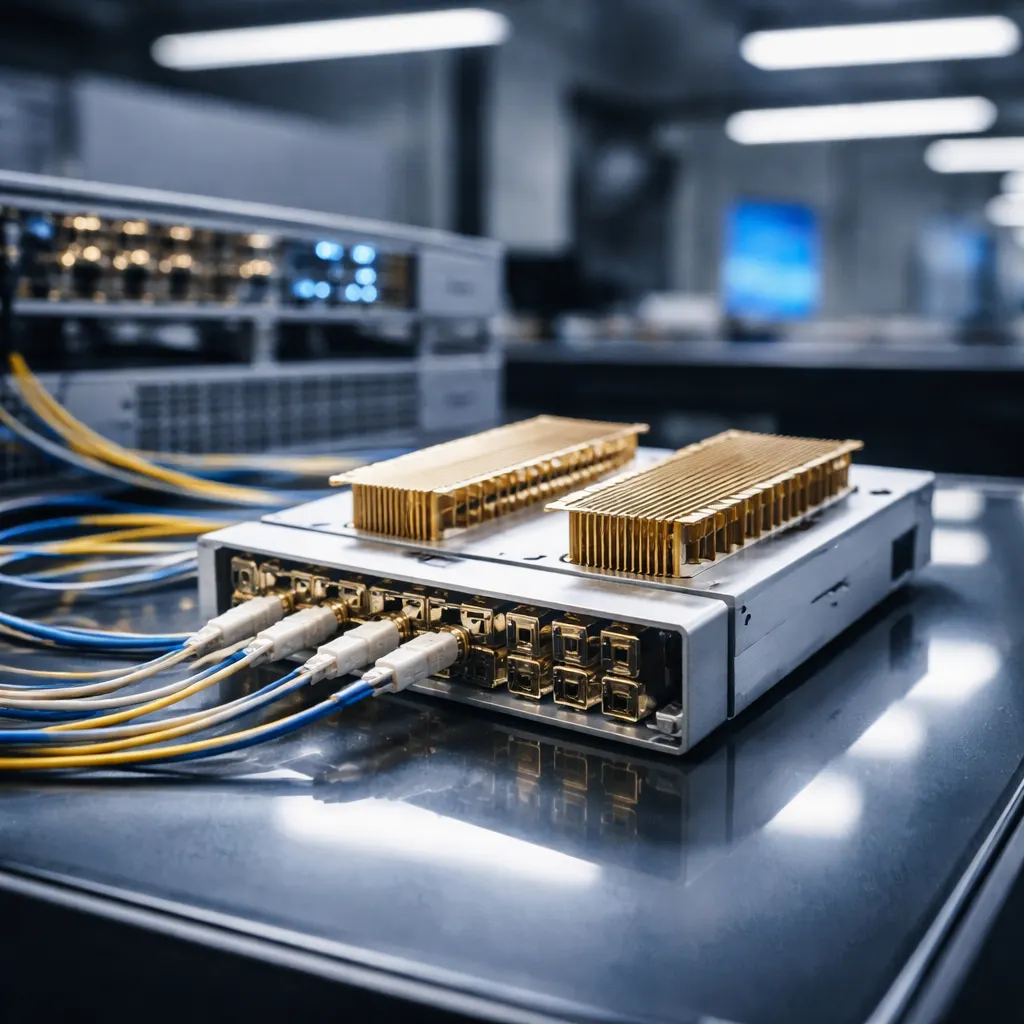
Huawei has introduced a near-packaged optics module capable of 7.2 terabits per second, positioning the technology as a middle path between today's pluggable modules and the expensive co-packaged optics favored by some rivals. The Chinese tech giant displayed the NPO module at the China International Optoelectronic Exposition in Shenzhen from September 9-11, saying it will power the company's upcoming third-generation SuperPOD AI systems. Huawei is now pushing for industry-wide standardization of near-packaged optics, arguing the approach delivers most of the benefits of tighter integration without the maintenance problems.
Near-packaged optics places the optical engine as close as feasible to a network switch's application-specific integrated circuit, but keeps it as a distinct package plugged into the mainboard rather than directly bonded to the chip substrate. According to Dr Man Jiangwei, director of Huawei's Advanced Opto-Electronics Laboratory, the design removes the module's separate digital signal processor by folding those functions into the ASIC itself. Man says this drops latency from 100 nanoseconds to 10 nanoseconds and cuts power consumption by roughly 60 percent. Huawei's NPO uses 200 gigabits per second per lane across 36 lanes, a configuration that differs from the 32-lane, 6.4 Tbps interface being drafted by the Optical Internetworking Forum. That standards project, which includes Cisco, HPE, Arista, and Nvidia, launched only in May 2026 and targets 6.4 Tbps initially with a future extension to 12.8 Tbps.
Man told reporters that the difference between 6.4 and 7.2 terabits per second reflects the varying bandwidth requirements of different vendors and system makers. "I believe this kind of technical divergence or differing opinions is quite common in standardization," he said, adding he's confident the industry will find a path to ensure compatibility between the two speeds. On the question of whether Huawei's prominent role could hinder adoption given U.S. export restrictions and political tensions, Man said he wasn't the right person to address the political environment. He stressed Huawei's willingness to collaborate with suppliers and customers in different countries and regions, including the United States, China, and Japan, to build out the NPO ecosystem.
Huawei is framing near-packaged optics as the most practical choice for the near term, contrasting it with co-packaged optics, where the optical engine sits on the same substrate as the switch silicon. The report notes that while co-packaged optics promises low latency and power use, the advanced packaging is costly and makes replacing failed optical engines in the datacenter difficult. Man said near-packaged optics is more mature and easier to ramp in production and maintain, making it "the most mature technology at the moment" and "a practical choice in this day and age." Huawei hasn't disclosed when its third-generation SuperPOD will ship, though Man hinted more details would emerge at the Huawei Connect event in Shanghai this week. The company also faces competition from Arista Networks' eXtra-dense Pluggable Optics concept, unveiled earlier in 2026, which updates pluggable modules with integrated liquid cooling and delivers up to 12.8 Tbps per module. The report concludes that which format gains the widest adoption will hinge on switch vendor support and customer priorities, and near-packaged, co-packaged, and extra-dense pluggable optics are likely to coexist for some time. Huawei's early product launch and aggressive standardization push signal the company's intent to shape the architecture of AI networking before rivals lock in their own approaches. The stakes extend beyond technical specs—whichever format datacenter operators choose will determine supply chains, maintenance workflows, and upgrade paths for years to come.