
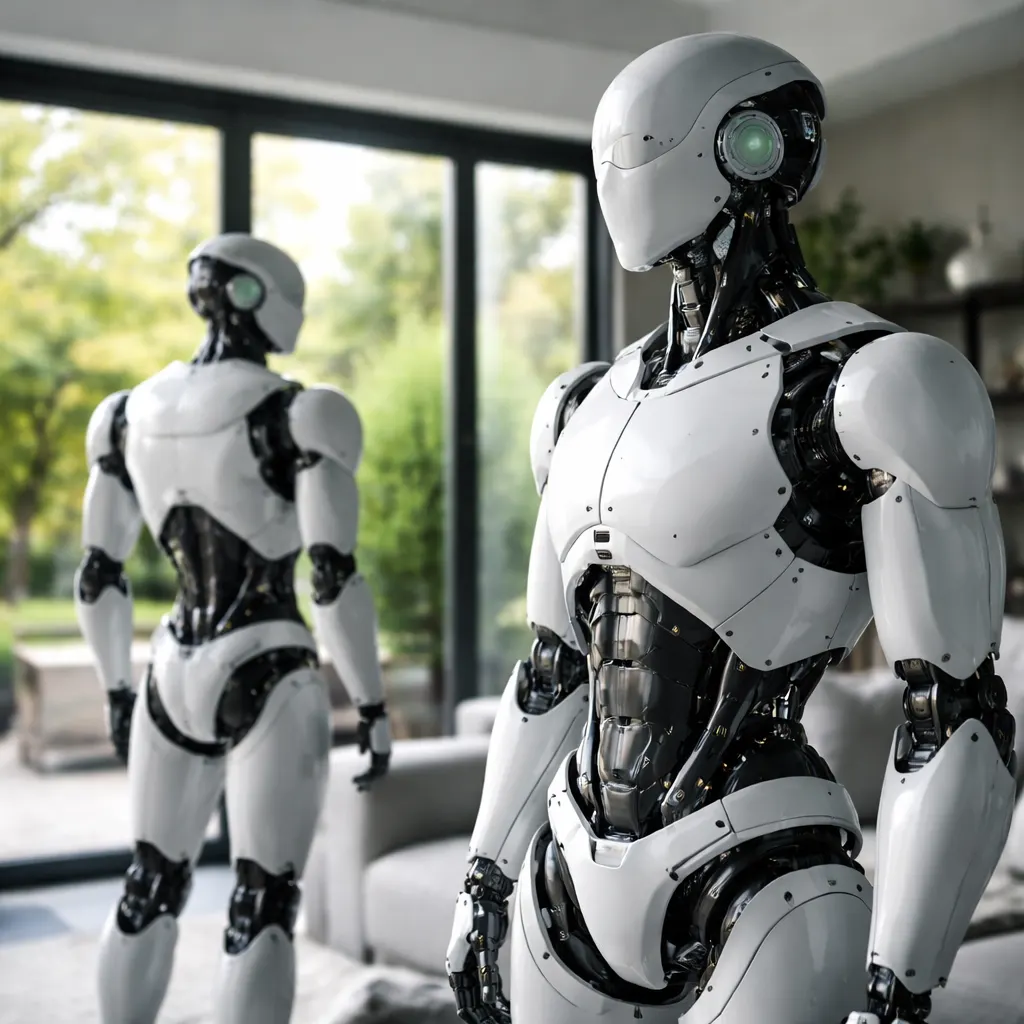
Despite bold predictions from tech leaders that humanoid robots will revolutionize daily life within years, robotics researchers say fully autonomous machines capable of domestic work remain at least a decade away, according to a report published October 8, 2026, by MIT Technology Review in collaboration with Aventine, a non-profit research foundation. The analysis examines the growing disconnect between industry excitement over AI-powered humanoid robots and the painstaking reality of progress in robotics labs. While Elon Musk claims Tesla's Optimus robot will become "not just Tesla's biggest product ever, but probably the biggest product ever" and predicts public sales by late 2027, researchers question whether current AI breakthroughs are sufficient to deliver on such promises.
The few humanoid robots deployed in real-world settings are performing highly limited tasks in tightly controlled environments, far from the generalist capabilities industry leaders envision. Agility Robotics has hundreds of robots being tested at facilities operated by GXO Logistics, Amazon, and Schaeffler, but these machines are handling simple jobs like moving bins and totes. Musk stated in January 2026 that Tesla had only "some of the Tesla Optimus robots doing simple tasks in the factory," walking back his May 2025 claim that thousands would be working at Tesla facilities by year-end. Chinese manufacturers dominated the humanoid robot market in 2025, shipping nearly 90% of the roughly 15,000 units delivered globally, according to market intelligence firm Omdia and Chinese robotics company Unitree. Unitree shipped more humanoid robots than any competitor last year and offers one model for less than $6,000, though orders come predominantly from corporate and academic labs plus state-owned enterprises. Morgan Stanley projects the number of human-resembling robots will reach nearly 1 billion by 2050, creating a market exceeding $5 trillion.
Yann LeCun, often called one of the godfathers of AI, dismisses the idea that language-based AI models can power capable robots, stating at a January 2026 Davos event that "the approaches that have been successful for language do not work for high-dimensional, continuous, noisy data" common in robotics. Jonathan Hurst, cofounder and chief robot officer of Agility Robotics, explains that while "it's very easy to make a robot that looks like a person," it is "dramatically more difficult to make a machine that moves or behaves dynamically or physically like a person." Marc Raibert, founder of Boston Dynamics, highlights a fundamental reliability problem: with current vision-language-action models, "people are very excited when their result goes from 50% success to 70% success," but "70% success is like it doesn't work, right?" The report notes that fully autonomous motion planning so robots know where to go in new, chaotic environments remains a largely unsolved challenge. Asked about the timeline for fully autonomous domestic robots, Hurst said, "If I had to pick a number, I'd say it's 10 years before robots are … actually doing useful things in people's homes."
The central obstacle lies in how robots learn. Current vision-language-action models can only reliably perform tasks they've been explicitly trained on through human demonstrations, and collecting sufficient training data remains expensive and time-consuming. Google DeepMind's Gemini Robotics system demonstrates this limitation: while it can pack a lunchbox or perform origami after training on many hours of examples, it fails when asked to do anything outside its training set. Achieving true generality would require what Hurst describes as "complete data coverage of all of the things that a robot could ever do"—an almost infinite pool of training data given how tasks in the real world explode in complexity. The report points to "world models"—AI systems trained to predict outcomes of actions in the physical world—as a promising alternative approach. Companies including Nvidia and Google are developing the technology, and startups like World Labs (acquired by AMD in September 2025 for $8.2 billion) and AMI Labs have each raised $1 billion in funding. But Stanford AI researcher Fei-Fei Li, who cofounded World Labs, described the field as "nascent" in late 2024, noting that "foundational approaches are still being established." A glimpse of potential came in April 2026 when startup Physical Intelligence released π0.7, a model that showed the first signs of compositional generalization by nearly completing an air fryer task it had never been trained to perform. Yet even this breakthrough required finding snippets of relevant data hidden in its training material.
The dream of humanoid robots extends back to Leonardo da Vinci's 1495 sketches for a mechanical knight, and the 20th century produced machines like Westinghouse's Elektro in 1939 and Honda's ASIMO in 2000—all impressive feats of engineering that proved unable to navigate the real world beyond demonstrations. ASIMO was discontinued in 2018 after failing to advance far enough to be useful. The report concludes that today's robots, even powered by transformative AI, still face the same existential challenge their predecessors did. For consumers eager to bring robots into their homes, the 1X Neo humanoid is available for preorder at $20,000 with delivery expected later this year, promising to handle boring household tasks. But the machine requires a remote human operator peering through its cameras to perform most functions, underscoring how far current technology remains from the autonomous domestic helpers industry leaders describe. The gap between carefully controlled demonstrations—where robots appear to dance, serve drinks, or respond to commands—and genuine autonomous capability reflects a pattern that has repeated for over a century, with each generation of machines dazzling audiences before hitting the hard limits of real-world unpredictability. The question roboticists now debate isn't whether transformative progress is possible, but whether it requires an entirely new path beyond the AI methods that conquered language and images.