
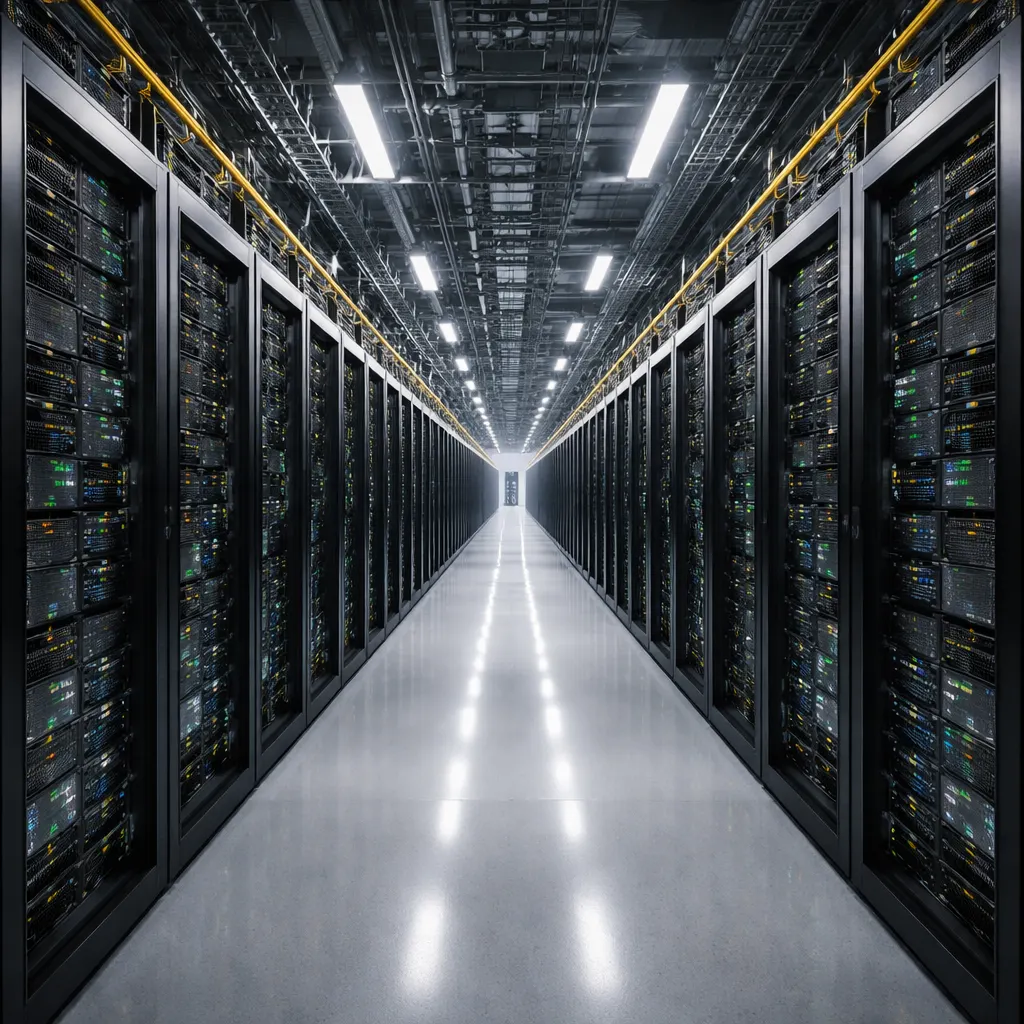
Meta is converting a former conventional data center into one of its largest AI computing operations, with plans to expand its Prometheus supercluster toward roughly 1 million GPUs, according to a report published by Channel Insider. What was once a standard facility handling routine web traffic now operates hundreds of thousands of Nvidia GPUs functioning as a single compute engine. The first phase has already finished pre-training runs for Meta's Muse foundation models, including its Muse Wonder agentic models.
The deployment currently runs two primary platforms: Catalina, built on the Nvidia GB200 NVL72 across a two-rack setup, and Clemente, which fits 72 Nvidia Blackwell Ultra GPUs into a single GB300 NVL72 rack consuming about 135 kilowatts. Meta will soon roll out San Miguel, a liquid-cooled rack with 72 Vera Rubin GPUs that pushes power beyond 170 kilowatts per rack. The company achieved over 85% goodput during pre-training runs and more than 90% for reinforcement learning on Muse Wonder, with mean time between interruptions reaching more than 54,000 GPU hours following fleet-wide firmware fixes. Rather than using proprietary fabrics between structures, Prometheus operates an Ethernet-based back-end network linking up to 20,736 GPUs per building fabric, bridging facilities across distances ranging from 2 kilometers to over 100 kilometers.
The report finds that shifting from eight-GPU systems to 72 tightly coupled GPUs expanded the failure blast radius by nine times. To counter this risk, Meta runs 64 active GPUs per rack while maintaining eight as immediate in-rack spares, alongside roughly 2% whole-rack reserves. When a GPU drops, an onboard spare steps in so the workload can restart from the last checkpoint rather than waiting on physical repairs. Physical deployment was expedited using rapid-deployment structures—heavy-duty tent enclosures spanning roughly two football fields that cut build schedules down to months. To manage sudden 30% to 40% cluster power swings, Meta relies on its "Dynamo Dimmer" software, local battery backup modules, and capacitor trays to smooth electrical transients.
According to the report, AI infrastructure value is migrating rapidly from bare silicon toward systems integration, thermal facilities, and interconnect stability. Because an issue on a single host can drag down an entire job, fleet stability becomes critical when running frontier models at gigawatt scale. Corporate data centers looking to stand up on-premises generative AI can't treat high-density GPU nodes as simple plug-and-play servers. Inside the halls, Meta paired air-assisted liquid cooling with facility closed-loop liquid cooling, highlighting the sophisticated networking, cooling, power management, and maintenance required to keep high-density GPU systems running reliably.
The report concludes that for value-added resellers, systems integrators, and managed service providers, this operational shift creates a major advisory opening. Mid-market enterprises lack the co-engineering resources to embed vendor engineers on-site or design custom power-capping frameworks like Dynamo Dimmer. While most mid-market enterprises won't deploy AI systems approaching Meta's scale, the underlying challenges of maintaining reliable, high-density compute environments can still affect smaller installations. Channel partners that can assess power and cooling capacity, integrate specialized hardware, and support ongoing infrastructure maintenance may be better positioned to help customers expand AI workloads without disrupting existing IT operations. As hyperscalers validate hardware architectures, the gap between what vendors ship and what actually runs reliably in production will define competitive advantage for enterprise infrastructure providers. Partners who can bridge that gap stand to capture demand that silicon vendors alone can't serve.