
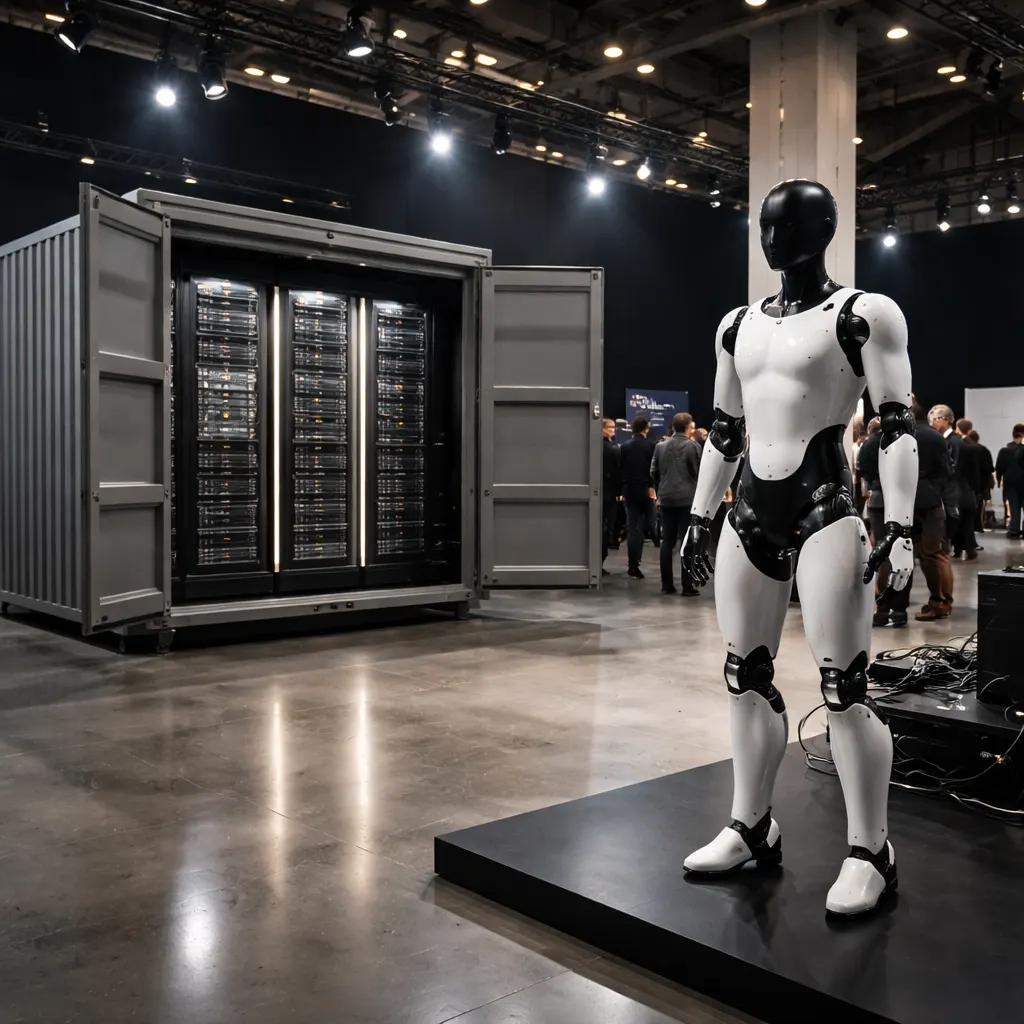
Nvidia introduced a factory-built, containerized AI infrastructure system that the company claims could cut deployment time from six months to as little as 14 days, according to coverage of the company's GTC keynote in Berlin on October 21. CEO Jensen Huang presented the DSX POD reference design alongside demonstrations of AI-powered robots and announcements spanning autonomous vehicles, telecommunications networks, and humanoid robotics platforms. The keynote, briefly interrupted by environmental protesters demanding the company "clean up your act," showcased Nvidia's push to embed its hardware and software across industries beyond traditional data centers.
The DSX POD combines seven liquid-cooled Vera Rubin compute racks using Nvidia's Spectrum-X networking, with partners handling cabling, integration, and testing inside modular containers before shipping. The systems use closed-loop liquid cooling with coolant temperatures reaching up to 45°C, while outdoor dry coolers discharge heat into the air without requiring water evaporation. Huang stated that at 2 gigawatts, DSX can conserve 54 million liters of water daily. Availability is anticipated in early 2027, though the 14-day deployment timeline assumes site infrastructure—power, connectivity, and preparation—is already in place. Huang also revealed the Agile ONE SN, a humanoid robot reference platform developed by German startup Agile Robots using Nvidia's Isaac GR00T technology and a Jetson Thor compute module, also slated for early 2027.
According to the coverage, Huang declared that robotics would become "the next major industry, the next great industry." The CEO demonstrated small two-legged Microducks from Pollen Robotics responding to voice commands, illustrating a workflow where AI trains in the cloud, gets evaluated on an Nvidia RTX Spark PC, then deploys on physical robots. Huang said Nvidia's Hyperion car system has become "an industry standard, and now it's being designed into one car fleet after another," while claiming Europe's telecoms operators are deploying Nvidia-powered computing for AI-RAN services. "After working on this for nearly eight years, Nvidia made the first commercial phone call on the T-Mobile network with Nokia," he noted.
The announcements reflect Nvidia's strategy to position itself as infrastructure provider for AI applications ranging from factory robots to telecommunications, extending beyond the cloud computing data centers that have driven recent revenue growth. The containerized DSX POD addresses deployment bottlenecks by shifting integration work to controlled factory settings rather than on-site construction, though customers still face the challenge of preparing facilities with sufficient power and cooling capacity for multi-gigawatt installations. The humanoid robot platform aims to give researchers and developers a turnkey system for testing capabilities without building hardware from scratch, potentially accelerating commercial applications. Forrester principal analyst Paul Miller observed that Huang "positioned Nvidia as a strong supporter of—and enabler for—Europe's sovereign tech ambitions," noting the company has invested nearly $10 billion into Europe in the past year, including 14 investments into European startups during Huang's current trip. However, Miller pointed out that "anything with critical ongoing dependencies on Nvidia (or any other non-European firm) is unlikely to meet the purest definitions of European tech sovereignty," highlighting the tension between adopting leading-edge hardware and maintaining technological independence. The company's expansion into physical AI and edge computing represents a hedge against potential slowdowns in data center spending, while raising questions about whether enterprises will tolerate vendor concentration across both training infrastructure and deployment platforms.