
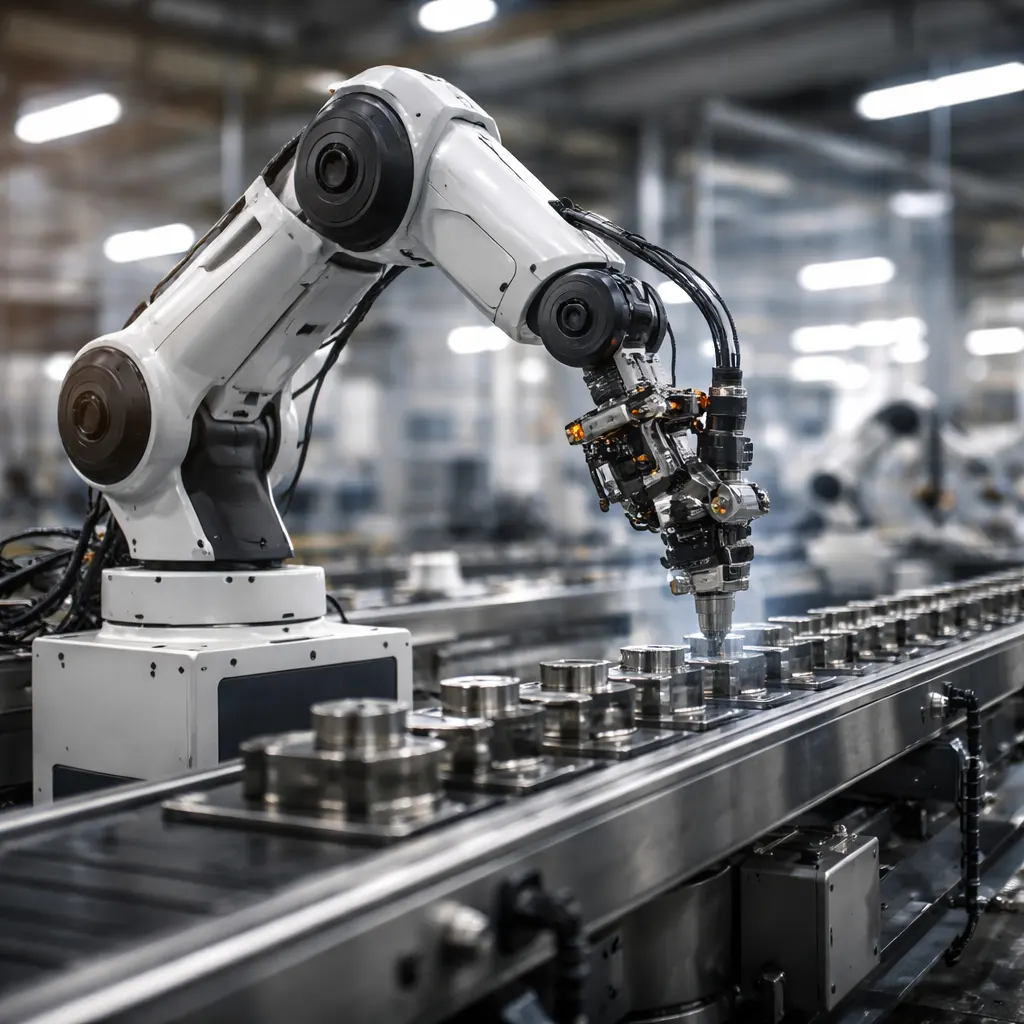
A San Francisco startup claims it can reconfigure factory automation in minutes instead of the weeks or months typically required, according to a presentation today at TechCrunch Disrupt 2026. Industrial Next, founded by former Tesla engineers, builds self-contained robotic workstations driven by proprietary foundation models that link vision, task understanding, and movement. The company says this approach eliminates traditional programming when switching production lines, letting manufacturers automate intricate and delicate work that has historically needed human hands.
The startup's robotic stations are already deployed on assembly lines for one of the world's best-selling smartphones, handling operations that manufacturers had repeatedly failed to automate, including guiding a fragile flex cable through its housing and clicking a miniature connector cap into position, according to co-founder Lukas Pankau. One workstation strips protective film from camera modules and buttons at or faster than human pace with perfect accuracy, and can be moved to a different phone model and production line it has never encountered before. Industrial Next announced onstage that it's working with BMW Group Technology Office to test the company's AI-powered dexterous manipulation for manufacturing applications. The company was established in 2021 by Pankau, a former lead electrical architect at Tesla who later moved to Waymo, and Allen Pan, who ran Tesla's autonomous factory initiatives before becoming chief architect at self-driving vehicle company Neolix.
The challenge of making robots genuinely adaptable comes down to training data, Pankau explained. "We can make robots do all these cool things like dance around, because there's data for that, but we can't make them assemble high-precision things," he said. Industrial Next addresses this by using simulated environments for high-precision and high-dexterity operations, building the robots' understanding of processes through what Pankau called "an extremely high-fidelity simulation engine that is close to the real dynamics." Traditional industrial robots are coded for very specific, repeatable actions, meaning even minor changes in the process or product can trigger failure or expensive downtime and push manufacturers to simplify designs for the sake of repeatability.
The founders' frustration with decades-old factory equipment at Tesla drove them to rethink manufacturing using today's technology, Pankau said, recalling engineers skilled at designing cars and self-driving systems but "effectively stumped at the factory looking at this equipment from the 1980s." Industrial Next's stations can be reconfigured, linked together, and reused across different product lines, with new tasks taught through simulation and demonstration rather than hard-coded instructions. The company's ultimate ambition is to move beyond phones: "We want to take this to building a full car end-to-end without any human touching ever," Pankau said. For manufacturers weighing automation investments, the technology represents a fundamental shift in how flexible production systems might be designed, though proving that flexibility at automotive scale remains an open question.