
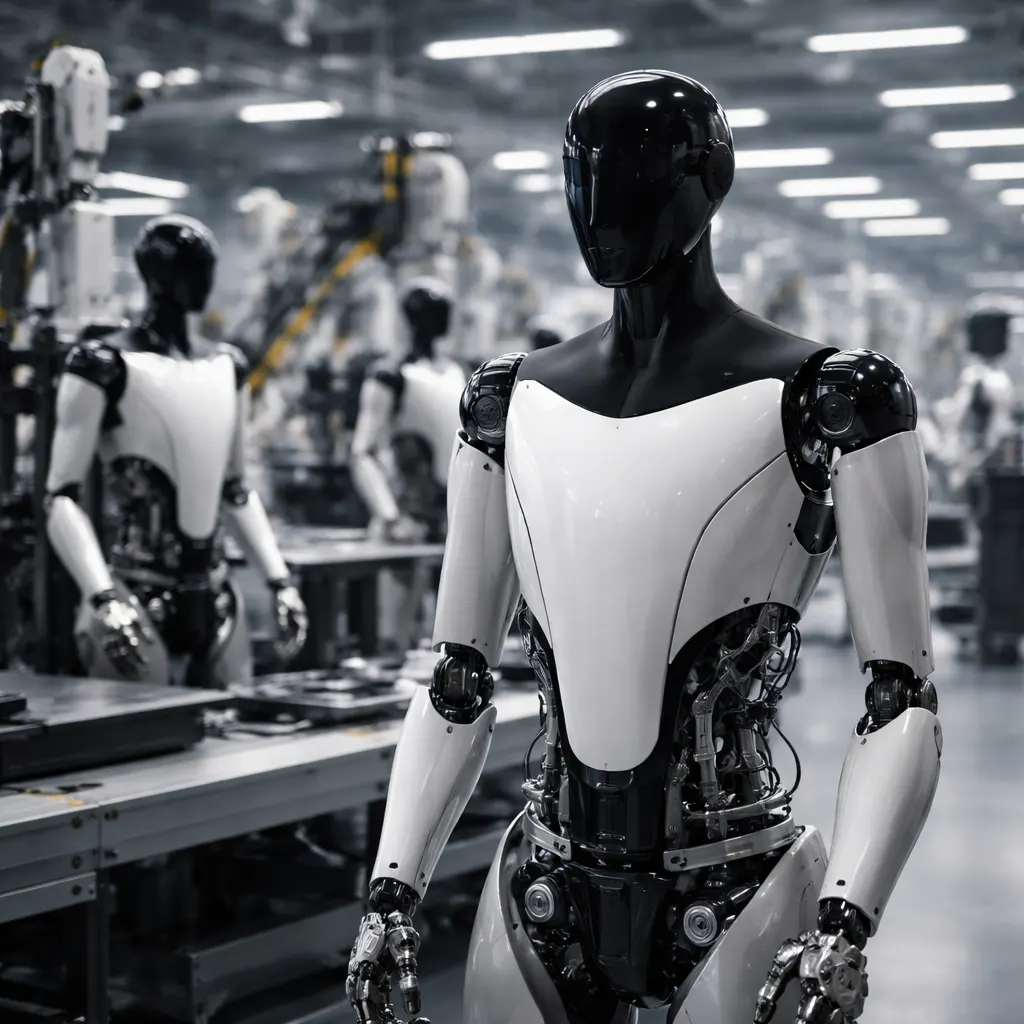
Tesla has begun manufacturing its Optimus humanoid robot at its Fremont, California facility, converting factory space previously used for electric vehicles, the company disclosed Wednesday in its third-quarter shareholder letter. The robots now rolling off the assembly line represent the first units meeting production standards, though the company acknowledged it will keep refining both the hardware design and manufacturing approach. CEO Elon Musk described this phase as "early production" with a gradual and potentially uneven ramp-up, yet projected weekly output could hit 20,000 units by late 2027.
The optimistic robotics milestone arrived alongside disappointing financial results for the quarter. Tesla's net income plunged 43% year-over-year to $787 million, down from $1.37 billion in the same period last year, as spending surged on artificial intelligence initiatives and the Optimus project. Total revenue barely budged at $28.04 billion, just shy of the $28.09 billion recorded in third-quarter 2025 and roughly $200 million below the prior quarter's $28.23 billion. Electric vehicle sales stayed flat at $20 billion year-over-year, with 486,532 vehicles delivered—about 6,000 more than the previous quarter but fewer than the same period in 2025. The company's solar and energy storage division saw revenue fall 16% year-over-year to $2.8 billion, attributed to tariff-related customer reimbursements. Services revenue climbed 33% year-over-year to $4.6 billion, delivering a record $734 million in gross profit, driven partly by subscriptions to the Full Self-Driving driver-assistance system. Reduced sales of regulatory credits further squeezed profitability.
According to Tesla's shareholder letter, the current Optimus manufacturing process has proven viable for a commercial product, even as iteration continues. Musk cautioned on the earnings call that design tweaks remain necessary to ensure the robot is safe, reliable, and durable enough to avoid wearing out quickly. He also noted substantial work lies ahead on the AI side to make the robot genuinely useful for open-ended tasks. Ashok Elluswamy, Tesla's vice president of AI software, told investors the company expects to activate the first customer vehicles as part of a robotaxi fleet "somewhere around Q2 next year," referring to a software update that would enable unsupervised driving for privately owned Teslas equipped with FSD. That timeline represents another delay; Musk had said in April the unsupervised version would "probably" ship in the fourth quarter of this year.
The steep profit decline reflects Tesla's aggressive bet on robotics, AI, and autonomous driving even as its core EV business stalls. Revenue stayed essentially flat because vehicle deliveries failed to grow year-over-year, while the energy division contracted due to tariff complications. Services growth—fueled by FSD subscriptions—provided a bright spot, but couldn't offset the jump in spending tied to Optimus and AI projects. The company's executives struck a bullish tone on FSD despite the repeated pushback of the unsupervised release, underscoring the company's conviction that autonomy and humanoid robots will define its next chapter. For now, investors are left weighing near-term profitability pressure against the promise of manufacturing thousands of robots weekly within 15 months. The shift from electric vehicle assembly lines to humanoid production signals a fundamental pivot in how Tesla defines its business—and where it's willing to spend. Companies undergoing platform transitions often face quarters where legacy revenue stagnates while new ventures consume capital, testing investor patience before the new model proves itself commercially.