
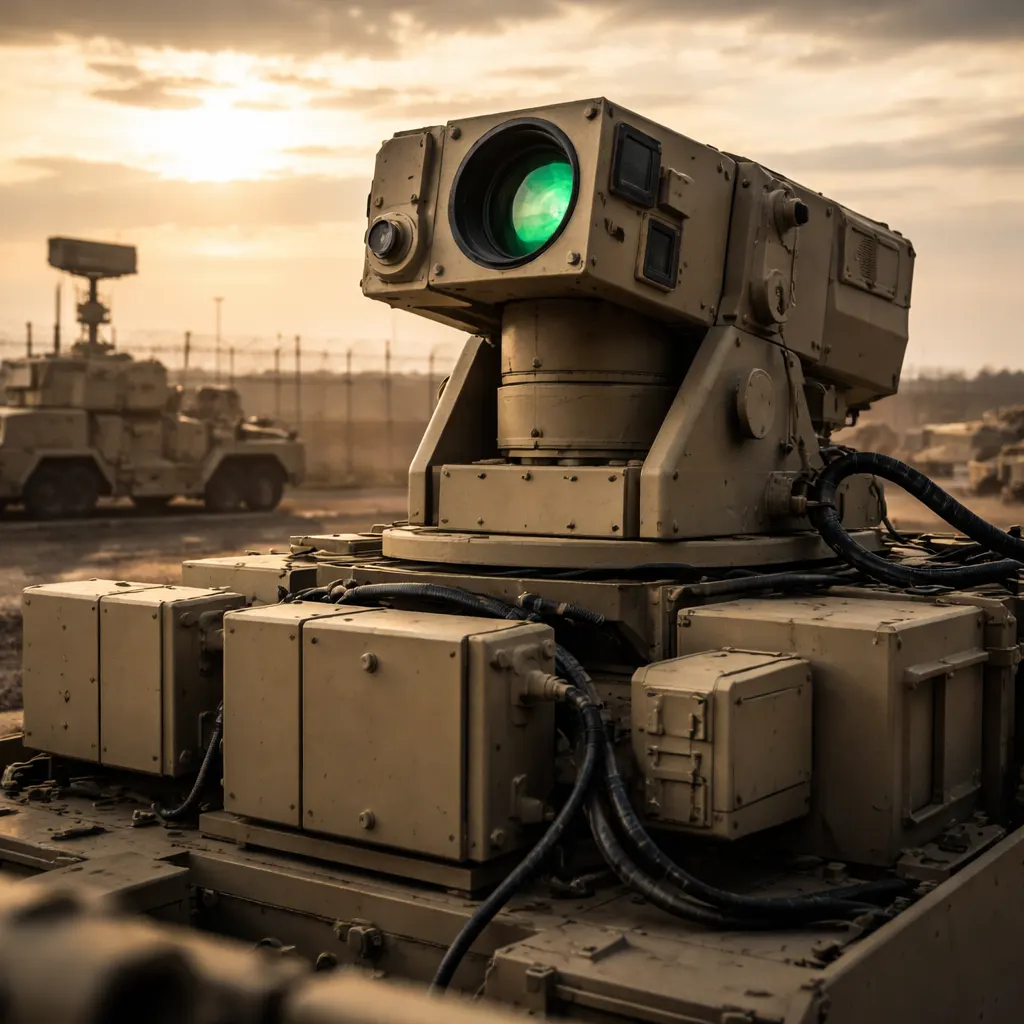
The US Army is preparing to sign a contract worth hundreds of millions of dollars to acquire and rapidly deploy laser weapons at bases around the world to defend against drone attacks, according to a report published this week by WIRED. The deal, which could be announced as early as this week, marks the first time the US military will commit to equipping its forces with laser weapons in significant numbers. After more than 50 years of failed attempts to develop working laser weapons, the technology is finally becoming an operational reality.
The Pentagon is expected to award the contract to defense contractor AeroVironment for up to 20 Enduring High Energy Laser systems, each compact enough to fit inside a four-by-seven-foot container or atop an all-terrain vehicle. According to the report, the Army yanked four vehicles equipped with Raytheon air-defense lasers from the Middle East after poor reviews from soldiers, while an AeroVironment laser positioned along the southern US border accidentally shot down a party balloon in February and later hit a Border Patrol drone by mistake. The US previously fired $4 million Patriot missiles at $35,000 Iranian drones during the early days of the Iran conflict. On March 1, an Iranian drone killed six US service members and injured 30 others, prompting Pentagon and FAA officials to visit White Sands less than a week later for a demonstration of the AeroVironment system.
"For years, lasers were going to be the future, and they never really came to their own. Now, they're actually coming to their own," Mark J. Lewis, the former Air Force chief scientist, told WIRED. The truly novel development, according to the report, is that the Enduring High Energy Laser will become an operational "program of record"—military terminology for a formally approved piece of equipment officially inscribed in the Pentagon's five-year budget. Lt. Gen Frank Lozano said at a DC think tank event that the system had showed "a lot of recent promise and capability out at White Sands," adding that the Army was "negotiating a contract with AeroVironment right now for the Enduring High Energy Laser system." President Donald Trump hyped the technology's capabilities two days after the White Sands demonstration, telling reporters at his Doral, Florida club that "the laser technology that we have now is incredible."
The report explains that the wars in Iran and Ukraine have demonstrated that drones are now so inexpensive, plentiful, and lethal that no single countermeasure can stop them. Modern lasers never run out of ammunition and can keep firing as long as they have power, according to the report, making them particularly useful against drone swarm attacks. The Pentagon has been scrambling to field defenses against mass-produced, low-cost attack drones, rolling out radio frequency jammers, microwave weapons, an array of missiles, drones designed to kill other drones, and even copies of Iranian robots—but none in isolation have been enough. Recent advances in fiber lasers, which rely on bundles of glass wires infused with rare-earth ions, have made the technology more efficient at absorbing energy and releasing heat while allowing for an almost perfectly focused beam.
However, the report notes that lasers still face significant limitations: rain and fog stop them short, and they must be fired at one target at a time for a few seconds per target. Scott Keeney, CEO of nLight—a company that provides lasers to contractors like AeroVironment and recently won a Pentagon contract worth up to $627 million—acknowledged that "if you've got 1,000 drones coming in, you're not going to hit every single one." Lewis called the idea of swapping traditional munitions for lasers "really dumb," arguing that lasers should be used "in ways that you can't use the gun"—especially when the metaphorical gun costs millions of dollars per shot and the target is a cheap killer drone. The Pentagon's decision to make this a program of record signals a wider cultural acceptance of the new technology as a military capability and tells contractors to ramp up production. The defense establishment has essentially wagered that practical constraints around weather and targeting speed matter less than solving the immediate economic mismatch between expensive interceptors and disposable threats, even as the operational record remains mixed and the technology's niche role becomes clearer with each deployment.