
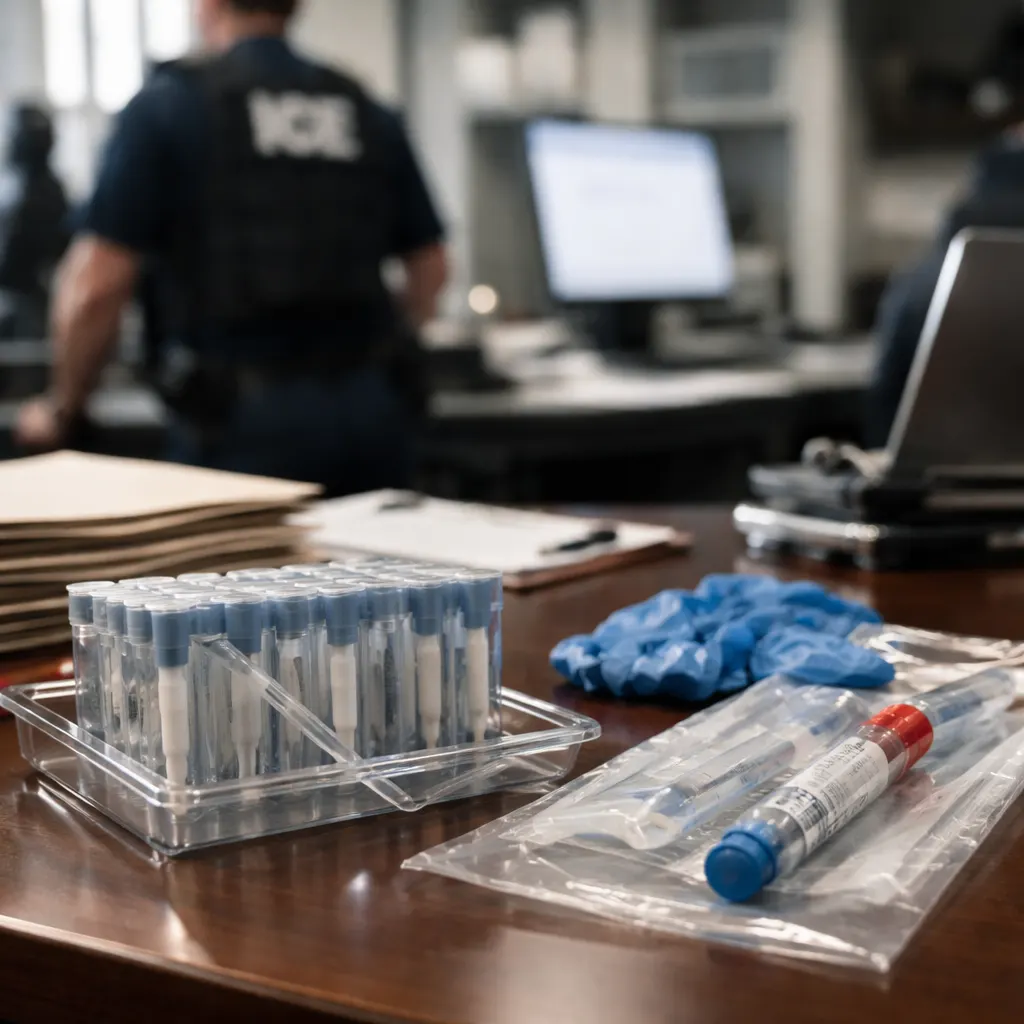
The Department of Homeland Security has become the largest single contributor of genetic profiles to the nation's criminal DNA system, with Immigration and Customs Enforcement potentially adding roughly 920,000 profiles in 2025 alone, according to new research from Georgetown Law's Center on Privacy and Technology. The DNA comes from people held for civil immigration violations—most of whom have no criminal conviction—and feeds directly into the FBI's Combined DNA Index System, or CODIS, a database built for criminal investigations. Once inside, those genetic profiles can be compared against evidence from unsolved crimes and crime-scene DNA collected years or decades into the future.
FBI records show the "detainee" index of CODIS reached 3,345,692 profiles by December 2025, growing by roughly 995,000 that year—more than 2,700 people every single day. That represents a dramatic shift from earlier years, when ICE's contribution was marginal. Internal training slides obtained through the Freedom of Information Act show ICE collected just 3,609 DNA samples in fiscal year 2020 and 16,392 more through mid-May 2021—roughly 20,000 total. During that same period, Customs and Border Protection operated at a far larger scale, sending the FBI DNA from at least 1.36 million people between October 2020 and the end of 2024, according to agency spreadsheets analyzed by Georgetown.
The expansion has reached families held in immigration detention, including children swabbed at a family detention center in Dilley, Texas. "None of the families at Dilley have been convicted of a crime," US representatives Joaquin Castro, Greg Stanton, and Nanette Barragán said in a joint statement. "They do not belong in a database meant for violent criminals, especially children." The case of Hugo Moreno-Mendez illustrates the enforcement behind the program: after refusing multiple times to provide a cheek swab during his March 2025 ICE arrest in Waco, Texas, he was charged with refusing to provide DNA while in federal custody—a misdemeanor that ICE itself said in 2021 it was unaware had ever been prosecuted. A magistrate judge found him guilty in August 2025 and sentenced him to time served.
The vast majority of people in ICE custody have no criminal conviction, and residing in the US without documentation is typically a civil offense, not a criminal one. Yet the DNA collection program—backed by the threat of prosecution—channels their genetic profiles into a system designed for criminal investigations anyway. Law enforcement agencies across the country can search those profiles against evidence from unsolved crimes, and the physical samples, which hold a person's entire genome, remain in a federal laboratory indefinitely. A DHS spokesperson defended the practice as a border-security and identification measure, stating that CBP takes samples from people arrested on federal charges and from detained noncitizens subject to fingerprinting who aren't otherwise exempt.
The report's findings suggest the program entered an entirely new phase in 2025, with ICE's contribution potentially eclipsing CBP's for the first time. DHS did not address Georgetown's estimate that ICE may have added hundreds of thousands of profiles to CODIS last year. The physical and legal infrastructure is now in place to funnel the DNA of nearly everyone passing through immigration detention into a permanent criminal database—a system that treats civil immigration violations as if they were crimes, and stores the genetic information of children alongside violent offenders.