
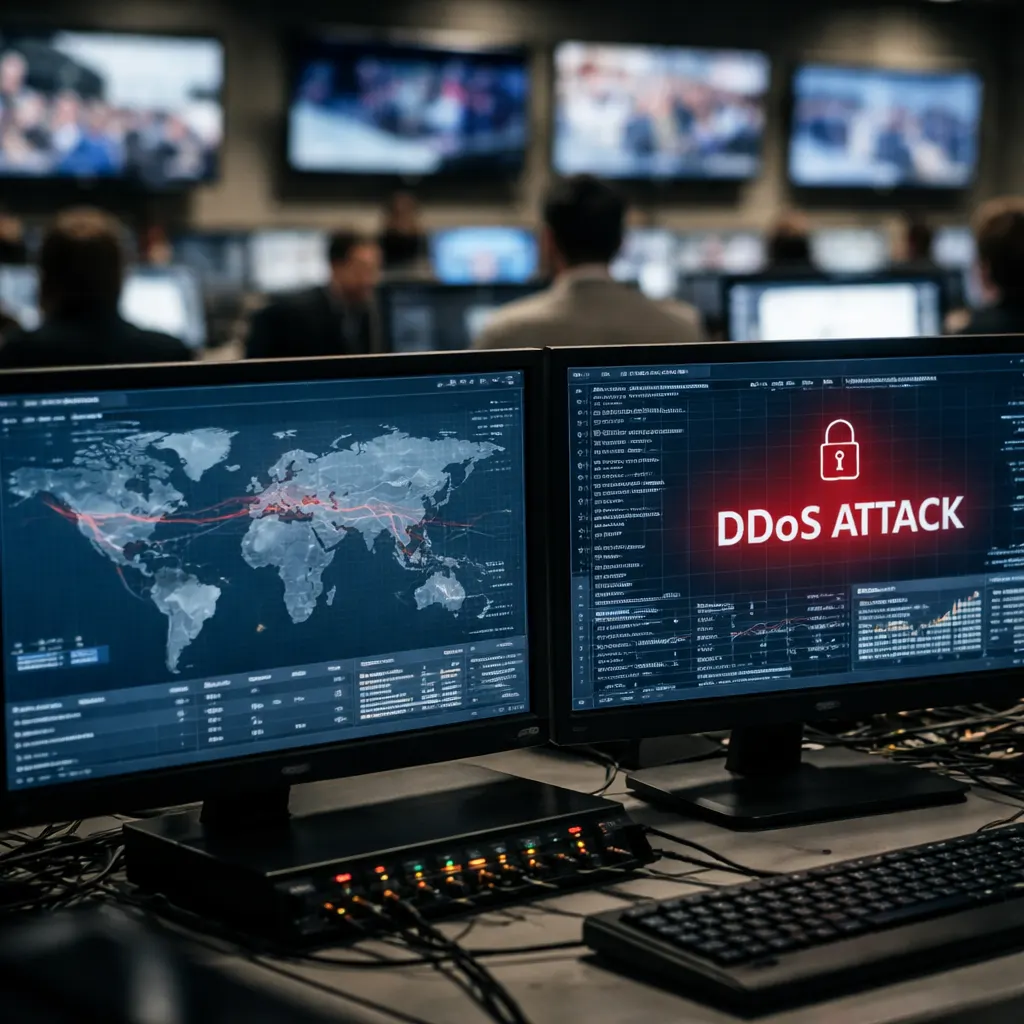
Media, production, and publishing organizations absorbed 14.2 percent of all DDoS attacks launched globally during the first half of 2026, making the sector the most heavily targeted of the year, according to Cloudflare's latest threat intelligence data. The ongoing conflicts in Ukraine and Iran, along with the FIFA World Cup, drove a geopolitically motivated assault on news organizations, with attacks aiming to censor coverage and disrupt information flow during peak readership moments. The findings align with separate telemetry from Akamai and Palo Alto Networks showing sharp increases in cybercrime and pro-Russia hacktivist activity following the outbreak of the U.S.-Iran war in February.
The media sector endured nearly four times the volume of attacks aimed at the second most-targeted industry—gambling and casinos—and six times more in the second quarter alone. Cloudflare mitigated 805 network-layer attacks exceeding 1 terabit per second in Q2, a 519 percent jump compared to Q1. Despite their dramatic scale, hyper-volumetric attacks above 1 Tbps represented just 0.004 percent of all DDoS incidents, while the vast majority—96.62 percent—transmitted less than 500 megabits per second and 90.6 percent concluded in under ten minutes. The U.S.-Iran conflict also propelled government entities from the 29th most-targeted sector in Q1 to ninth in Q2, with the United States and China comprising the two most-attacked regions and Turkey jumping to third after hosting the Ankara NATO summit in July.
Blake Darché, Head of Cloudforce One and Threat Intelligence at Cloudflare, explained that "DDoS attacks on media organisations can be highly effective at achieving their core goals, which differ fundamentally from attacks on other sectors." According to Darché, while a DDoS strike on an e-commerce platform might seek to steal transaction revenue, assaults on publishers typically pursue censorship, information suppression, or timing disruption. "DDoS attacks are uniquely effective against publishers because news expires quickly," he told The Register, noting that downing an outlet for just two hours during an election night, military conflict, or breaking story successfully silences it at peak readership, and the attack succeeds even if systems recover shortly after.
Network-layer attacks operate at layer 3 of the OSI model, overwhelming core routing, transport, and infrastructure protocols to incapacitate networking equipment, the report explains. Hyper-volumetric attacks transmit enormous volumes of data—enough to collapse even the most resilient internet infrastructure—and rank among the fastest threats ever observed, with the first 1 Tbps incident on record targeting Dyn DNS in 2016 and downing major platforms including Twitter, Netflix, Reddit, Spotify, and GitHub. Even smaller attacks pose serious risks: Cloudflare notes that a 100 Mbps attack can knock a website or server offline, while a 1 Gbps assault could disrupt an entire datacenter lacking DDoS protection. Hyper-volumetric strikes often last only seconds, yet the report warns that "the cascading effects of even a short burst can trigger routing instability, TCP retransmissions, application timeouts, and downstream service degradation that takes hours or days to fully resolve—all while services remain down or impaired."
The report emphasizes that manual mitigation and on-demand solutions prove too slow for the current threat environment, since by the time an alert reaches a security analyst, the attack has already completed, leaving no practical window for human intervention. Hacktivists—who rely heavily on DDoS tactics and coordinate attacks via social media platforms—remain a persistent threat, though signals intelligence agencies characterize their efforts as almost always low-level and low-impact. A law enforcement operation in March disrupted infrastructure supporting four major botnets, including Aisuru, which by late 2025 had recruited up to 4 million devices and was launching multiple 1 Tbps attacks daily. Publishers face a unique vulnerability because availability is their core deliverable, and even brief outages during critical news cycles achieve the attackers' censorship objectives regardless of how quickly systems recover. Organizations that depend on real-time information delivery may need to recalibrate their defense posture, recognizing that traditional incident response timelines no longer match the speed or motivations of adversaries targeting the news cycle itself.