Monday, September 14, 2026Debriefing the tech that moves your business.
AI Spending Fuels Historic Computer Investment Surge, But Growth Shows Signs of Cooling
US business investment in computers surged 115% in 18 months, driven by AI infrastructure spending that now accounts for one-third of GDP growth, though momentum cooled significantly in Q2 2026.
By Allen YoungMonday, September 14, 2026
Illustrative image only — not an actual photo of the events or people described in this article.
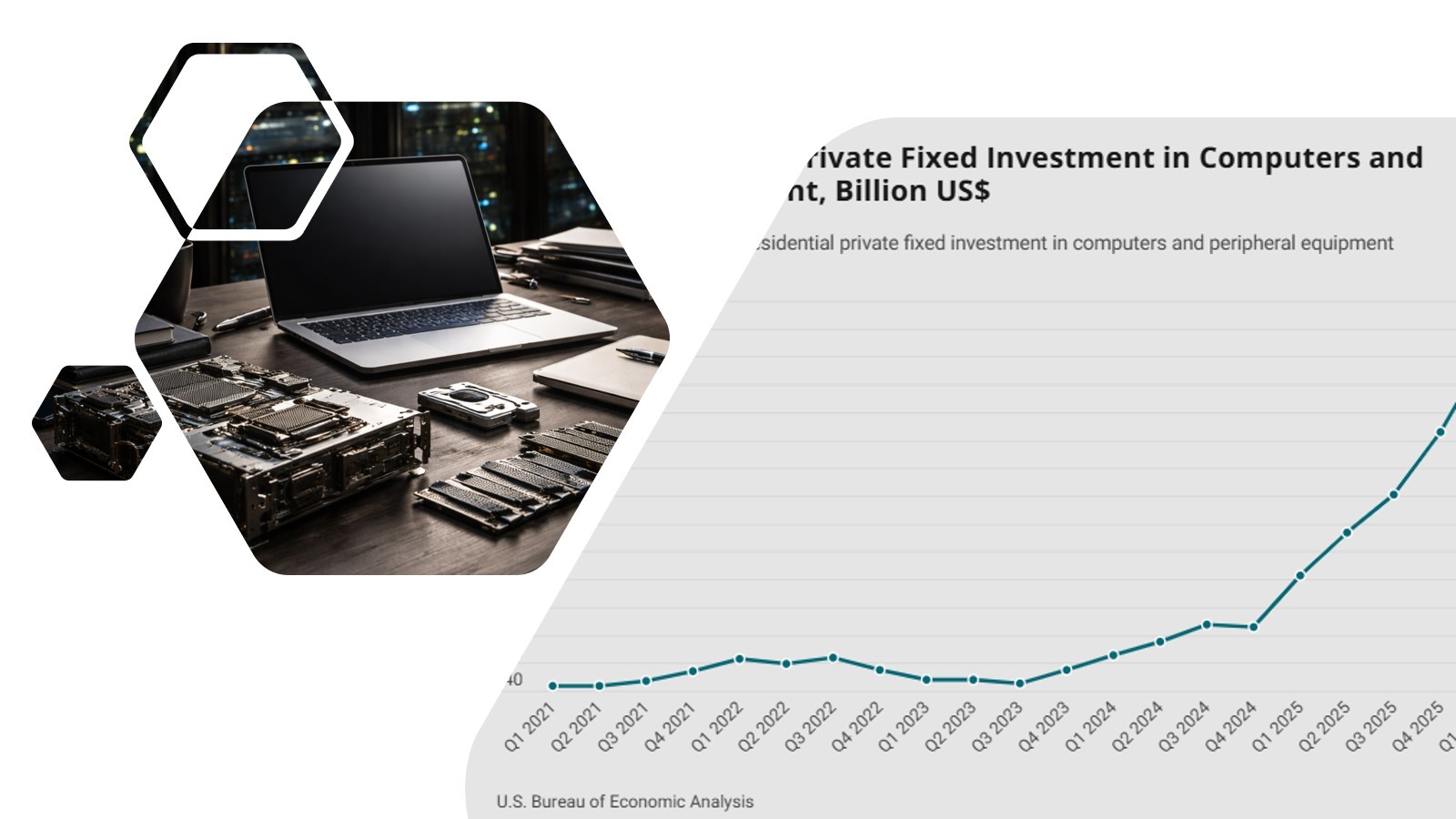
American businesses are pouring money into computers and AI infrastructure at a pace never seen before. Private investment in computers and peripheral equipment hit $400.6 billion in the second quarter of 2026, more than doubling from $186.1 billion just six quarters earlier—a stunning 115% jump in eighteen months. This isn't just another tech cycle. It's a fundamental reshaping of corporate America's capital priorities, driven almost entirely by the race to build AI data centers and the computing power they demand. The numbers from the Federal Reserve Economic Data tell the story of an industry that's shifted into overdrive.
Nonresidential private investment in computers and peripheral equipment exploded from $186.1 billion in Q4 2024 to $400.6 billion in Q2 2026, with the sharpest acceleration occurring between Q4 2024 and Q1 2026 before growth rates moderated.
The chart reveals two distinct eras. From early 2021 through late 2023, computer investment bounced between $143 billion and $165 billion per quarter, showing modest fluctuations but no clear direction. Then everything changed in Q4 2023, when spending hit $155.1 billion and began a relentless climb. By Q1 2024, it reached $165.5 billion. Three quarters later, in Q4 2024, it stood at $186.1 billion. But the real acceleration came next: Q1 2025 jumped to $222.8 billion, Q2 2025 surged to $253.8 billion, Q3 2025 climbed to $280.9 billion, and Q4 2025 reached $325.4 billion. The first quarter of 2026 saw investment rocket to $384.2 billion, an 18% increase in just three months. Then came Q2 2026 at $400.6 billion—still growing, but at a much gentler 4.3% pace compared to the previous quarter's explosive gains.
But the flattening growth rate from Q1 to Q2 2026 raises important questions about sustainability. While investment hit a new peak, the quarter-over-quarter increase slowed dramatically—from 18% to just 4.3%. This deceleration coincided with broader economic headwinds: US GDP growth slowed to 1.5% in Q2 2026, down from 2.1% in Q1 and missing the 2.1% consensus forecast. The slowdown wasn't due to weak domestic demand—consumer spending and business investment actually strengthened. Instead, a sharp 11.5% increase in imports, driven partly by heavy purchases of semiconductors and other goods feeding the AI buildout, cut 1.5 percentage points from GDP. Since chips account for roughly 60% of total AI data center investment, according to McKinsey, much of that computer equipment spending flows right back overseas to semiconductor manufacturers. The result is a widening trade deficit that creates a mathematical drag on GDP even as companies spend furiously on AI infrastructure.
The sharp climb from late 2024 through early 2026 captured the initial frenzy of AI infrastructure buildout—the moment when every major tech company realized it needed massive computing capacity immediately or risk falling behind. The cooling pace in Q2 2026 doesn't signal retreat; it suggests the market is catching its breath after an unsustainable sprint. Companies are still investing at record absolute levels, but the rate of acceleration has moderated as supply chains strain, power constraints emerge, and firms start questioning whether current spending can generate returns before the next technological shift arrives. What happens next depends on whether AI applications justify the infrastructure already built—or whether this becomes a cautionary tale about building too much, too fast.
Enjoyed This Analysis?
Subscribe to get stories like this delivered to your inbox every week — free, no spam, unsubscribe anytime.