

California's software publishing industry just hit its lowest employment level in six years, and the timing tells a story that should worry every developer in Silicon Valley. The state shed nearly 20,000 software publisher jobs—a 15% drop—from the August 2022 peak of 120,300 workers to just 101,800 in August 2026. This isn't just another tech correction. It's a structural shift happening in real time, and the chart pattern reveals something unsettling: AI coding assistants might be doing exactly what they were designed to do—automate developers out of existence.
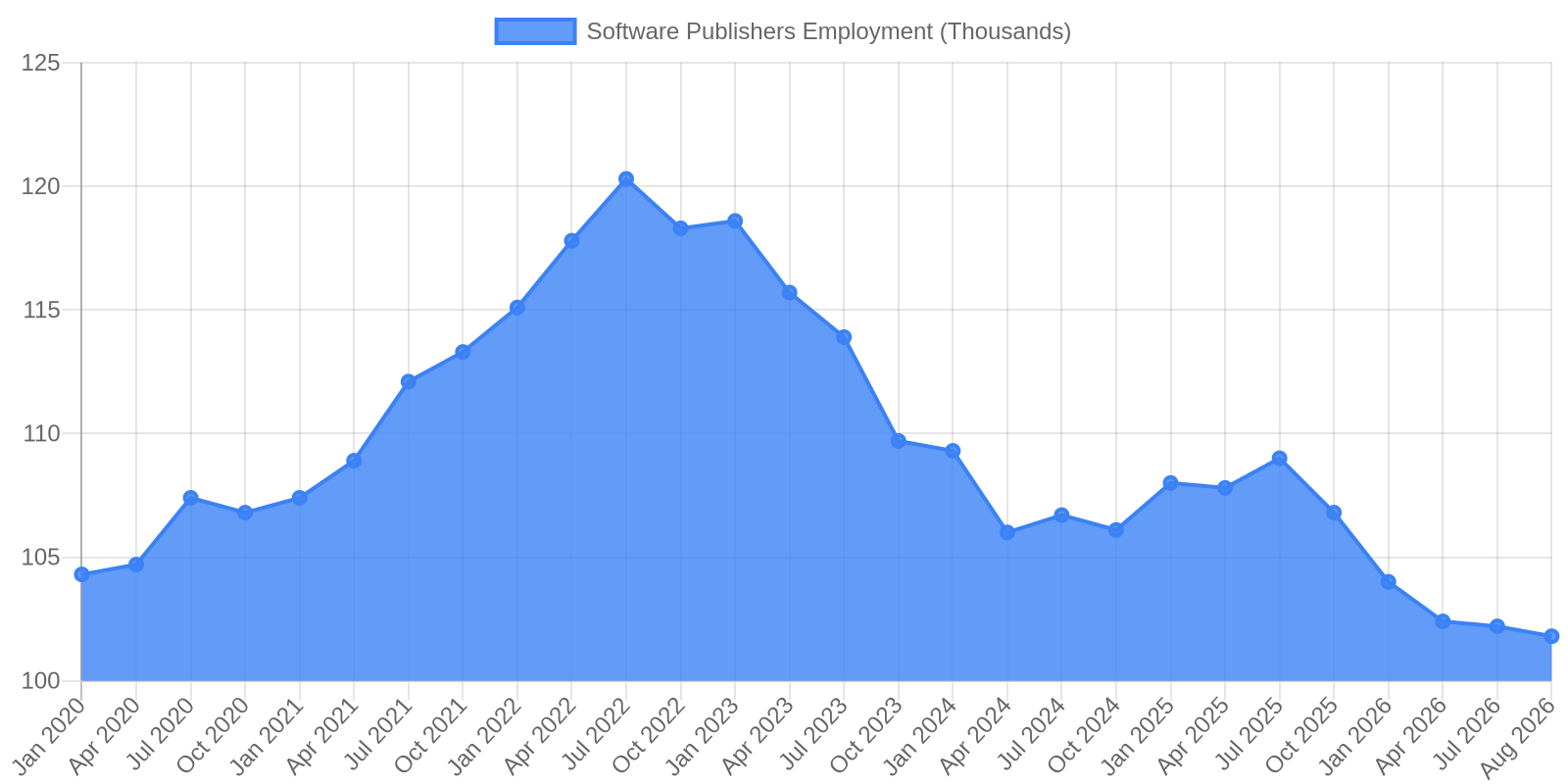
California software publisher employment declined from a peak of 120,300 workers in August 2022 to 101,800 in August 2026, with a brief stabilization in 2024-2025 followed by an accelerating decline as AI coding tools became widely adopted.
The numbers sketch a three-act drama. Act one: explosive growth through mid-2022, when California's software publishers added 16,000 jobs in just 18 months, riding the pandemic tech boom to a peak of 120,300 workers in August 2022. Act two: a brutal 14-month contraction through October 2023, wiping out 10,600 positions as the tech-cession hit and companies like Meta, Amazon, and Microsoft executed mass layoffs. Act three gets interesting—and ominous. From early 2024 through mid-2025, employment stabilized and even ticked upward, climbing from 104,900 in May 2024 to 109,000 in July 2025. That 4,100-worker bounce coincided precisely with the mainstreaming of AI coding tools: GitHub Copilot hit 20 million users by July 2025, and 84% of developers reported using or planning to use AI tools by that point. Then the bottom fell out again. From August 2025 through August 2026, California lost 7,200 software publisher jobs in a relentless 13-month slide—steeper and more sustained than the 2022-2023 crash.
Here's where the reference articles clarify what's happening. California has been bleeding tech jobs since August 2022, losing 21,000 jobs in computer systems design, 15,000 in streaming and social networks, 11,000 in software publishing, and 7,000 in web search—a concentrated hit to the state that represents 30% of total US tech sector output. The broader tech sector context matters: companies are reconfiguring workforces to leverage AI for increased efficiency and reduced operating costs, implementing this realignment even when reporting strong financial performance. The numbers are stark across the industry: around 127,000 workers were let go from U.S.-based tech companies in 2025, and more than 110,000 tech workers have been laid off in 2026 as AI transforms hiring across California's technology economy. What's particularly telling is the Public Policy Institute of California estimates that information sector jobs declined by 17% between mid-2022 and February 2026, tracking almost perfectly with our software publisher employment data.
The AI adoption timeline matches the employment collapse with disturbing precision. When GitHub Copilot was generating just 27% of code at launch, California's software publishers were still adding jobs. But as that figure climbed to 46% by 2025 and 22% of all merged code became AI-authored, employment turned sharply negative. The brief 2024-2025 stabilization likely reflects what economists call "augmentation"—AI tools making existing developers more productive without replacing them. One study found developers complete tasks 55% faster with Copilot, and McKinsey reported productivity gains of 20-45% in software engineering. But here's the trap: higher productivity means you need fewer people to ship the same amount of code. As 79% of conversations on Claude Code were classified as "automation" rather than "augmentation", the balance tipped from "helping developers" to "replacing developers." Companies did the math: if each developer can now produce twice as much code, you can cut your headcount in half and still hit the same deadlines. The steeper decline since mid-2025 suggests we've crossed that threshold—AI tools are no longer just productivity boosters; they're workforce reducers.
California's software publishing sector is living through what may be the first AI-driven labor displacement at scale. The chart doesn't lie: employment is down 15% from peak, the decline is accelerating, and it's happening as AI coding tools hit critical mass. For the 101,800 developers still standing in California's software publishing industry, the message is clear—you're not just competing with the person in the next cubicle anymore. You're competing with an algorithm that writes code at 3am, never asks for equity, and gets smarter every quarter. The only question left is whether the floor is 100,000 workers, 90,000, or something much lower.