
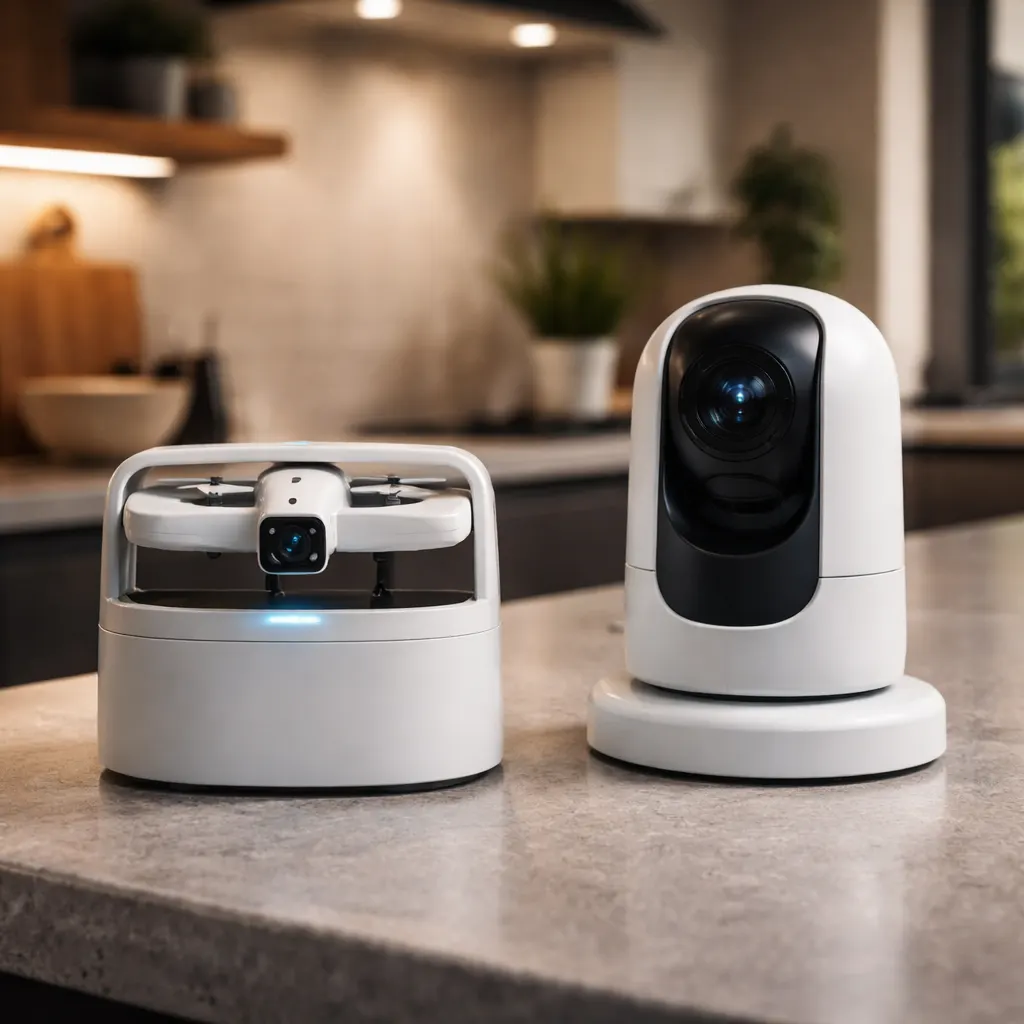
Amazon unveiled Ring Robotics on Tuesday with two mobile surveillance products: a flying drone for residential security and a wheeled robot with a telescoping camera designed for business patrols. Both devices are built to autonomously navigate indoor spaces on pre-programmed routes and respond to alerts from connected alarm systems, marking what Ring founder Jamie Siminoff called "the beginning of a future where proactive, autonomous protection is something every home and every business can have."
The Ring Drone Cam operates from a charging dock that keeps it hidden when idle and flies predetermined paths through homes using a 2K camera with a 148-degree field of view and LED lighting for nighttime surveillance. The Ring Rover Cam, targeted at commercial users, rolls through businesses on a platform similar to a robotic vacuum and features a camera mounted on an extendable mast that can adjust to various heights for viewing over counters and shelves. The Rover performs 360-degree scans, records video in up to 4K resolution while moving, and includes a siren, lights, and two-way audio for deterring intruders. Both robots use Amazon's AI Pilot system, which combines onboard cameras, specialized vision models, sensors, and cloud processing to navigate autonomously and generate floor plans of interior spaces during setup.
According to Ring's announcement, the devices create mapped layouts by having users either carry the Drone through their space or allowing the Rover to explore independently, with AI Pilot identifying room types and recommending key patrol zones that users can modify through the Ring app. The company states that footage captured by the robots will be secured through Throw Away the Key Encryption, a system revealed in August that temporarily grants Ring's cloud services access to recordings before deleting encryption keys, leaving only users and their authorized contacts able to view videos. A Ring spokesperson told The Register that "customers decide where these devices go and when," emphasizing user control as central to privacy protection.
The privacy implications resurrect concerns that derailed Amazon's 2024 attempt to acquire Roomba maker iRobot, which collapsed under regulatory scrutiny focused on the data collected by robots mapping home interiors. Ring has settled multiple privacy complaints, including a $5.8 million FTC agreement in 2023 over improper employee access to customer videos and inadequate account protection, and faces a proposed class-action lawsuit filed in June alleging its Familiar Faces feature collected biometric information without consent. The Rover Cam ships December 16 at approximately $1,000, while the Drone Cam's planned January 27, 2027 release remains contingent on FCC authorization, which Amazon notes has not yet been granted and is required before the device can legally be sold or leased. For companies weighing surveillance capabilities against reputational risk, the arrival of autonomous indoor cameras introduces a capability that may prove harder to uninstall than stationary alternatives once employees or visitors become aware of their presence.