
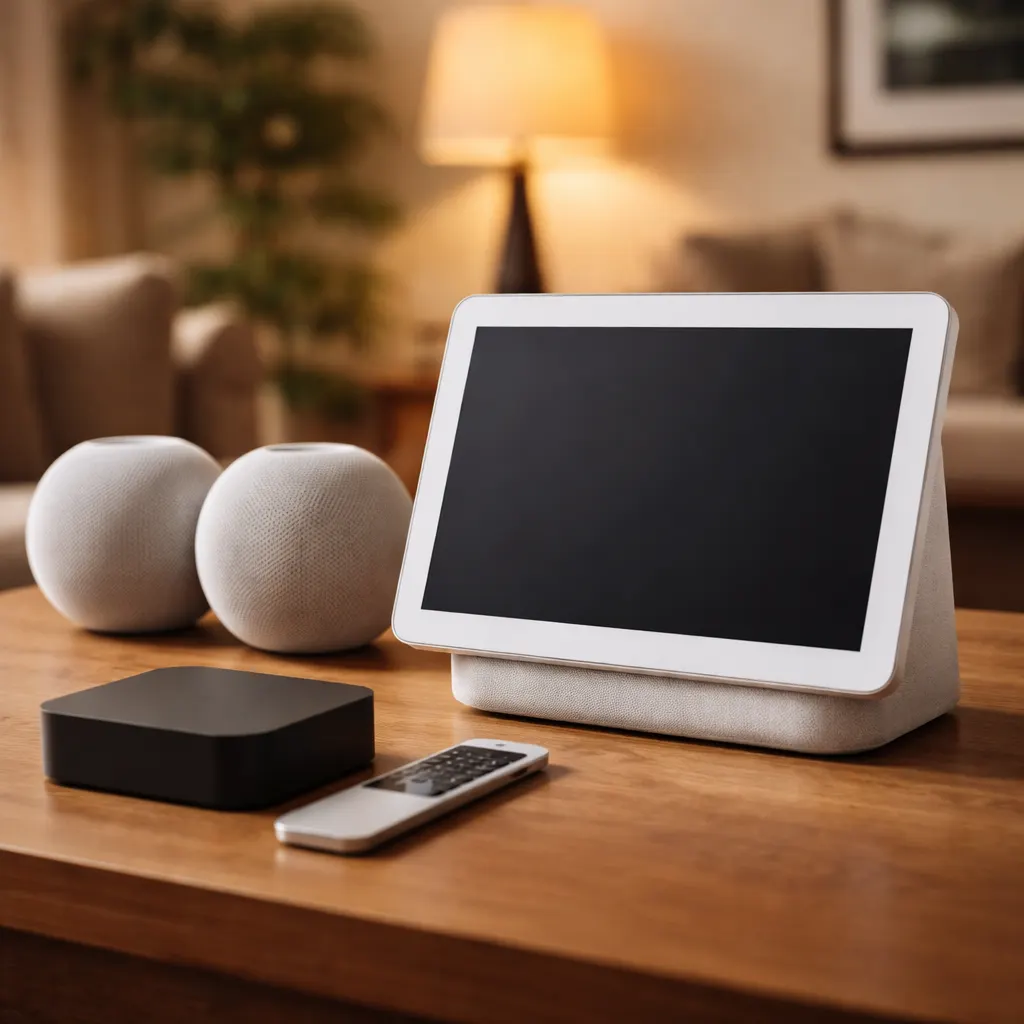
Apple introduced its first smart display and a collection of new smart home devices at a media-only event in New York City, marking the company's most significant entry into the smart home market in years. The lineup includes the HomeView, a countertop device with a 7-inch square screen; the HomePod Mini 2 speaker priced at $149; and a fourth-generation Apple TV 4K streaming box retailing for $299. Apple also revealed a suite of smart home products developed with LG and Schneider Electric, featuring video doorbells, thermostats, and security cameras that connect automatically to the Apple Home app without requiring separate manufacturer accounts.
The HomeView operates on what Apple calls HomeView Software, a standalone system without App Store access, though the company has selected apps for the platform including Messages, Safari, FaceTime, and third-party options like Spotify. The device supports up to six iCloud profiles and uses its built-in camera to display custom views for each person when their face is detected, provided their iPhone is on the same Wi-Fi network and was recently unlocked. Available for preorder now at $299, the HomeView launches November 13 in the US, UK, Australia, Canada, New Zealand, India, Singapore, and South Africa. The HomePod Mini 2, available October 30, represents a $50 increase over the original model's launch price and comes in green, white, midnight, pink, and black. The Apple TV 4K's $299 price tag marks a $170 jump from its predecessor, though this version includes both Wi-Fi and Ethernet connectivity plus 128 GB of storage compared to the prior 64 GB base model.
The new products rely heavily on Apple's revamped Siri AI, which the company updated this year in iOS 27 to answer broad questions similar to Gemini or ChatGPT while providing personalized responses based on personal context cataloged on a user's iPhone. Users need an iPhone with Apple Intelligence support—iPhone 15 Pro or newer—to get the most out of the HomeView, and the device can't be set up with an iPad. The Apple Home Collection addresses what Apple identifies as a significant gap in its smart home presence: a relatively limited HomeKit device ecosystem compared to competitors. The collaboration products range from the LG Indoor Camera Plug-In at $200 to the LG Smart Deadbolt Lock at $350, with all devices launching in December and security cameras initially available only in the UK, US, and Canada.
The timing of Apple's push coincides with Amazon and Google updating their ecosystems by replacing older assistants with Alexa+ and Gemini, both powered by large language models. According to Jitesh Ubrani, director of Consumer Devices Research at IDC, "Amazon and Google have both reset their platforms with Alexa+ and Gemini, but even their rollouts have been slow," meaning Apple is bringing Siri AI to the home when the competition hasn't pulled far ahead. The report notes that while Apple may finally have the necessary hardware infrastructure in place, Siri AI still needs to demonstrate it can compete effectively in the space. The aggressive pricing on the Apple TV 4K and the premium positioning of the entire product line suggest Apple is betting that its integrated ecosystem and improved voice assistant will justify higher costs than rivals charge, even as it enters a market where Amazon and Google have dominated for a decade.