
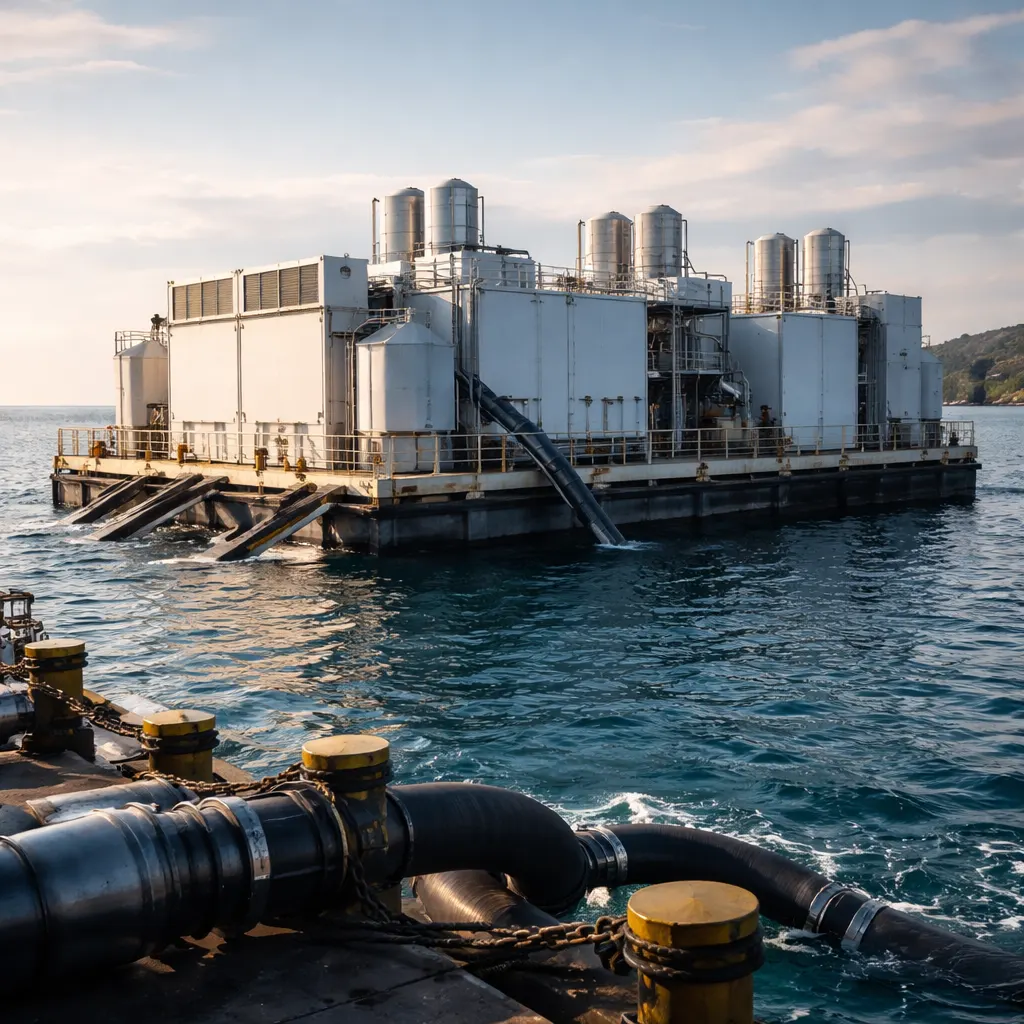
A Washington, D.C.-based startup has raised $20 million to build floating data centers powered by harvesting thermal energy from the ocean, according to an exclusive report from TechCrunch. Drogue, which was founded just six months ago and has kept a low profile until now, plans to deploy its first prototype in early 2028. The company aims to help data center developers install servers on timelines that match the explosive growth of artificial intelligence demand.
The startup's backers include XYZ Venture Capital, Toyota Ventures, Tamarack Global, Dream, FDVC, Garuda Ventures, Flexcap, Boost VC, and Slow Ventures, among others, the report states. In those six months since its founding, Drogue has designed a multi-megawatt prototype that will be installed on a traditional oceangoing ship and sent out to sea. Each vessel would operate at sea for roughly a decade, according to founder and CEO Sam Sipe. The oceans have been absorbing an additional 5.8 million terawatt-hours of energy annually as the planet warms, compared to the roughly 180,000 terawatt-hours that all of human civilization consumes each year. Future versions of Drogue's platforms will be constructed on floating structures that resemble offshore oil platforms more closely than ships.
According to Sipe, a former U.S. Navy pilot who flew E-2D Hawkeyes off aircraft carriers, "the data center industry is a real estate game, and so they're playing on 8- to 10-year timelines, including interoperability with utilities and [independent system operators]" that manage regional power grids. He added that "AI demand has increased 10x in just the last three years. It's completely incompatible." The startup has already received approval in principle from the American Bureau of Shipping, which sets and verifies safety standards for ships, according to the report. Drogue is now in the process of purchasing its first ship to begin constructing a prototype ready for open ocean deployment.
The technology relies on ocean thermal energy conversion, or OTEC, an approach first developed in the 1950s and tested in the 1980s but abandoned. Drogue's system operates like a heat pump in reverse: instead of using electricity to move heat, it uses temperature differences to generate electricity. The platform draws in warm surface water to cool the data centers, then sends the now-warmer water to boil ammonia, which becomes gas at negative 28 degrees Fahrenheit. That ammonia gas spins a turbine to produce electricity before passing through a condenser, where cold water drawn from 1,000 meters deep absorbs the heat. The warmed water then dissipates back into the ocean, and the ammonia returns to the sealed loop to repeat the cycle. Surface waters are heated by the sun while deep-ocean temperatures remain around 39 degrees Fahrenheit on average. Sipe consulted people who worked on the early OTEC efforts and learned that advances in manufacturing techniques for pipes and heat exchangers have made the concept more viable. Data centers proved ideal for this approach because servers are compact relative to other equipment, and transmitting data off the platform is extremely cheap compared to shipping physical materials or finished goods to shore.
The report notes that Drogue's concept shares similarities with Elon Musk's plan for orbital data centers: locate a cheap power source and position data centers as close to it as possible. Unlike orbital platforms, however, Drogue's floating facilities don't require expensive rocket launches—they can simply sail on the ocean, something humanity has done for millennia. The startup's less-than-two-year timeline to get its first prototype operational at sea represents a dramatic acceleration compared to the eight-to-ten-year cycles typical in traditional data center real estate development. For an industry struggling to keep pace with demand that has multiplied tenfold in three years, the ocean's virtually limitless thermal gradient offers a path forward that doesn't depend on grid operators or utility approvals. The broader question is whether maritime operations can scale quickly enough to matter, and whether customers will trust their workloads to platforms that spend a decade bobbing in international waters.