
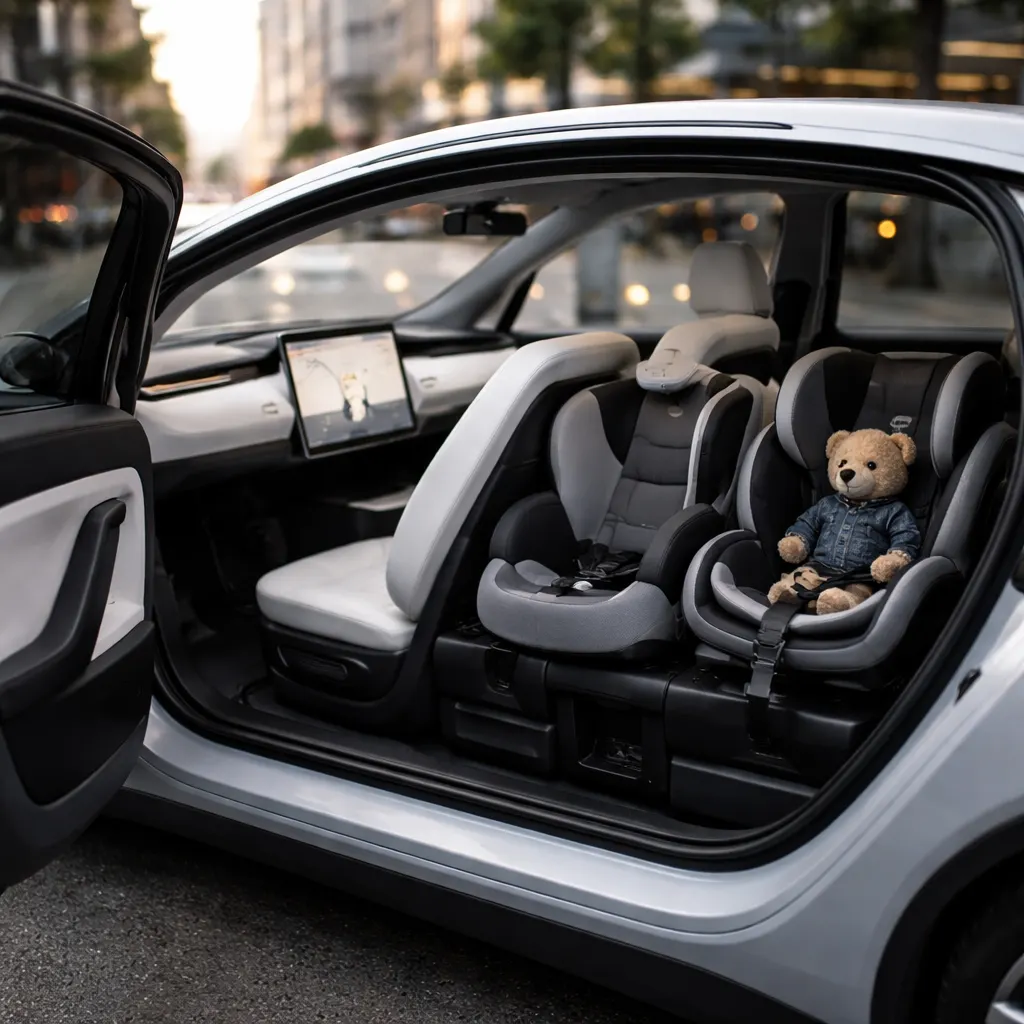
Tesla won't allow children under 13 to ride in its Cybercab autonomous vehicle "at this time," according to fine print details released Thursday following a private launch event for the robotaxi. The company shared scattered specifics about the fully autonomous car—which CEO Elon Musk has positioned as a camera-and-AI-driven alternative to Waymo at a lower price—through PDFs and updated terms in its "Robotaxi" app rather than through the typical large-scale presentation. Tesla now faces the task of demonstrating to regulators and the public that these vehicles are safe, even as the National Highway Traffic Safety Administration has launched an investigation into the Cybercab's deployment.
Young passengers between 8 and 17 can ride in Tesla's "Robotaxi" Model Y SUVs, and the company provides instructions for child seat installation in both vehicle types. But the Cybercab lacks standard LATCH anchors for securing child seats—they can only be fastened with seat belts. All minors under 18 must travel with an adult in either vehicle. The private event itself was a departure from Tesla's usual approach: no livestream, no extended presentation, and a keynote lasting just 15 minutes, with no apparent remarks from Musk himself. Windows in the Cybercab "cannot be fully opened at this time," though the company offered no explanation for the restriction. One bright spot: USB-C outlets deliver 90 watts of power, roughly four times the typical output found in cars.
When a Cybercab crashes, the vehicle initiates a sequence designed to protect passengers and alert help: airbags deploy, doors unlock, hazard and interior lights switch on, the high-voltage battery shuts down, windows move to a "vent" position, brakes engage to bring the car to a stop and park, and the infotainment screen connects riders to Tesla's support team. The automatic door unlocking is significant given recent scrutiny of Tesla's electronic latches, which have drawn criticism in both the U.S. and China for potentially trapping occupants after collisions. Just last month, Tesla recalled 3 million vehicles in China alongside other manufacturers following an investigation into electronic door latches. Inside the Cybercab, manual door releases are positioned clearly on each door's armrest, addressing earlier complaints that emergency releases in other Tesla models are too difficult to locate.
The Cybercab uses brake-by-wire technology—electronic actuators controlling brake calipers instead of a hydraulic system that pumps fluid through lines—as part of Tesla's cost-cutting strategy. Musk explained that electric brakes eliminate the complexity of hydraulics and the need to route plumbing throughout the vehicle. Tesla previously became the first major automaker to adopt steer-by-wire in its Cybertruck, removing the physical link between steering wheel and front wheels. Electronic door latches enable the Cybercab's doors to open automatically at ride start and end, with a small exterior button offering an alternative access method. The combination of by-wire systems and stripped-down components reflects executives' stated focus on removing unnecessary parts to drive down production costs, though the removal of child seat anchors stands out as an unusual target for savings. For autonomous vehicles to win public trust and regulatory approval, safety demonstrations will need to extend beyond technical specifications to address real-world scenarios involving passengers of all ages.