
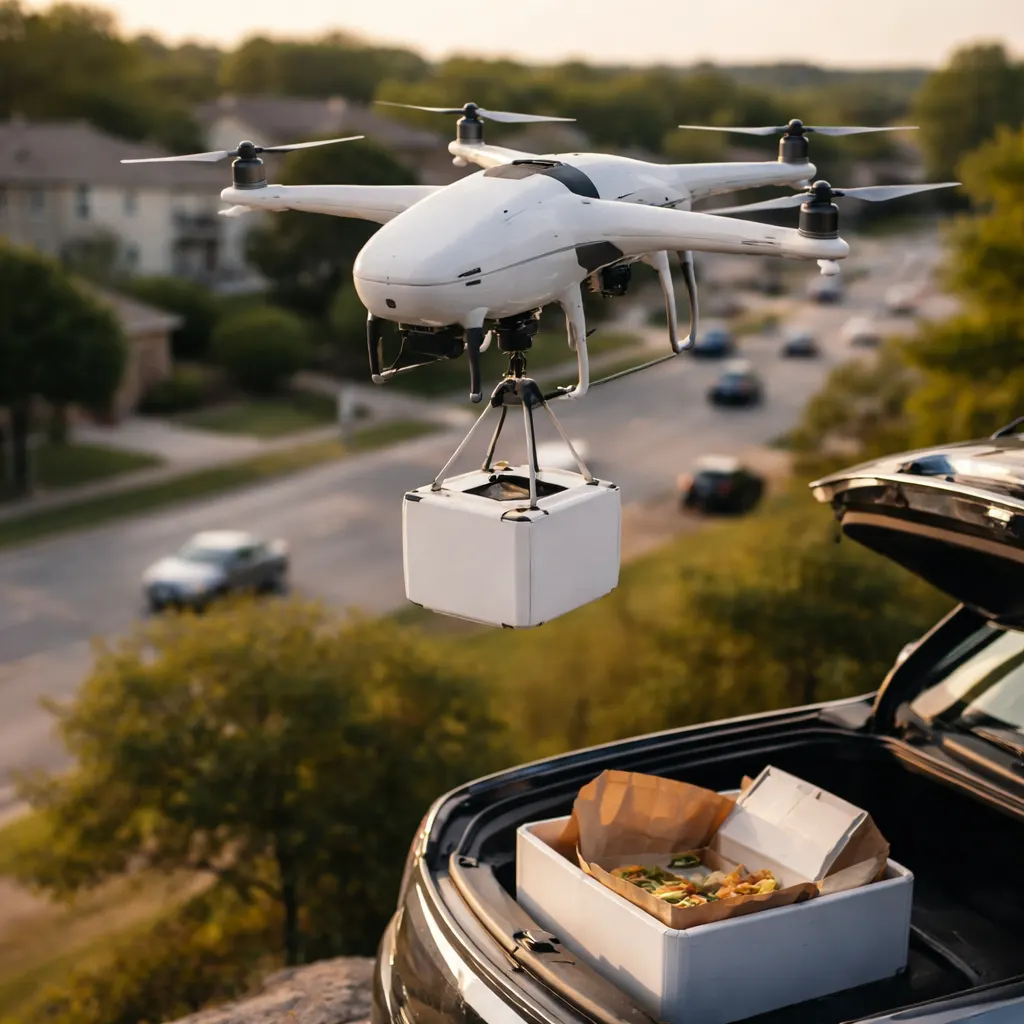
Residents in a Houston suburb can now receive restaurant orders delivered by autonomous drone, marking the first commercial rollout of a partnership between Uber and Zipline announced earlier this year. The service launched Tuesday in Spring, Texas, with plans to expand to Dallas and then dozens more American cities as the companies pursue a goal of completing one million drone deliveries daily by the close of 2029, according to TechCrunch.
Zipline's long-range autonomous aircraft will transport meal orders up to eight pounds, cruising roughly 300 feet overhead at speeds reaching 70 miles per hour. The drones don't touch down—instead, they use a tether to lower food encased in protective pods directly to customers' locations. Uber Eats users in coverage zones can tap a new "drone" icon on the app's main screen to browse participating restaurants, which at launch include national chains like Jersey Mike's and Zaxby's alongside local spots such as Urban Bird and Abu Omar Halal. Neither Uber nor Zipline disclosed the size of Uber's investment in the startup, though Zipline announced last week it had secured $1.5 billion in funding led by Paradigm, WCM Investment Management, and Layer Global, with backing from Uber among others.
"In partnership with Uber Eats we're going to create a new expectation for delivery in America," Zipline CEO and co-founder Keller Cliffton said in a statement. The nationwide ambitions echo those of rivals including Alphabet-owned Wing and Amazon's Prime Air service, though these expansion plans have collided with resident concerns in some areas about noise, wildlife disruption, and safety and privacy risks. Firms scaling in this emerging sector argue that drone delivery brings net benefits to society, pointing to advantages like reduced traffic as customers skip car trips to stores or restaurants.
The industry remains in its infancy despite years of development by Zipline and competitors, and adoption in communities with available service is still limited. Zipline, founded in 2014, built a delivery ecosystem encompassing aircraft, launch and landing systems, and logistics software—initially focused on transporting blood in Rwanda before expanding to the United States. The California-based company's domestic operations grew rapidly after securing Part 135 air carrier certification from the Federal Aviation Administration in 2022, a crucial regulatory milestone that authorized long-range commercial drone deliveries.
The partnership positions both companies to test whether autonomous aerial delivery can scale beyond isolated pilots into a mass-market transportation mode. Reaching the one-million-deliveries-per-day target by 2029 would require not just technical execution but also regulatory approvals across dozens of municipalities and acceptance from residents who've pushed back elsewhere on noise and safety grounds. For executives betting on drones as the next logistics platform, navigating local politics may prove as challenging as the engineering itself.