
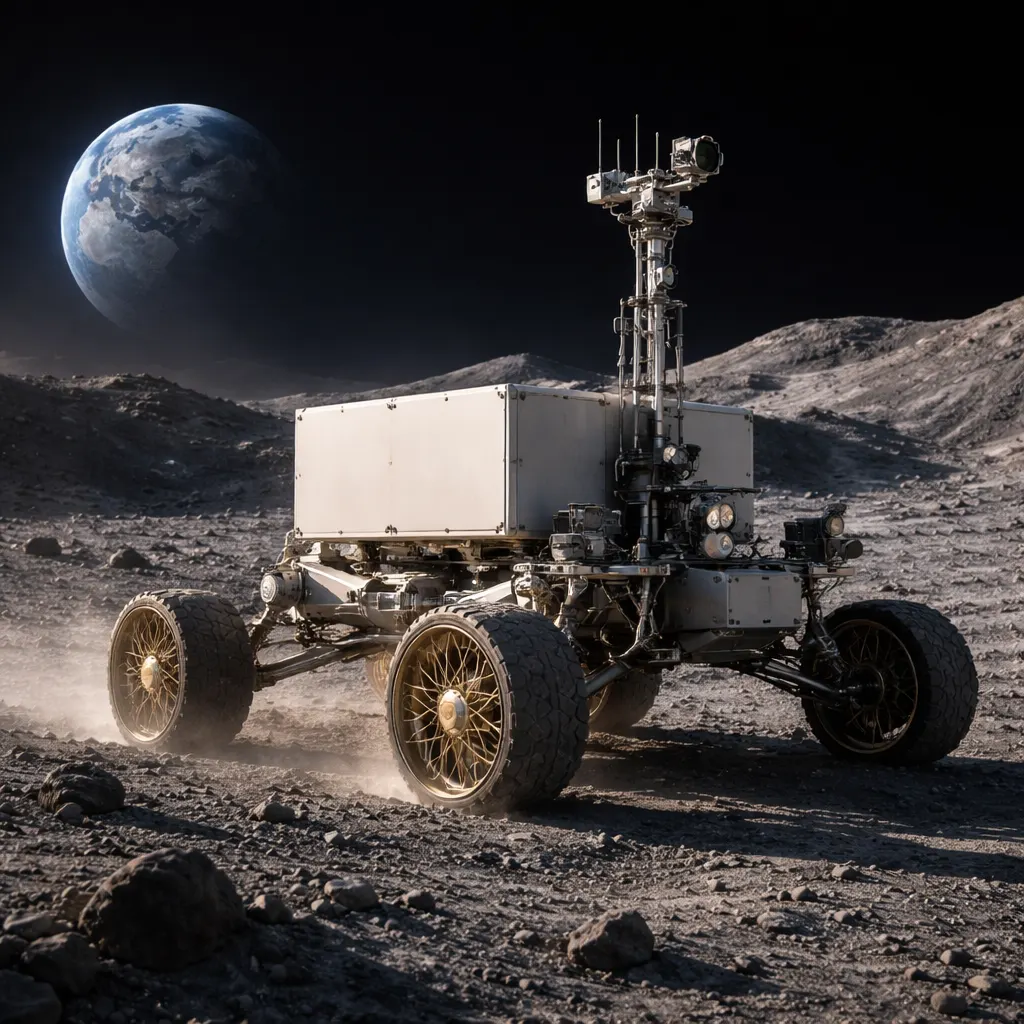
A computer system capable of operating large language models will launch to the lunar surface aboard a robotic rover as soon as November 2026, according to a report published by MIT Technology Review on October 20, 2026. The 480-kilogram FLIP rover, built by Astrolab under contract with NASA, will become the first vehicle to run LLM software on the moon. The mission aims to prove that AI systems can function reliably in the extreme conditions of space and support autonomous decision-making without real-time communication with Earth.
FLIP—short for "FLEX Lunar Innovation Platform"—will transport 20 scientific instruments, including a lidar 3D mapper and a sensor designed to detect concentrations of helium-3 isotope in lunar soil. The rover's wheels are engineered to handle rough terrain, and the vehicle is built to endure at least 150 hours of the moon's frigid night. An HPE-manufactured high-performance computer aboard FLIP will mark the first time LLMs operate on the lunar surface, according to the report. The system consists of a 64-bit CPU paired with a GPU that can handle parallel computational tasks, far exceeding the capability of computers aboard NASA's Mars rovers Curiosity and Perseverance, which the report compares to laptops from the late 1990s. China's Chang'e-6 rover, which touched down on the moon's far side in 2024, used only basic AI algorithms and neural networks for self-guided navigation, the report notes.
HPE has already tested three Spaceborne computers on the International Space Station, with the Spaceborne-2 and Spaceborne-3 systems launched in 2021 and 2024 running Meta's Llama 3.2 LLM as part of a 2025 initiative. According to Mark Fernandez, HPE's chief scientist, time delays create serious operational risks: "The time delay, for example, on Mars can be up to 20 minutes," he said, noting that "the Soviets lost two rovers in the past because of operator errors caused by the time delay." During FLIP's mission, custom-built LLMs will analyze camera and lidar data to assist with safe navigation and reduce the volume of information transmitted back to Earth. Francisco Cordova, chief operating officer for the ISS National Laboratory, stated during a press conference that "as we venture further and further out into space, I believe that we're going to rely more on AI for space exploration."
The lunar environment presents challenges far beyond what the ISS computers faced. The report explains that while temperatures inside the space station stay around 20 degrees Celsius, FLIP will land near the moon's south pole, where conditions swing from 80 degrees Celsius in sunlit areas to negative 200 degrees Celsius in shadowed regions. Cosmic radiation at the moon's surface reaches nearly three times the intensity experienced inside the shielded ISS, which also benefits from Earth's magnetic field protection. Rather than spending years developing specialized radiation-hardened hardware, HPE deployed software that monitors the system and detects disruptions from charged cosmic particles, reducing power and speed during radiation spikes to protect the electronics. The company's earlier ISS computers each ran successfully for more than two years, exceeding initial expectations, but HPE officials acknowledge the moon mission represents a far greater test.
The report states that HPE expects the Spaceborne-4 computer to last through FLIP's planned 10-day mission, with the rover designed to operate without the redundancy, repair technicians, or spare parts available on Earth. Roser Almenar, an AI and space law researcher at the University of Valencia, told the publication that LLMs hold "enormous potential, in particular for future missions to Mars and beyond, where communication delays will make it increasingly difficult to rely on immediate assistance from Earth," but cautioned that "these systems can produce inaccurate or misleading information" and "in space, even a seemingly small error can have serious consequences." The technology could eliminate bandwidth constraints and stale data problems that have plagued deep-space robotics, enabling spacecraft to make intelligent choices in real time rather than waiting for instructions from mission control. The question now centers not on whether space agencies will adopt autonomous AI systems, but on how quickly they can validate the technology's reliability under conditions where human intervention becomes impossible.