
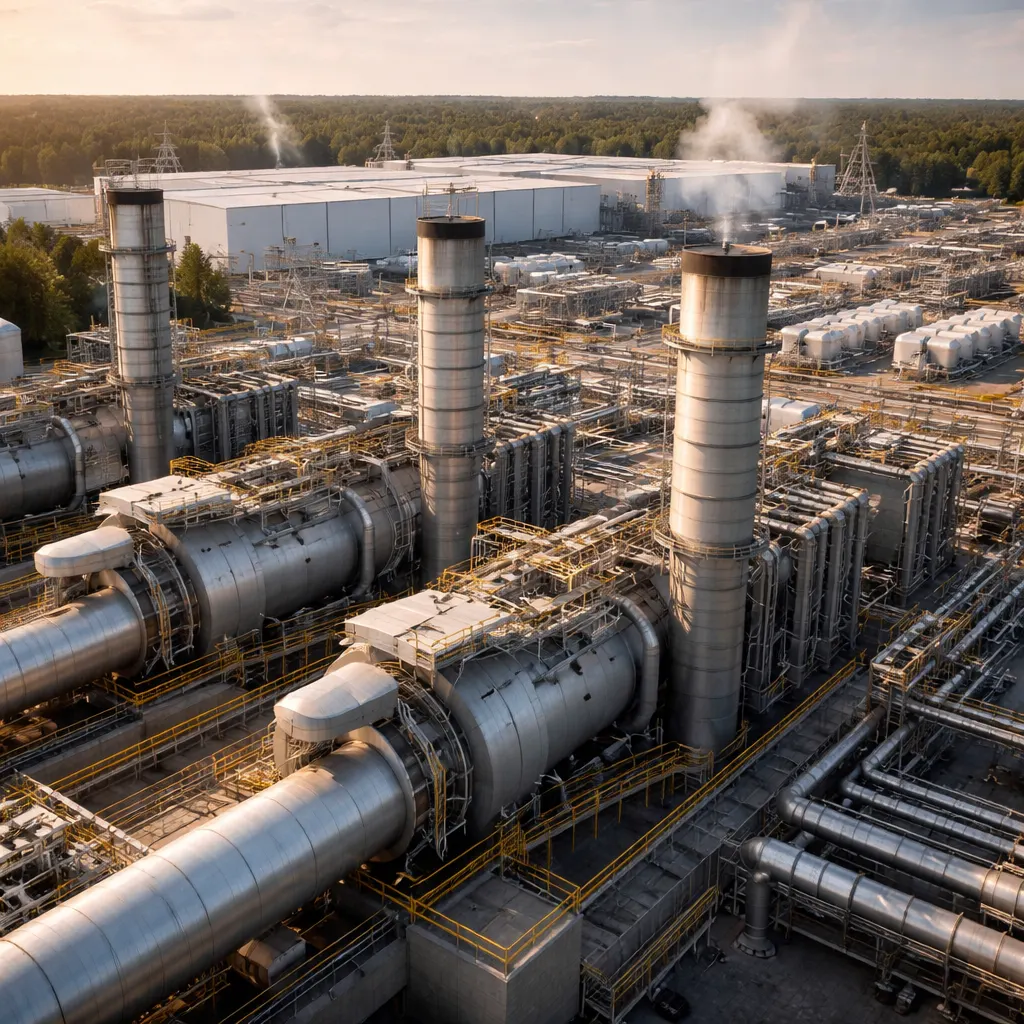
Amazon has purchased a huge off-grid power facility under construction in Texas for one of its data centers, and it's authorized to release up to 33 million tons of greenhouse gases annually, according to a report published by Wired. The installation will depend entirely on simple cycle turbines, which are significantly less efficient than the combined cycle units typically deployed at traditional power plants. This approach is becoming more widespread across data center developments nationwide, with potentially major consequences for artificial intelligence's environmental footprint and the evolution of America's electrical grid.
The facility will operate exclusively with simple cycle turbines, which blend fuel and air in a combustion chamber to generate power while releasing substantial waste heat. Combined cycle units, the standard technology at grid-connected power stations, incorporate an extra steam turbine component that captures this waste heat and converts it into additional energy, resulting in lower emissions per unit of energy produced. While permitted emissions on natural gas installations typically exceed actual output, even if Amazon's plant emits half its permitted amount annually, it would still generate more greenhouse gas pollution than 78 average-sized natural gas facilities, based on US Environmental Protection Agency data. Multiple other tech giants are following this pattern: at least three power plants Williams is developing in Ohio for Meta will use simple cycle units, while Crusoe is constructing a facility on its Stargate campus in Abilene, Texas, with 39 simple-cycle turbines to power a Microsoft data center. Google's Goodnight data center at another Texas location being built by Crusoe plans to rely on 20 simple-cycle turbines, and both xAI's Colossus 1 and Colossus 2 data centers in Memphis are being powered by dozens of simple cycle turbines, all permitted to discharge millions of tons of greenhouse gases.
According to Britt Burt, a senior vice president at Industrial Info Resources, he didn't anticipate data center developers would depend so heavily on simple cycle turbines for electricity, calling it "not the most efficient way to use a gas turbine." Amazon spokesperson Margaret Callahan stated the Texas plant offers "on-site generation that won't raise electricity costs for Texas families," noting the site would also feature solar and battery storage and that Amazon remains committed to achieving net-zero emissions by 2040. The permit application for the Amazon plant specifically identifies simple cycle technology's absence of water consumption as an "environmental benefit," the report notes.
For companies rushing to bring data centers online, installing several simple-cycle turbines is considerably faster and less expensive than waiting for the additional equipment required for combined-cycle units, particularly given a years-long backlog for turbine orders and related components. The energy demands of data centers, especially those training AI models, make simple cycle turbines attractive because their fewer moving parts allow them to start up and shut down more quickly than combined cycle units, which suits AI training's requirement for large energy spikes on demand. Stephen Lynch, a professor of mechanical engineering at Penn State and director of the school's Center for Gas Turbine Research, Education, and Outreach, explained that with highly variable loads, it's preferable to have numerous units that can turn on and off individually rather than one large system that doesn't tolerate frequent cycling. Simple cycle turbines also typically don't need water, which has become an increasingly contentious issue for communities located near data centers—Burt estimates a 250-megawatt combined-cycle plant could consume roughly 75,000 gallons per hour.
The federal government and a growing number of state governors across the political spectrum are pushing data center power providers to source or construct their own energy to prevent increases in consumer electricity bills. Some companies have pledged to eventually connect their power plants to the grid—Callahan said the Texas plant is "designed to transition to grid-connected service as interconnection timelines allow," and Williams indicated it may consider the Ohio plants for interconnection later. For now, though, the rapid construction of new isolated power plants with inefficient turbines, many designed to operate for decades, threatens to establish a parallel fossil fuel grid generating millions of tons of greenhouse gas emissions. If the AI bubble bursts or tech companies' energy needs decline, these massive, inefficient gas plants could become what Burt calls "stranded assets." The architecture of energy infrastructure is being rewritten around speed rather than sustainability, and the choices made in boardrooms today will determine whether tomorrow's grid runs cleaner or simply runs faster toward obsolescence.