
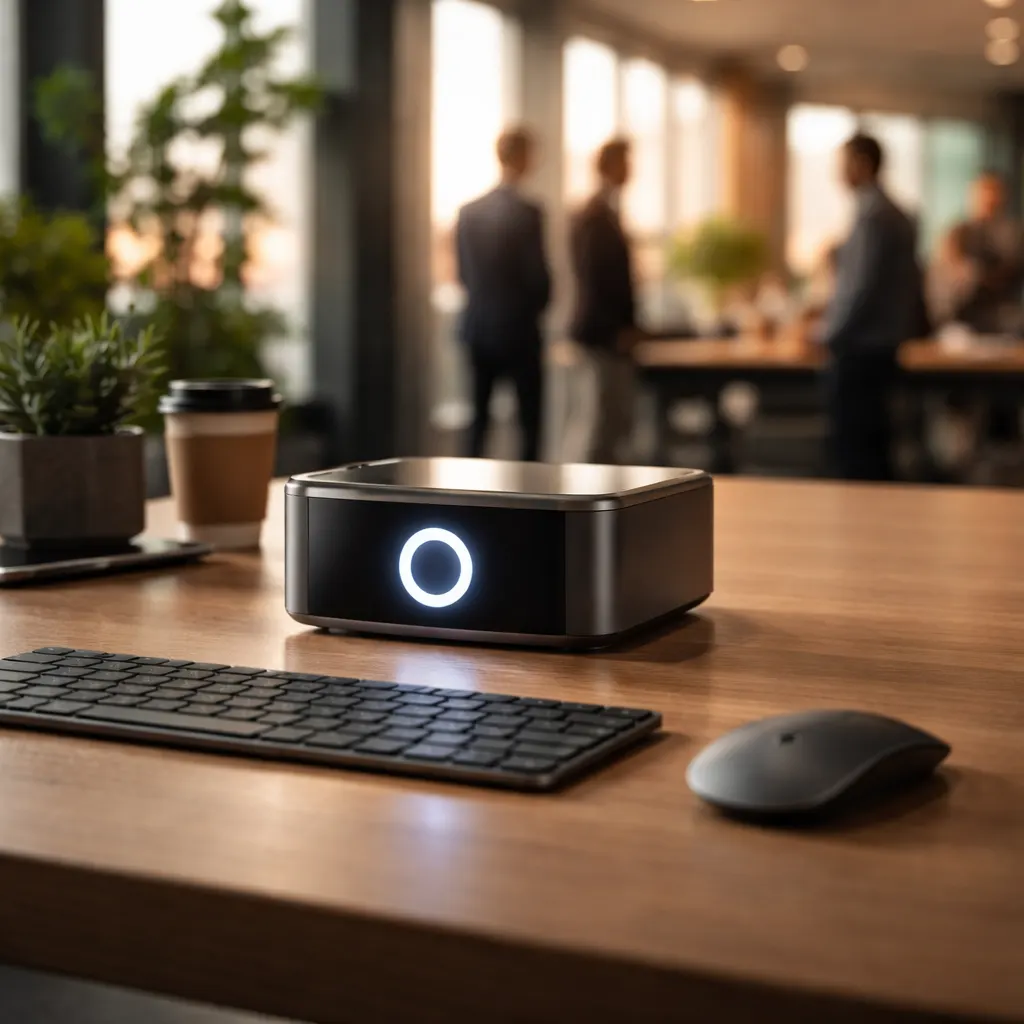
A 19-year-old founder has raised $11 million to build a dedicated computer for running personal AI agents, according to an announcement published Monday. Zain Javaid's company Ghost emerged from stealth after a year of development with seed funding led by Andreessen Horowitz, alongside backing from Abstract, Audacious Ventures, SV Angel, and Nova. The startup's first product, called Core, is a personal computer priced at $3,499 that's built specifically to run AI agents capable of acting on a user's behalf by centralizing their data from desktops, apps, and smart home devices into one piece of hardware.
Core includes an Nvidia RTX Pro 4000 SFF Blackwell GPU bundled into the device's price, so buyers don't need to purchase the chip separately. The hardware ships with three models already installed: Qwen-3.8-Next, Qwen-3.8-27B, and Gemma-4-31B, and users can add other models from Hugging Face or load their own trained models. Preorders for the first batch opened Monday, with shipping scheduled for the last week of October. Ghost's founding team includes Nicholas Chua, 19, Yifei Chen, 24, and Gautam Sharda, 23, and the units are currently built at the company's San Francisco facility.
Javaid described Core as a "brain in a box" without a screen that users access through a phone or app, with voice mode also available through the Core app rather than speaking to the device itself. According to Javaid, the models and personal memory operate locally, and all personal information is encrypted so no cloud provider or third party, including Ghost itself, can meaningfully access it. The device features its own software layer, browser, and filing system, and can continuously process information and tasks without constant prompting. When asked how Core differs from a Mac Mini configured for AI, Javaid said Core's hardware and software were purpose-built for running AI agents with models preinstalled, while Apple's desktop is a general-purpose computer.
Ghost designed Core to function autonomously even if the company shuts down, with all source code, logic, and model weights stored on the device rather than external services. The team is building a firewall that monitors every outgoing network request and rejects any attempt by the agent to perform unauthorized actions or leak data, flagging such events for user review. Over-the-air updates can push new models or improvements similar to how Tesla operates, with the company asking users whether they want to switch when new generations arrive, and users can enable auto-updates to always run the latest version. Javaid offered an example of Core's intended functionality: the device proactively notifies a user they might be getting sick by observing elevated resting heart rate, seeing from computer history that they stayed up late working on a project, and applying seasonal context that it's flu season in San Francisco. The company's main focus is building a product people love, Javaid said, adding that if Ghost can't accomplish that, established competitors like Apple aren't the reason they failed. Hardware alone doesn't guarantee success when much of what Core tackles is software—how the model reasons over someone's life, remembers information, takes action, and knows when to reach out. For buyers willing to pay the premium, the bet is that purpose-built infrastructure for AI agents will deliver a better experience than repurposing existing computers, though that advantage depends entirely on whether Ghost's software layer proves meaningfully superior to what users can configure themselves.