
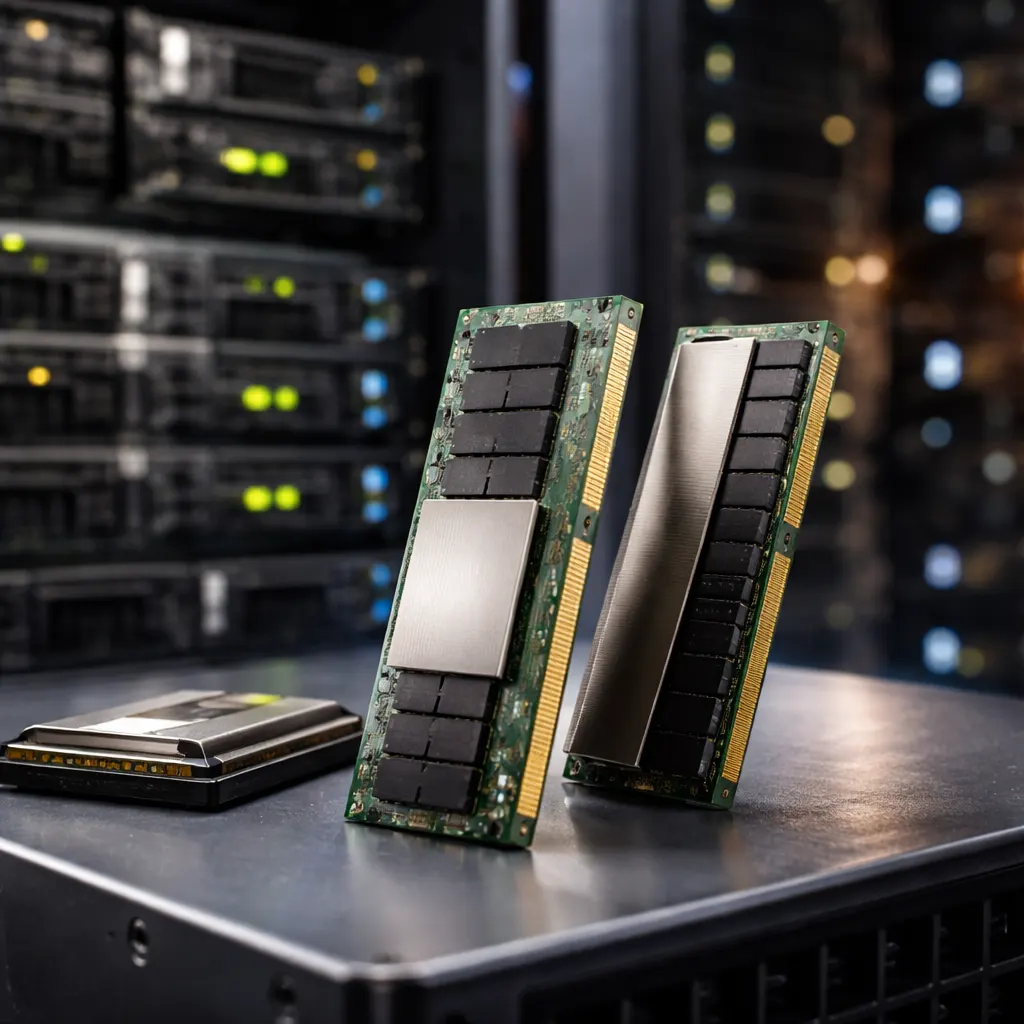
AMD is marketing software that uses artificial intelligence to deliver up to 99 percent of server performance while slashing memory requirements by half, according to a report published by The Register on November 11. The technology, acquired from startup Mext in June 2026, relies on machine learning models to shift memory pages between costly DRAM and cheaper NVMe flash storage before applications or operating systems realize they need them. AMD is positioning the solution as a way to sidestep ballooning memory costs driven by datacenter expansion for AI workloads.
The company claims the technology could reduce enterprise server expenses by as much as 83 percent by swapping expensive RDIMMs for flash storage, according to Gary Smerdon, the former Mext CEO now serving as AMD's corporate vice president of business development. Across 145 systems where the software has been installed so far, customers have already avoided roughly $5 million in memory expenditures, Smerdon estimates. In testing against Synopsys' PrimeTime electronic design automation suite, systems offloading half their memory to flash retained 95 percent of DRAM-only performance, while configurations using 25 percent DRAM and 75 percent flash dropped to 80 percent of baseline performance. For Apache Spark workloads, AMD's Mext team reports achieving 99 percent of full performance even after replacing half the system's DRAM with flash. Memory can account for 60 to 90 percent of a large server's total cost, Smerdon noted, and research from Meta has shown that between 50 and 80 percent of memory pages go untouched for five minutes or longer, even in systems where 95 percent of memory appears "in use."
According to Smerdon, "we realized we could use AI to monitor the system and proactively push those pages back into DRAM, so that as far as the application or the operating system knew, they were there the whole time." The report explains that Mext employs a transformer-based model—similar in architecture to ChatGPT or Claude—but instead of predicting the next word in a sentence, it forecasts which memory page the system will require next. Flash storage is 50 times cheaper per bit and uses 30 times less power, but it's also 500 times slower than DRAM, which is why traditional disk swapping destroys application performance and violates service level agreements. The software trains its model on a single Epyc core in under one second, then continuously refines predictions over time, ensuring pages arrive in DRAM before they're needed—functioning like running an errand during the workday and returning before anyone notices you left.
AMD is now integrating Mext into its enterprise lineup and will offer the software exclusively for AMD hardware as a license sold through OEM partners, the report states. The company is in phase one of its rollout, collaborating with partners like HPE to certify systems as "Mext ready," and plans to begin selling licenses and preinstalling a RAM View application to help enterprises identify suitable workloads in phase two. Linux systems need only a kernel driver to run the software, while the RAM View tool will guide deployment decisions. AMD initially targeted memory-intensive applications like electronic design automation and content creation but has since expanded support to latency-sensitive workloads including databases and agentic AI pipelines. The chip maker is wagering that customers will accept modest performance trade-offs in exchange for substantial memory savings as DRAM availability remains constrained by the ongoing AI datacenter buildout. The bet reflects a broader industry tension between architectural purity and operational pragmatism, where the economics of memory provisioning may increasingly override traditional performance benchmarks.