
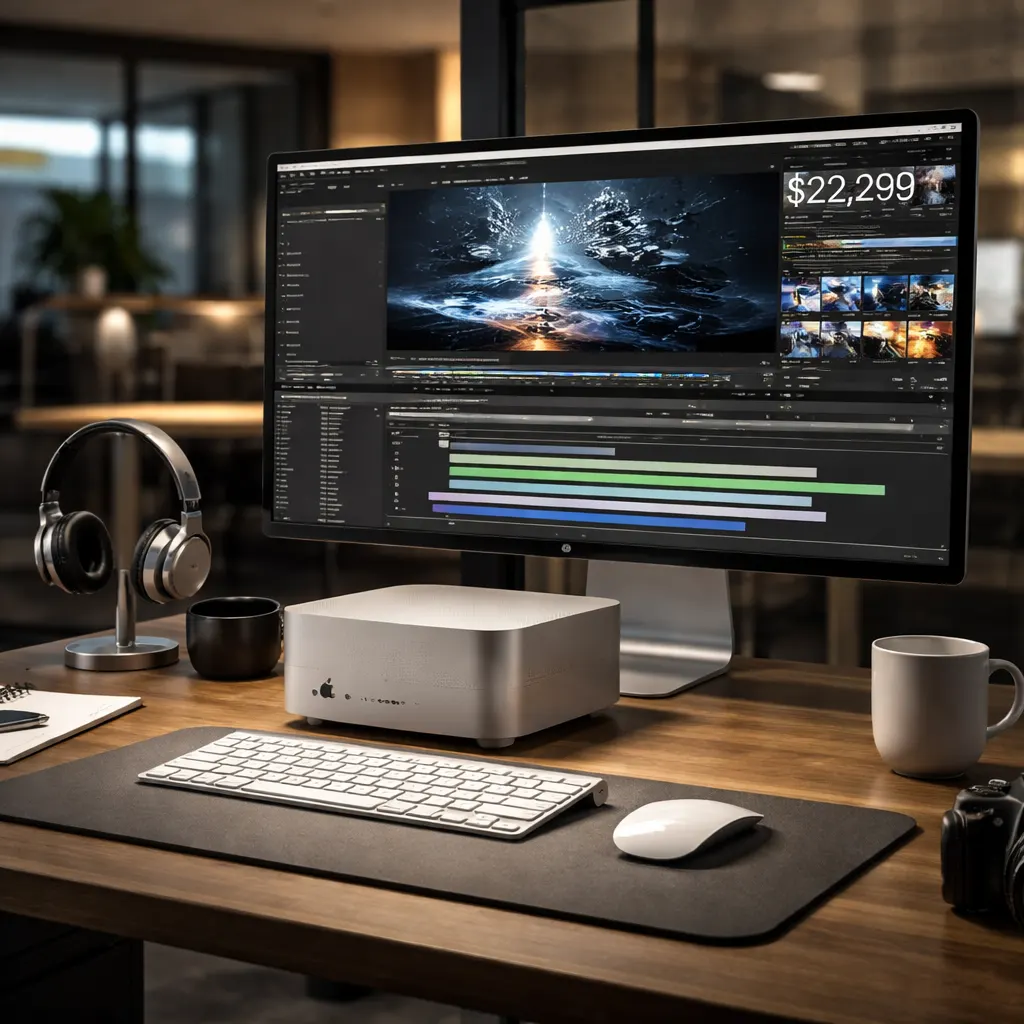
Apple has started accepting orders for a desktop workstation priced at $22,299 that comes equipped with 512GB of unified memory, according to a report published by Channel Insider. The new Mac Studio configuration, featuring the M5 Ultra processor, gives AI developers, creative professionals, and enterprise customers access to substantially more computing power than typical office systems. But the steep cost creates a key challenge for channel partners: figuring out which clients truly require this level of capability and whether the investment delivers meaningful returns.
The M5 Ultra Mac Studio includes a 36-core CPU, an 80-core GPU equipped with Neural Accelerators, memory bandwidth reaching 1.2 TB/s, Thunderbolt 5 connectivity, 10Gb Ethernet, Wi-Fi 7, and Bluetooth 6, according to the report. Orders submitted now are anticipated to ship in late November through early December. The 512GB memory option is available exclusively on the top-tier M5 Ultra processor, while M5 Max configurations max out at 128GB. Apple first revealed the M5 Max and M5 Ultra Mac Studio models in August, with the 512GB variant scheduled for October release. Channel partners face an unusual pricing consideration: two M5 Ultra Mac Studios, each configured with 256GB of RAM and 1TB SSD storage, cost $21,598 together—roughly $700 less than one 512GB unit—delivering dual M5 Ultra processors and twice the solid-state storage, though memory stays separated across individual machines.
The report notes that Apple's unified memory architecture lets the CPU, GPU, and other processors tap into a shared memory pool, which can prove particularly valuable for applications handling extremely large datasets or complex AI models. The 512GB configuration enables professionals to run work locally rather than depending entirely on cloud computing infrastructure—AI developers can operate larger language models and process substantial data volumes directly on the workstation, creative professionals can tackle complex 3D rendering and high-resolution video editing, and researchers can execute memory-intensive simulations. However, the report finds that 512GB of memory doesn't automatically deliver faster performance for every application, with the biggest advantages going to organizations whose software can leverage the additional capacity, especially for workloads that would otherwise surpass the memory available on smaller systems.
For MSPs, VARs, and solution providers, the $22,299 Mac Studio represents an opportunity to help enterprise customers make smarter infrastructure investments, particularly those running AI models, managing high-resolution video production, or processing large datasets, according to the report. Rather than simply fulfilling hardware orders, partners can assess client workloads, benchmark memory requirements, and determine whether a single high-memory workstation, a cluster of smaller Mac Studios, or cloud infrastructure offers the best return on investment. Apple supports clustering multiple Mac Studios using Thunderbolt 5 and RDMA, allowing compatible distributed AI workloads to access memory across connected systems—though software must support the architecture. The company's July 2026 testing showed a four-system cluster delivering up to three times the AI inference performance of a single machine. The opportunity extends beyond the initial purchase, with partners able to generate additional services revenue through Apple silicon integration, AI workload optimization, storage and networking upgrades, security configuration, and ongoing infrastructure management. Organizations deploying multiple Mac Studios may also need help configuring Thunderbolt 5 connectivity and ensuring their software supports distributed processing.
The report concludes that the 512GB Mac Studio is unlikely to become a high-volume channel product, with its greater value for partners residing in the consulting and specialized services surrounding it, particularly when customers need help determining whether the workstation delivers meaningful advantages over less expensive alternatives. For partners serving creative agencies, AI developers, and research organizations, these engagements could open doors to broader infrastructure modernization projects and longer-term managed services relationships. The real question for channel partners isn't whether the hardware is powerful, but whether they can translate that power into tailored solutions that address specific client challenges while building recurring service relationships that outlast the initial sale.