
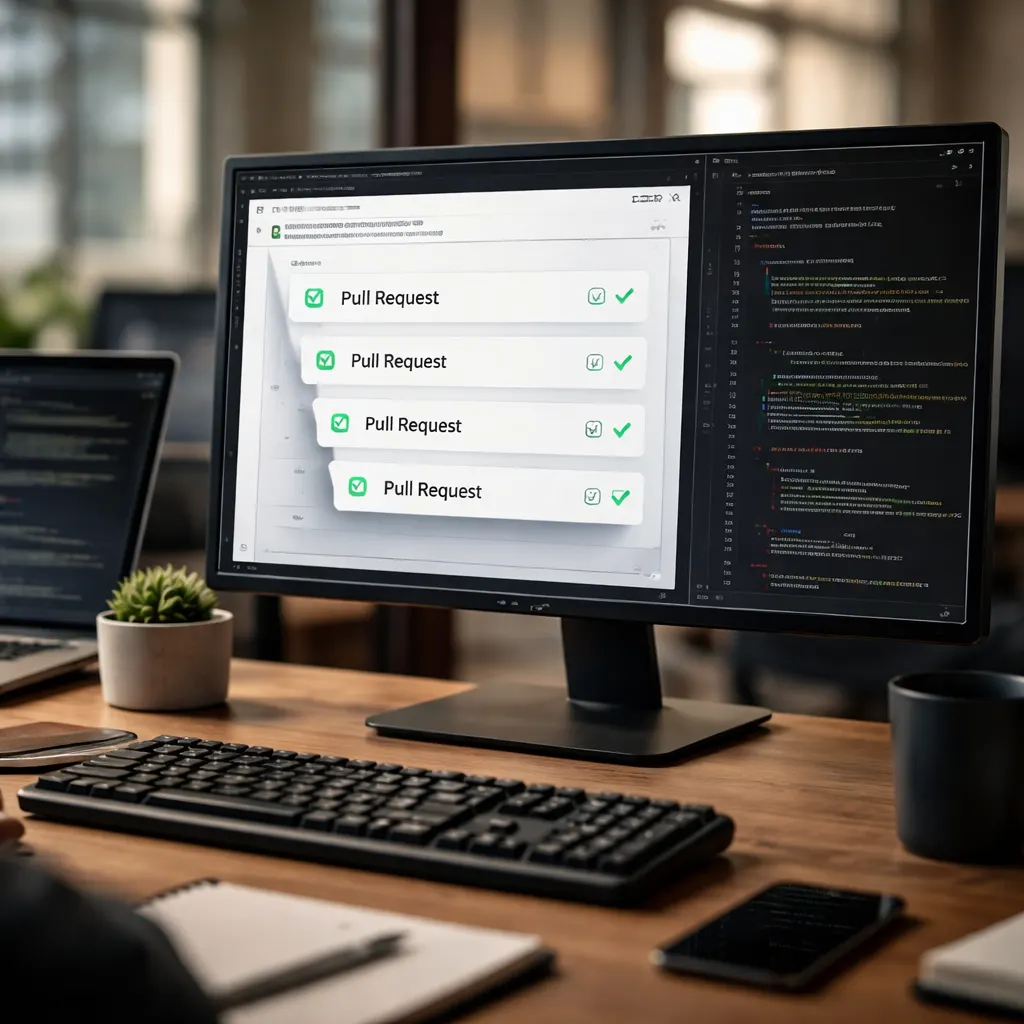
GitHub has introduced Stacked Pull Requests in public preview, offering native support for dividing large software modifications into smaller, interdependent pull requests that can be reviewed and merged separately. The feature addresses a persistent challenge in modern software development: reconciling the accelerating pace of code generation—especially with AI assistance—against the constrained capacity of human reviewers. Instead of submitting one pull request with hundreds or thousands of lines, developers can now arrange their work into a sequence of smaller requests, each depending on the one before it.
GitHub's approach allows reviewers to assess each logical modification on its own, lowering cognitive burden while letting development proceed without waiting for an entire feature to finish before review starts. The company's implementation maintains existing branch protection rules, review workflows, and merge policies, making stacked development a natural fit with current repository practices rather than demanding a separate process. The platform removes much of the operational overhead that previously discouraged broader use, since teams can now create, review, update, and merge dependent pull requests through familiar GitHub workflows without adding extra tooling to their engineering environments. Although stacked development isn't new to GitHub—Meta popularized "stacked diffs" through internal tools, while companies like Graphite and Sapling built dedicated platforms around similar workflows—Microsoft's integration into GitHub itself eliminates the need for third-party solutions many teams previously relied on.
Beyond streamlining reviews, stacked pull requests support better developer workflow, the report notes. Large features often require foundational work that blocks later development until reviews finish, but with stacked changes, developers can keep building on earlier work while reviewers evaluate each layer on its own. This enables more continuous collaboration between authors and reviewers while cutting the need for large, long-lived feature branches that often suffer from merge conflicts and outdated code. The report finds that smaller reviews are generally easier to understand, easier to validate, and less likely to introduce defects through overlooked changes. Recent research reinforces this challenge: an analysis of early adoption of agentic coding tools discovered that while AI-generated pull requests are becoming more common, successful integration still depends heavily on human oversight, with most projects relying on a single experienced reviewer to validate agent-generated contributions before merging.
The timing reflects a broader industry shift. AI coding assistants can now generate substantial amounts of production-ready code in minutes, but code review has remained largely a human activity, meaning review quality risks becoming the primary bottleneck in software delivery as development velocity climbs. Stacked pull requests attempt to solve this by reducing review scope rather than speeding up review itself: instead of asking reviewers to grasp dozens of unrelated changes at once, each pull request represents one logical step, such as introducing a new API, updating a database schema, or implementing a specific business capability. The trend aligns with GitHub's recent innovations, including Copilot coding agents, CodeQL enhancements, artifact attestations, secret scanning through MCP, and expanded AI-assisted development workflows, suggesting that the future of software engineering will depend less on generating more code and more on creating workflows that allow humans and AI to collaborate safely, transparently, and at scale.
The report concludes that as AI continues to accelerate software development, features like stacked pull requests may shift from convenience to necessity. In an era where generating code is becoming increasingly automated, the ability to review, understand, and safely integrate that code may prove to be one of the defining capabilities of high-performing engineering organizations. Other research examining practitioner opinions found that code review has become the primary control point determining whether AI improves or degrades software quality, making structured review processes more important as coding agents grow more capable. The move also encourages developers to think about software changes as incremental architectural improvements rather than monolithic feature deliveries, a practice already associated with lower deployment risk and faster feedback. Organizations that master human-AI code integration workflows now will likely define competitive advantage in engineering productivity for years ahead, while those treating review as an afterthought risk turning velocity gains into quality liabilities.