
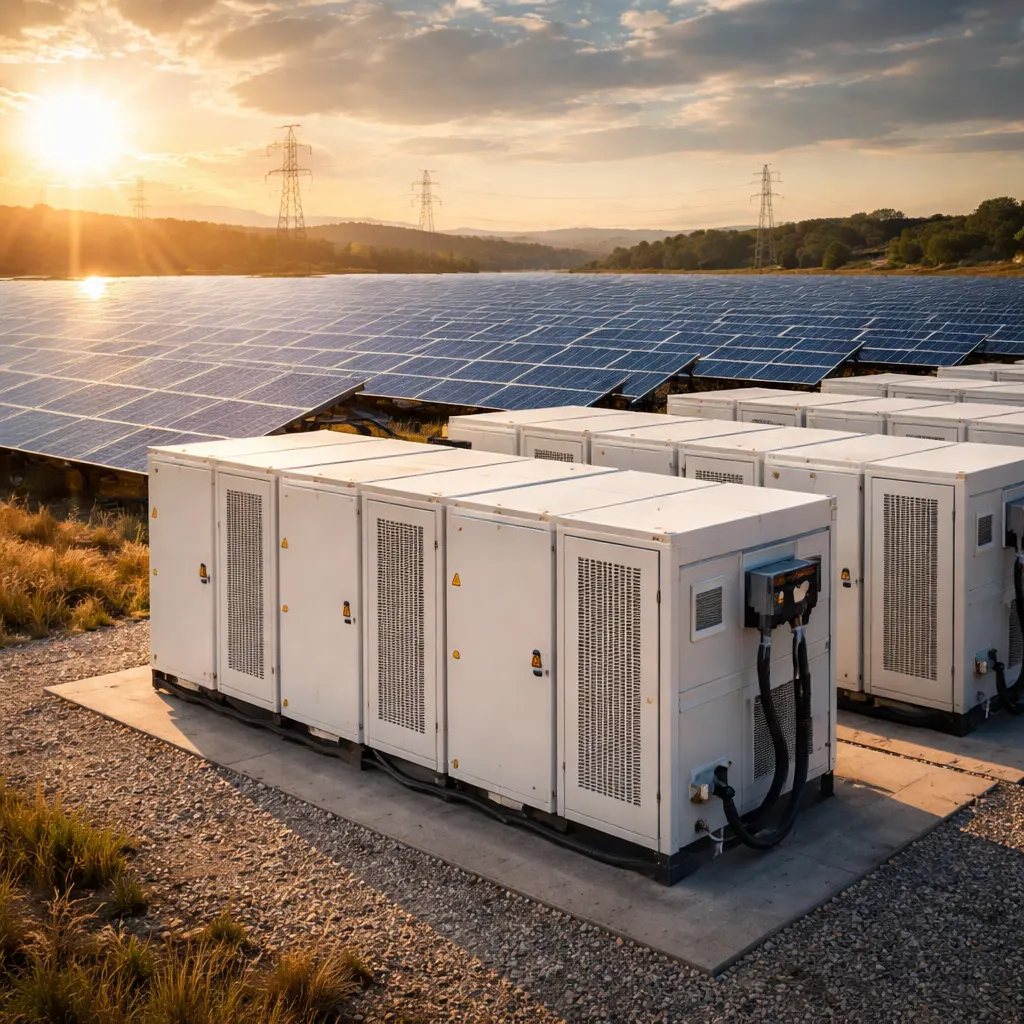
A venture capital firm that backed AI infrastructure company Crusoe argues that solar power paired with energy storage offers a faster, cheaper path to powering the next generation of artificial intelligence data centers than the natural gas plants companies have been rushing to deploy. G2 Venture Partners published its analysis on November 24, 2026, concluding that hyperscalers and data center developers should pivot toward off-grid renewable facilities to accelerate deployment and avoid permitting bottlenecks. The firm estimates that data center investment will reach more than $4 trillion through the end of the decade.
The analysis points to a stark disparity in manufacturing capacity between the two energy sources. Global natural gas power plant capacity stands at roughly 60 to 70 gigawatts annually, while solar production already exceeds one terawatt per year — more than 14 times larger. The U.S. electricity grid has shifted from essentially flat growth to adding several gigawatts each year in just a short time span. The firm identifies two emerging models for the next wave of facilities: smaller installations connected to the grid with dedicated generation, and larger centers running on solar plus long-duration storage operating independently from the utility network.
According to Brook Porter, a partner at G2VP who led the firm's investment in Crusoe's Series C round, demand for power is accelerating faster than most observers realize. "It's atoms, not bits, and the world is in the process of recognizing the realities of those challenges," Porter told TechCrunch. The firm's analysis emphasizes that both solar panels and modular energy storage systems benefit from Wright's Law — the principle that costs fall as cumulative production volume rises — which Porter describes as "the most important lesson that we've learned over the last 20 years of backing companies."
The report argues that building off-grid facilities would let developers sidestep constraints tied to grid access and air quality permits, dramatically shortening time to market. Companies have been securing power in whatever form they can find because supply chains take time to scale, frequently leading them to purchase, lease, or install natural gas plants as a stopgap. But G2VP contends that relying on renewables paired with storage can deliver advantages across speed, scale, and cost simultaneously. While lithium-ion batteries remain too expensive for continuous power, newer long-duration storage technologies from companies like Form Energy and G2VP portfolio firm Antora Energy have brought costs per megawatt-hour down sharply.
Porter acknowledges these technologies may still be a few years from widespread adoption among data center builders, but he urges the industry to start planning now. "It's analogous to surfing the biggest waves off of Mavericks here in Northern California," he said. "The wave is so big that you really have to be paddling and moving and be incredibly nimble to catch it." The firm's thesis centers on choosing energy sources that can be manufactured at massive scale through small, repeatable components, rather than custom-engineered natural gas turbines with constrained global production. Building with renewables and storage in locations independent of the grid would allow data center operators to control their own timelines and bypass regulatory delays, the report concludes. If the firm's bet proves correct, the next phase of AI infrastructure buildout could look radically different from the gas-fueled scramble of the past two years — though the window to position for that shift may already be narrowing.