
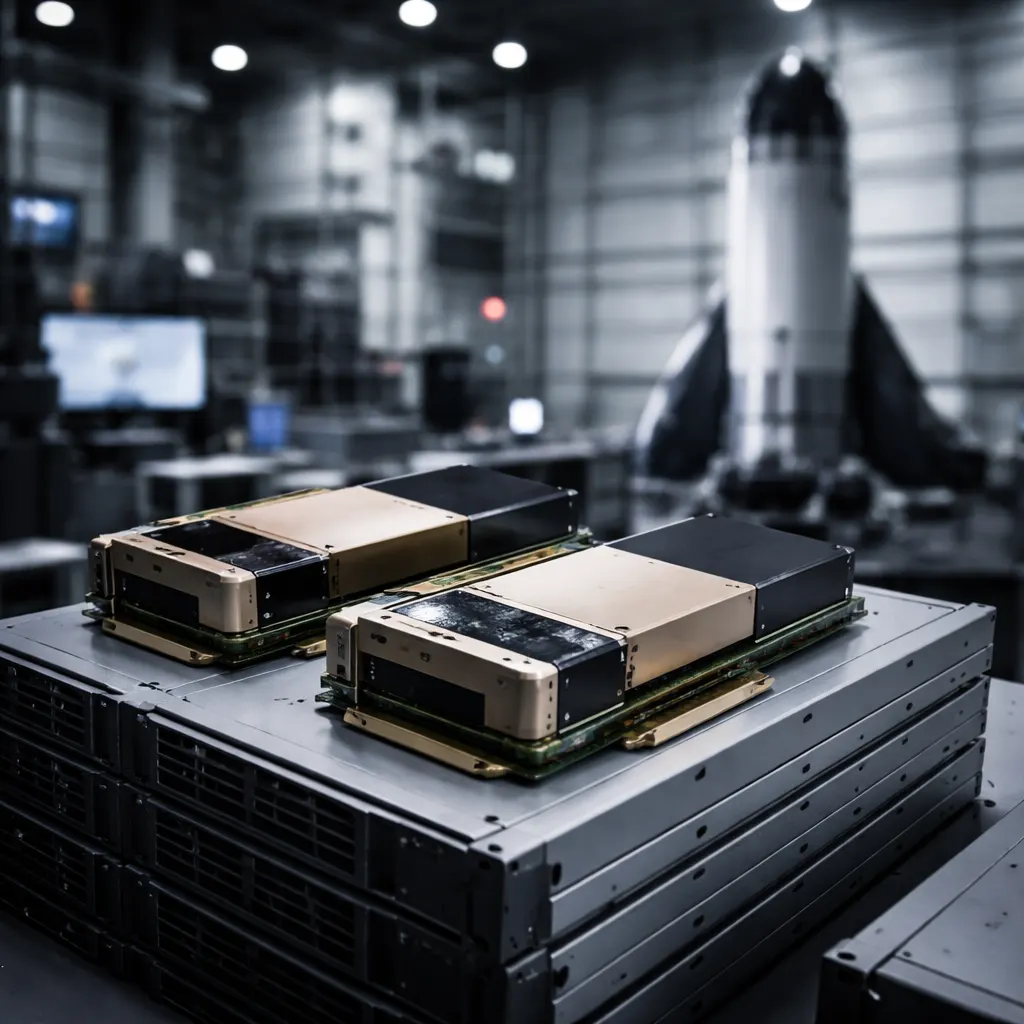
Elon Musk's SpaceX is pursuing $40 billion in financing to acquire Nvidia AI chips, according to reports from Channel Insider. The company has entered preliminary talks with banks and investment firms about a package that would consist of roughly $10 billion in bank loans and $30 billion in investment-grade debt. The proposed transaction illustrates the massive capital demands driving the competition to construct more powerful computing infrastructure for artificial intelligence.
SpaceX intends to leverage its BBB investment-grade rating to sell the debt to institutional pension and insurance funds, which operate under stringent restrictions on holding speculative securities. However, the borrowing campaign introduces significant balance-sheet tension. Following its June initial public offering valued at $86 billion, SpaceX issued $25 billion in high-grade notes that subsequently plummeted amid investor concern over capital expenditures, with 2056 notes trading at approximately 85 cents on the dollar—pricing comparable to junk bonds, according to MarketAxess data. Musk's brief pitch materials, which previously featured a two-page memo referencing data centers "somewhere in the universe," also generated unease among some underwriting committees. SpaceX is actively generating revenue from compute capacity, securing multi-year cloud contracts including $1.25 billion monthly from Anthropic and $920 million monthly from Google.
"We've decided to build exclusively on Nvidia because we think the Vera Rubin architecture is the best architecture," Musk stated during SpaceX's August earnings call. The report notes that financing semiconductor purchases with long-dated bonds creates a structural mismatch, since rocket launch pads and orbital satellite constellations represent durable physical infrastructure generating decades of operational cash flows, while advanced AI chips experience rapid hardware obsolescence every two to three years. According to the report, if SpaceX supports decades-long debt obligations with depreciating processing silicon, any slowdown in commercial compute leasing could leave the company servicing long-term liabilities on rapidly aging hardware.
The report explains that SpaceX's proposed financing plan underscores the expanding scale of investment necessary to compete in AI infrastructure. For cloud providers, infrastructure integrators, and enterprise technology partners, large chip acquisitions could shape competition for advanced computing capacity, though the impact on GPU availability and pricing will hinge on supply, deployment schedules, and broader market demand. The financing model carries implications for partners evaluating long-term cloud agreements, who may need to scrutinize provider financial stability, capacity commitments, and pricing terms more closely as AI infrastructure operators assume larger debt obligations.
For now, the proposed transaction remains under discussion, and its eventual structure and scale could signal how far major technology companies are willing to go to secure the computing power underpinning their AI ambitions. The combination of massive capital raises, bond market volatility, and the inherent obsolescence risk of semiconductor hardware presents a financial strategy that diverges sharply from SpaceX's traditional infrastructure investments, leaving open questions about sustainability if compute demand softens. The willingness to embrace this structural tension may reshape how technology firms approach the balance between competitive positioning and financial prudence in the race for artificial intelligence dominance.