
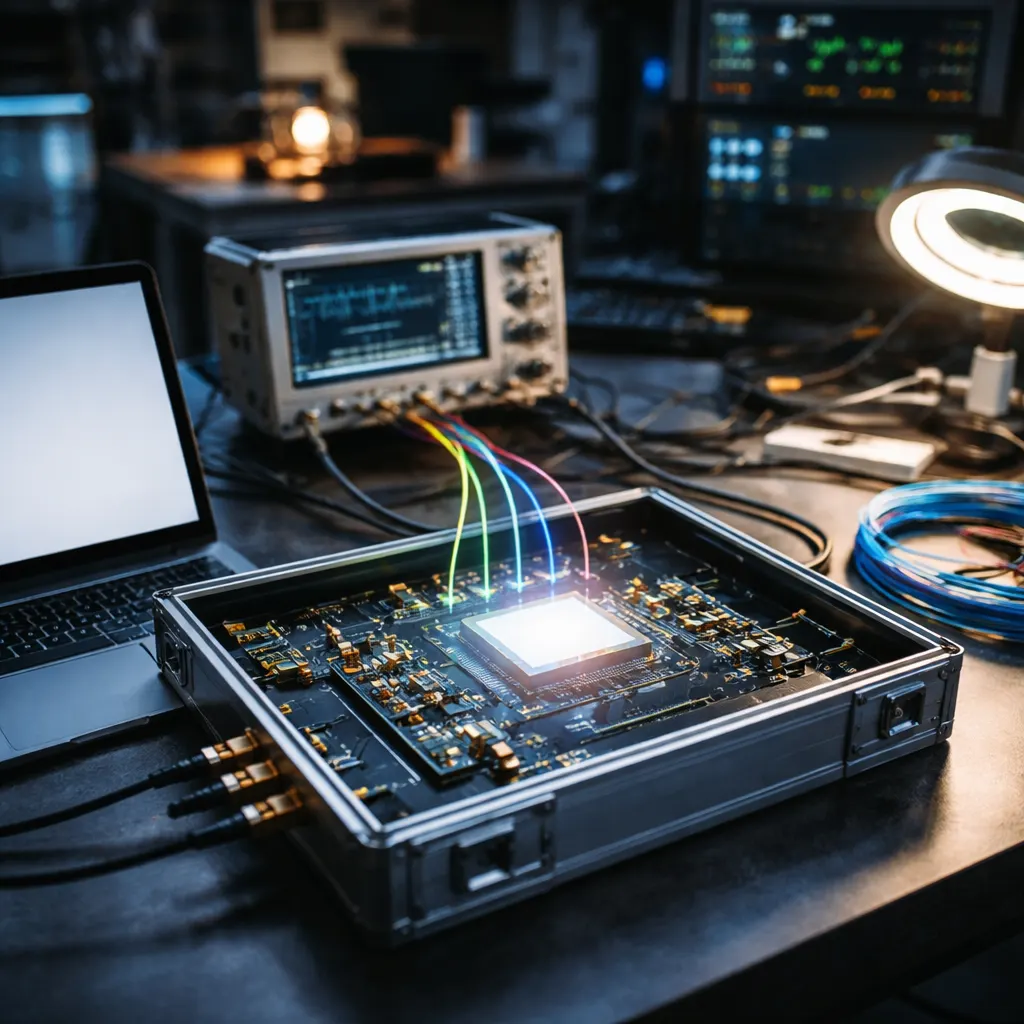
Q.ANT, a Stuttgart-based startup building processors that use light instead of electricity for AI calculations, released a free, open-source software toolkit this week that lets developers write and test programs for its photonic chips on standard computers. The company, which positions its technology as a way to run artificial intelligence on far less power than current chips require, published the Q.ANT Native Computing Toolkit on GitHub under a license permitting commercial use. Developers can now build applications in Python or C using a simulator that mimics the chip's behavior without needing Q.ANT drivers or hardware, according to the company.
The toolkit's initial release focuses on running AI models that have already been trained elsewhere, with examples including reading handwritten digits, recognizing objects in photographs, and outlining shapes in images. Training still happens on conventional CPUs and GPUs. Q.ANT's chips are currently operational at a handful of research computing centers, while other developers must wait "the coming months" for cloud access through German provider IONOS or an on-premises server from Q.ANT itself. In March, the company said its second-generation chips were running at the Leibniz Supercomputing Centre near Munich, where internal benchmarks showed the new chip performed more than 50 times faster than its predecessor at the matrix multiplication operations that power most AI models, and used six times less energy on typical workloads, by the company's own measurements.
"An ecosystem isn't created by hardware alone. It emerges when the software layer is open and others can build on it," said Michael Förtsch, Q.ANT's founder and CEO, calling the release the "Linux moment" of photonic computing. The company claims AI models built around wave-shaped functions similar to cosine—which its chips calculate using light rather than digital circuits—achieve better results with fewer parameters, the settings a model learns during training. Fewer parameters translate to smaller models, less data movement, and reduced power consumption, the report states. Q.ANT describes this as the first openly available software kit for programming a photonic processor, though Xanadu has offered free, open software for its light-based quantum computers since 2018.
The software release follows Nvidia's playbook: that company's dominance in AI stems as much from CUDA, the software developers use to program its GPUs, as from the chips themselves. Nvidia has been building CUDA for nearly 20 years and continues expanding it, including adding deeper native Python support last year. Q.ANT's approach differs from competitors like Lightmatter, which now focuses on using light to move data between chips rather than performing the calculations directly with photons. The startup raised €62 million in July 2025 in a round led by Cherry Ventures, UVC Partners, and imec.xpand. For now, developers can experiment with the simulator but can't yet validate Q.ANT's power-saving promises on their own models—that awaits hardware access. The company's broader claims, such as up to 30 times better energy efficiency, don't specify what baseline they're measured against.
Opening a development toolkit before hardware reaches the market tests whether software accessibility alone can build momentum for an unproven chip architecture. History suggests caution: Graphcore, the British AI chip startup, offered its own software kit yet still ended up sold to SoftBank in 2024, illustrating that polished developer tools can't always overcome the inertia favoring established platforms.