
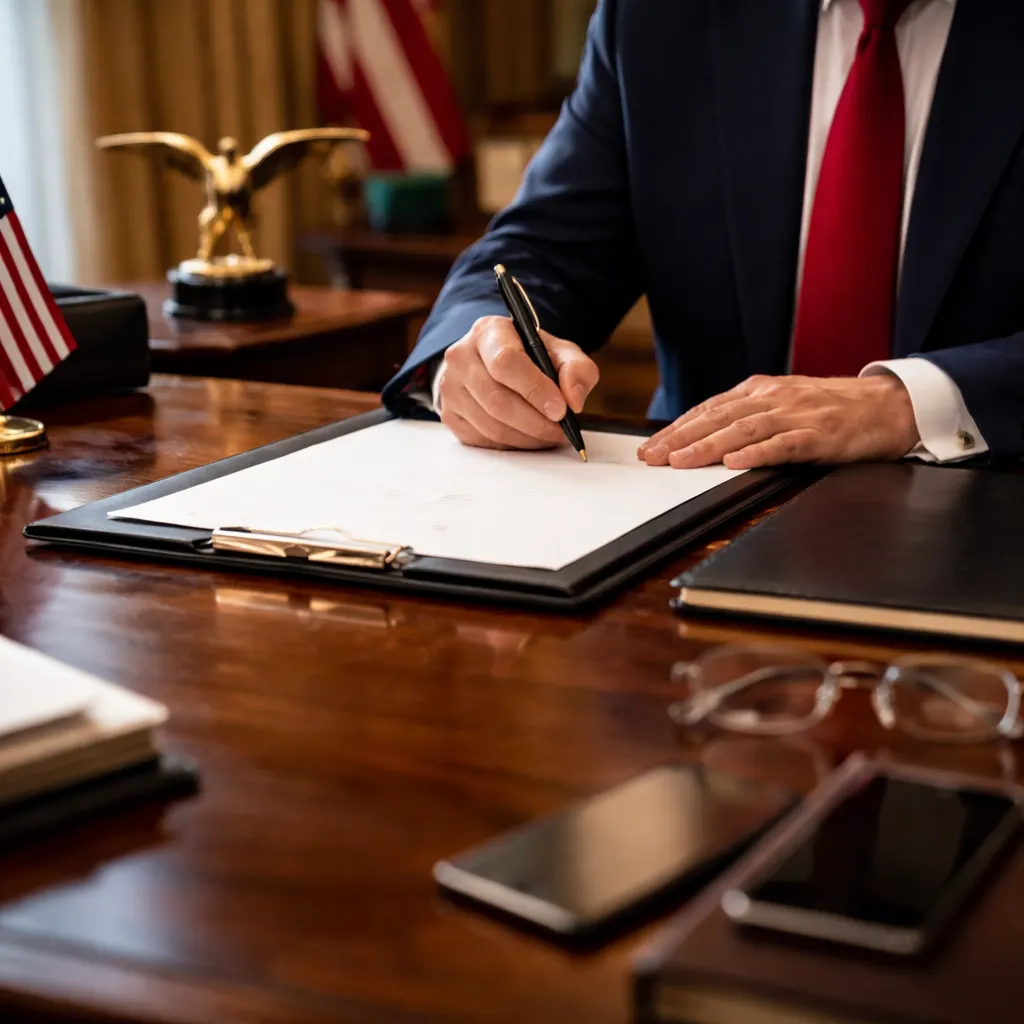
President Trump has issued an executive order directing all federal agencies to abandon the term "Artificial Intelligence" and replace it with "Super Intelligence" across government operations. The order, published this week, mandates that the executive branch use "Super Intelligence" and "SI" instead of "Artificial Intelligence" and "AI" in all official contexts. According to the directive, federal operations will no longer recognize the usage of "Artificial Intelligence" and "AI" in any applicable setting.
The order requires government websites, official correspondence, public communications, and policy documents to reflect this terminology change. The shift comes just three months after Trump signed a June executive order promoting "artificial intelligence innovation and security" that focused on upgrading American systems for advanced AI and granting the federal government access to frontier models. All that paperwork will now need to be replaced. The term Artificial Intelligence was coined by American computer and cognitive scientist John McCarthy in 1956, with conceptual roots tracing back to British mathematician Alan Turing's work published in 1950.
Trump argues in the order that the capabilities of today's frontier systems extend beyond merely imitating or automating discrete aspects of human intelligence. "They increasingly amplify human ingenuity and unlock new forms of creativity, empowering Americans to achieve what was previously impossible across science, medicine, and nearly every other domain of human endeavor," he states. As these capabilities continue to improve, they represent "not merely artificial intelligence, but a new era of Super Intelligence," according to the president. The directive declares that "Super Intelligence" is more appropriate for describing the advancing capabilities of these technologies and the transformative opportunities they create for the American people.
The abrupt terminology change has sparked speculation about motives beyond any technological breakthrough in recent months. Adam Cochran, a managing partner at Canadian venture capital firm Cinneamhain Ventures, claimed on X that the decision could be connected to investments in .si domains over the past three months, which he suggested would gain popularity among governments and companies seeking to curry favor with the administration. Cochran pointed to a surge in domain registrations with the .si suffix, including 12,000 MAGA-related domains and more than 10,000 AI-related terms registered to .si domains in the months before the announcement, with some now relisted for millions of dollars. While Cochran couldn't produce definitive evidence linking these investments to the president, his family, or business associates, the timing has raised questions. The report notes that observers must weigh the likelihood that the US has truly entered an era of super intelligence requiring immediate paperwork and website changes against the possibility that the executive order is part of a domain-name scheme.
The order's practical implications will require widespread administrative changes across the federal government as agencies update their communications, policy frameworks, and digital infrastructure to comply with the new terminology. The timing raises questions about whether the change reflects genuine technological advancement or other considerations, particularly given the minimal interval since the June order that heavily referenced artificial intelligence. For businesses and organizations working with federal agencies, the mandate may create pressure to adopt the new terminology in proposals, contracts, and communications with government partners.