
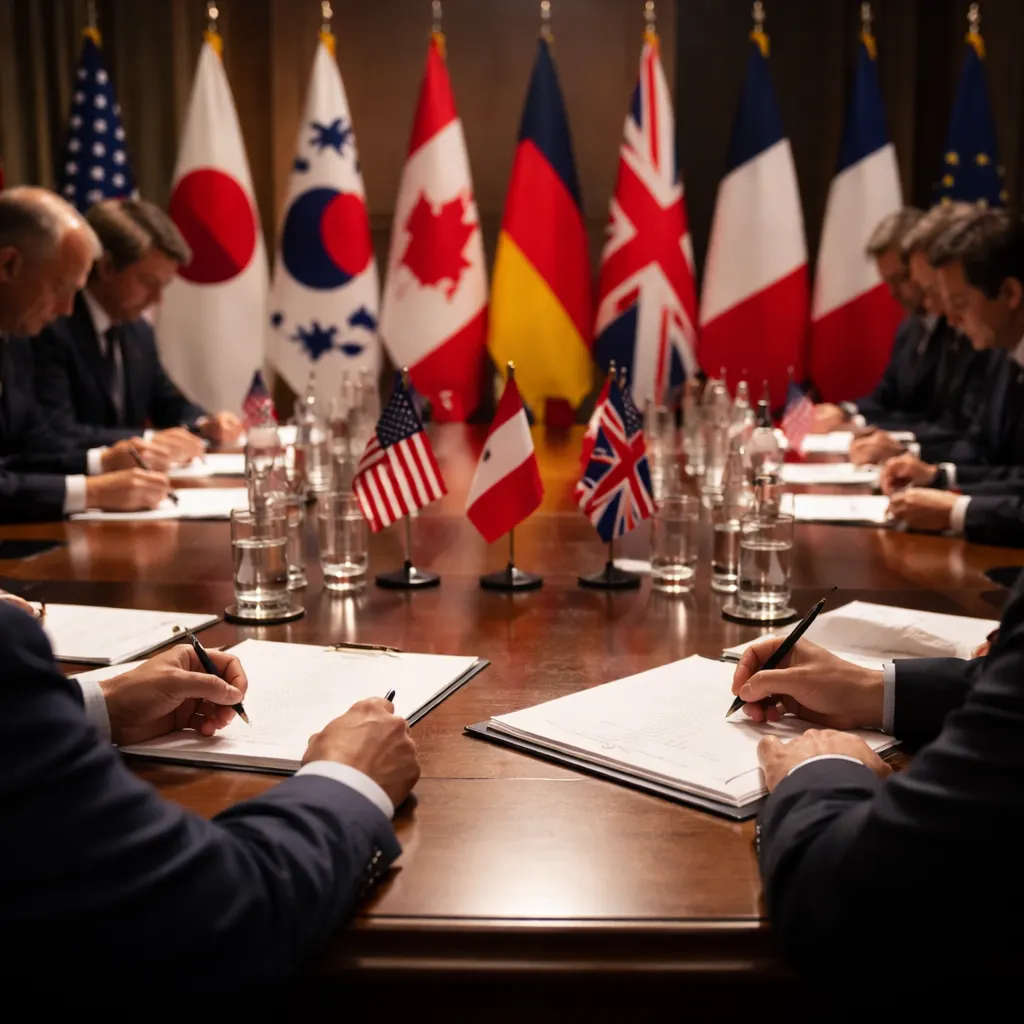
Nine nations including the United Kingdom have joined the United States in signing a declaration pledging to protect supply chains for artificial intelligence technology, according to a report from The Register published November 16. The agreement, formalized under the San Francisco declaration on November 15, advances the US-led Pax Silica initiative into what participants describe as a working partnership with shared responsibilities. While officially framed as an effort to secure vital parts of the global technology supply chain, the coalition notably excludes China, reinforcing suspicions that the arrangement aims to marginalize Beijing's AI ambitions.
The participating governments—Australia, India, Israel, Japan, South Korea, Qatar, Singapore, United Arab Emirates, and the United Kingdom—committed to protecting key foundational technologies essential to economic security. This encompasses software, materials, knowledge, components, and inputs critical to AI supply chains, as well as anything whose "theft, illicit transfer, or acquisition by hostile actors would confer a meaningful military or intelligence advantage," according to the declaration. The pact also covers critical infrastructure including ports, terminals, transport networks, communications systems, and the information and energy infrastructure these rely upon. The Pax Silica initiative itself, launched in December last year, focuses on frontier foundation models, compute and semiconductors, advanced manufacturing, minerals refining and processing, and energy.
US under-secretary of state for economic affairs Jacob Helberg told the Financial Times that "the know-how to design a chip, the machine that makes it, and the port that ships it can all be in different countries," explaining that Pax Silica partners have agreed to treat the security of those technologies and infrastructure as a shared responsibility. The declaration states that "the security of our peoples cannot be separated from the security of our economies and those of our closest partners," while committing signatories to protect these assets together. The South China Morning Post, based in Hong Kong, characterizes the effort as Trump's "campaign to China-proof AI and chip supply chains."
The agreement arrives as lawmakers from both Republican and Democratic parties push for additional measures preventing China from obtaining advanced chips used in AI processing, the report notes. It follows the recent high-profile resignation of Nvidia CEO Jensen Huang, who admitted to an affair with a woman suspected by US authorities of being a Beijing spy who worked for Singapore-based firm Megaspeed, which purchased Nvidia hardware and was suspected of making it available to Chinese users. A report released last week claimed US export controls aren't stopping Chinese AI labs from using restricted Nvidia chips, with many cutting-edge models trained using Blackwell GPUs. American efforts to limit Chinese access to its technology began during the first Trump administration and continued under President Joe Biden's leadership. President Trump is expected to hold bilateral talks with China's premier Xi Jinping this week at the Asia-Pacific Economic Co-operation summit in Shenzhen. The competing pressures of diplomatic engagement and technology containment will test whether coalition-based supply chain security can coexist with the economic interdependence that still binds these nations together.