
Google has launched its first datacenter satellite into orbit, but the company's new research reveals that scaling the concept would require SpaceX to conduct roughly 1,800 successful Starship launches and slash costs to $200 per kilogram. The peer-reviewed paper, titled "Toward a future space-based, highly scalable AI infrastructure system design," outlines the massive technical and economic hurdles standing between Google's experimental "Suncatcher" satellite and a functioning fleet of orbital servers. While the company successfully put its tensor processing units into space to test whether they can survive launch and the harsh conditions beyond Earth's atmosphere, the path to viability remains uncertain.
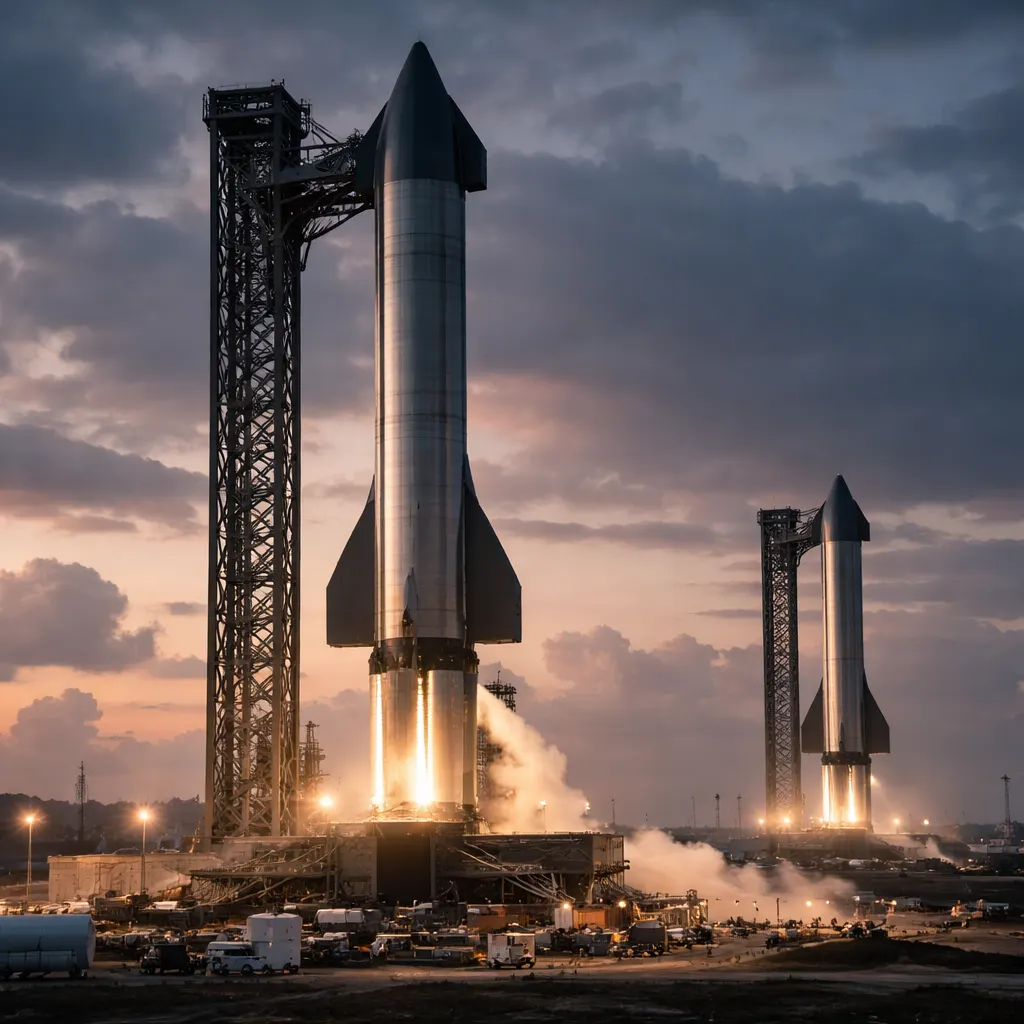
Google's calculations show that SpaceX has historically reduced launch costs by 20 percent after every doubling of the cumulative mass it's sent into orbit. To reach the critical $200 per kilogram threshold, SpaceX would need to launch an additional 370,000 tonnes of cumulative mass—equivalent to around 1,800 successful Starship flights—while reusing components 100 times. The paper notes that SpaceX and other companies have suggested orbital datacenters become economically sensible once costs hit that $200 per kilogram mark. For comparison, Starlink's second-generation satellites weigh 575 kilograms, though Google hasn't determined the mass of its future datacenter satellites.
At the $200 per kilogram price point, the paper concludes that "annualized cost per unit of power in space could be approximately comparable to terrestrial spend." However, Google's researchers found that existing network technologies likely can't link multiple satellites into functioning clusters, since rapid communication between satellites demands designs "significantly larger and entail much closer formation flight … than any previous or current satellite constellations." The authors also write that robust optical satellite-to-ground communications will be essential for scaled operations but face obstacles including atmospheric turbulence, high-speed relative motion errors, and precision beam tracking. NASA's TeraByte Infrared Delivery mission, which demonstrated 200 gigabits per second ground-to-low-earth-orbit communications, offers one promising approach.
Beyond networking, satellite design itself needs transformation. The paper's authors currently assume a conventional architecture with discrete compute payload, satellite bus, thermal radiator, and solar panels, but they expect that massive production will eventually drive highly integrated designs similar to smartphone systems-on-chip. The paper suggests that scaled space-based computing would ultimately involve integrated compute, radiator, and power systems built on next-generation architectures like computational substrates based on neural cellular automata. Google's researchers conclude that bringing their space datacenter vision to life "will require sustained research, iterative refinement of our design, and the achievement of several critical future milestones." The company is betting that limitless solar energy in orbit justifies the cost of putting servers beyond Earth's atmosphere, but only if SpaceX can maintain its cost reduction trajectory and engineers can solve networking challenges no constellation has ever faced. The semiconductor industry's shift toward integration suggests a path forward, though every piece—from launch economics to formation flying to ground links—must align before orbital computing moves from experimental satellite to operational reality.