
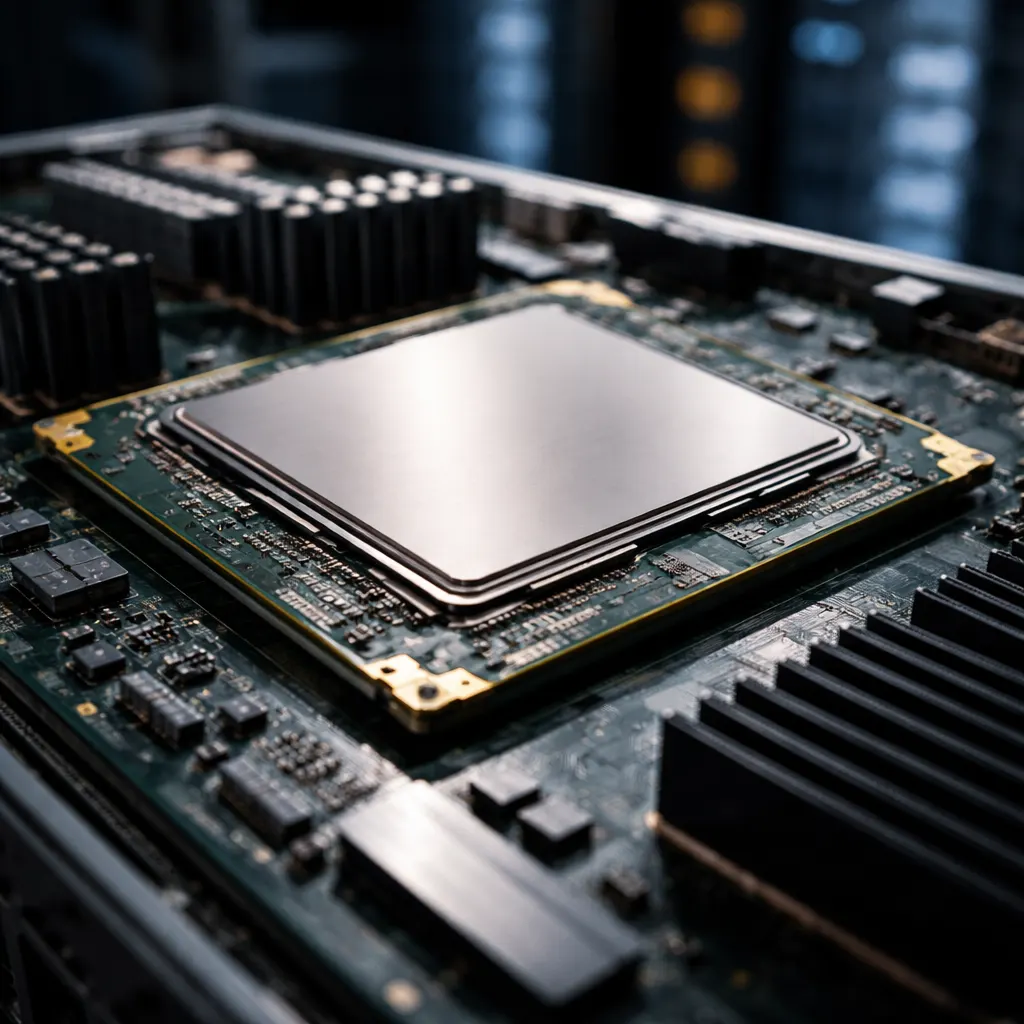
Intel's upcoming Xeon 7 processor, codenamed Diamond Rapids, will ship with 256 performance cores in its flagship configuration, the company revealed at Hot Chips this week — a significant increase from the 192 cores originally planned. The chip, delayed from 2024 to 2027, represents Intel's most ambitious server processor to date, built from up to 22 chiplets using advanced packaging techniques and aimed squarely at high-performance computing workloads where it'll compete directly with AMD's sixth-generation Venice Epyc processors, which also top out at 256 cores.
The Xeon 7 platform combines up to 16 core compute dies fabricated on Intel's 18A-P process, four compute building block base dies made on Intel 3-T, and two fabric hub dies on Intel 3. The chip offers 16 channels of DDR5 memory running at 8,000 MT/s — or 12,800 MT/s with MRDIMMs — and 128 lanes of PCIe 6.0 alongside CXL 3 and UPI 3 connectivity. Top-tier configurations pack 1.28 GB of L3 cache across the four compute building blocks, with 320 MB per block. Each core chiplet contains up to 16 cores and their L2 caches, with up to four of these chiplets stacked atop each base die using Foveros 3D direct hybrid bonding packaging. Power consumption for the flagship part is expected to land around 600 watts, matching AMD's competing Venice chips.
According to the technical deep dive published by The Register, Intel has abandoned mainstream server configurations entirely for this product line. The company cancelled all eight-channel Diamond Rapids-SP variants earlier this year, leaving only high-end AP models designed for HPC applications. The chip lacks hyperthreading — what the broader industry calls simultaneous multithreading — completely, meaning Intel won't compete with AMD across every market segment, just at the very top end. Intel's 18A-P process technology delivers the same performance at 18 percent less power compared to previous nodes, or up to 9 percent higher performance at identical power levels, before accounting for architectural improvements in the new performance cores.
Intel's new "fan-out-fabric" chiplet architecture enables uniform memory access across the entire chip rather than the three non-uniform memory access nodes that appeared by default in Granite Rapids-AP. The company achieved this by connecting compute building blocks to both scalable fabric hub dies through a traditional UCIe-S interconnect that carries data over the organic package substrate, rather than using its EMIB silicon bridge technology. This design choice allows the compute blocks to communicate directly with both I/O dies without requiring additional hops, keeping packaging costs manageable. The chip's success will ultimately hinge on pricing and value proposition — when AMD launched its Rome architecture in 2019, it couldn't match Intel on core-for-core performance but delivered more cores, I/O, and memory bandwidth per dollar, a strategy that remained effective until AMD's fifth-generation Epycs forced Intel to slash prices. For organizations running HPC workloads that don't benefit from hyperthreading — including the HPL benchmark used to rank the world's fastest supercomputers — Diamond Rapids could offer compelling performance if Intel prices it competitively against Venice. The chip's modular design allows Intel to add or remove chiplets depending on the desired balance of compute, cache, and memory, though product segmentation details remain unclear beyond confirmed 256-core and 192-core variants. Whether Intel truly competes on price or leans on architectural advantages will determine if Xeon 7 becomes more than a niche offering in an increasingly Nvidia-dominated datacenter landscape. The delay to 2027 gave Intel's engineering teams time to refine what may be the company's most technically sophisticated server chip ever built, but whether that technical prowess translates to market traction depends entirely on how aggressively Intel positions it against both AMD's proven Epyc lineup and Nvidia's in-house Vera processors.