
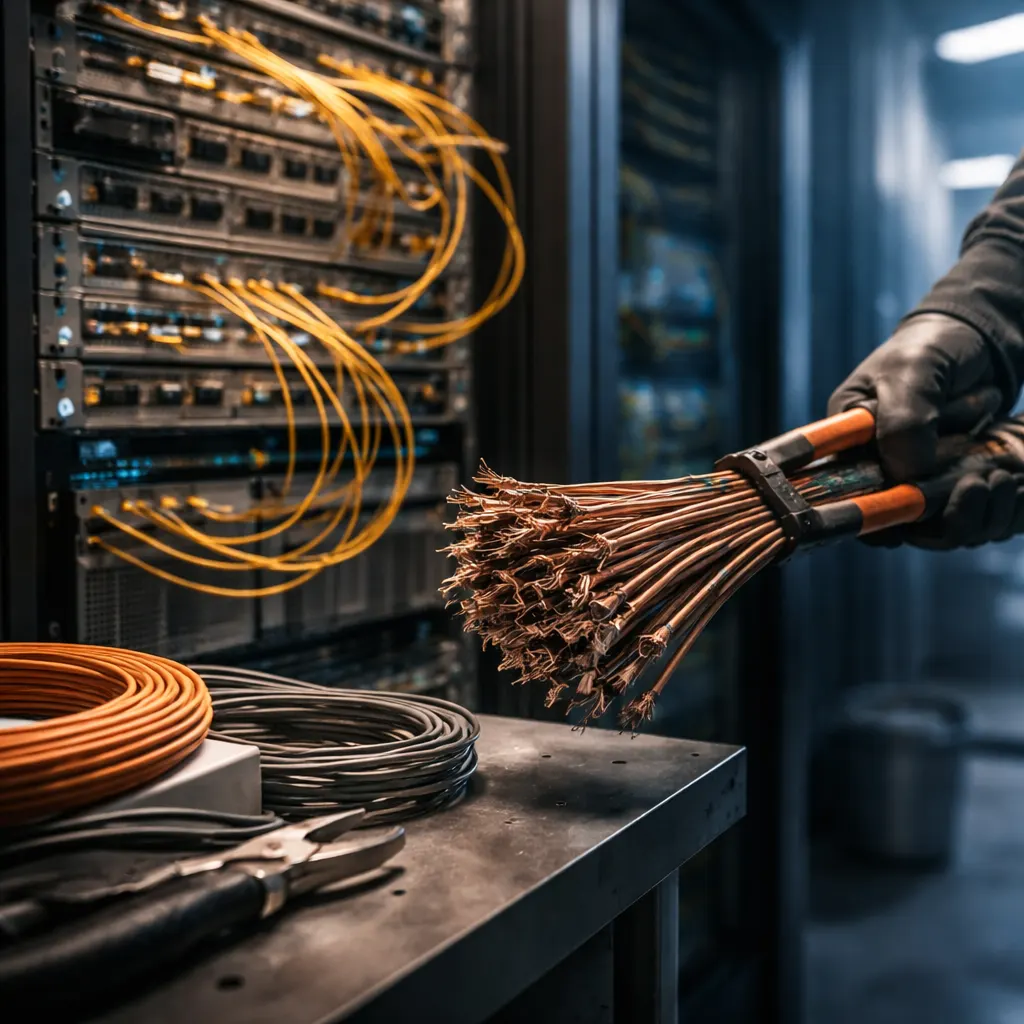
Lumen Technologies is deliberately shutting down its aging copper network infrastructure while expanding strategic services, a transition that's improving the company's profitability, according to executives at the telecommunications and enterprise technology firm. The Monroe, Louisiana-based company is accelerating the decommissioning of legacy copper networks in states including Iowa, Florida, Nevada, and Utah—roughly a quarter of its copper footprint—while traffic on its global public internet backbone has jumped 20 percent since January 2026. "Copper is worth more to us mined than operated," President and CEO Kate Johnson said during the company's third-quarter 2026 earnings call on Wednesday evening.
Strategic revenues, which include Network as a Service and other next-generation offerings like Alkira, grew 10 percent during the quarter to $1.28 billion, now representing 55 percent of business revenue. Legacy segment revenue fell 8 percent to $1.07 billion. The company's Large Enterprise segment climbed 3.6 percent to $810 million in the third quarter compared with $782 million a year earlier, while midmarket enterprise revenue declined 7 percent to $430 million from $464 million in the same period last year. Overall total revenue came in at $2.72 billion for the quarter ending September 30, down 12 percent from $3.09 billion in the year-ago period, missing Wall Street's expectations. The company reported a net loss of $265 million, an improvement from the $621 million loss in third-quarter 2025. Lumen's stock dropped 5.89 percent in after-hours trading Wednesday to $4.47. The company also signed an additional $700 million in Private Connectivity Fabric deals during the quarter, pushing cumulative agreements past $13.5 billion, and now serves more than 4,000 customers on its NaaS platform.
AI traffic has surged more than 1,000 percent since April, though it remains a small slice of overall traffic, Johnson said, "an indication that enterprises are really beginning to dig into AI inferencing." The company's old approach was to extract cash from legacy revenue and manage its decline, but with strategic business expanding, Lumen can now liberate capital by shutting legacy infrastructure down, executives told investors. "Strategic portfolio margins are meaningfully higher than legacy," said Chris Stansbury, executive vice president and CFO. "The future of Lumen is being built on strategic growth, not on preserving the past." Lumen in July acquired cloud networking specialist Alkira for $475 million, gaining its carrier-agnostic software control plane that, combined with Lumen's physical fiber infrastructure, is advancing the company's NaaS strategy and generating more strategic revenue, according to the firm.
The shift reflects Lumen's bet that next-generation network services will more than offset the decline of its traditional copper-based business, with executives pointing to growing enterprise demand for AI inferencing and cloud connectivity as the catalyst. Johnson said the company is "solving increasingly complex problems for our customers and expanding what the Lumen platform can do," with economics improving as the firm executes on its strategic pivot. Lumen this month expanded its partnership with Microsoft to embed the Lumen platform into Microsoft's enterprise selling motion, with the two companies jointly pursuing deals where AI, cloud, and network modernization intersect. Under the co-sell model, Microsoft sellers can retire Azure sales quota when customers adopt Lumen. Major brands like Nasdaq and Volvo continue selecting Lumen, and with Alkira, they can now extend connectivity and control across cloud and data center environments where AI and digital workloads are driving the fastest growth in network demand, Johnson said. The company's ability to free up cash by decommissioning copper infrastructure rather than maintaining it positions Lumen to reinvest in the strategic services where margins are meaningfully higher and customer demand is accelerating. The transformation hinges on whether enterprise adoption of network modernization and AI inferencing sustains momentum, offsetting not just the dollar value but the scale of legacy revenue that's evaporating—a calculus that becomes harder as the low-hanging fruit of copper decommissioning runs out.