
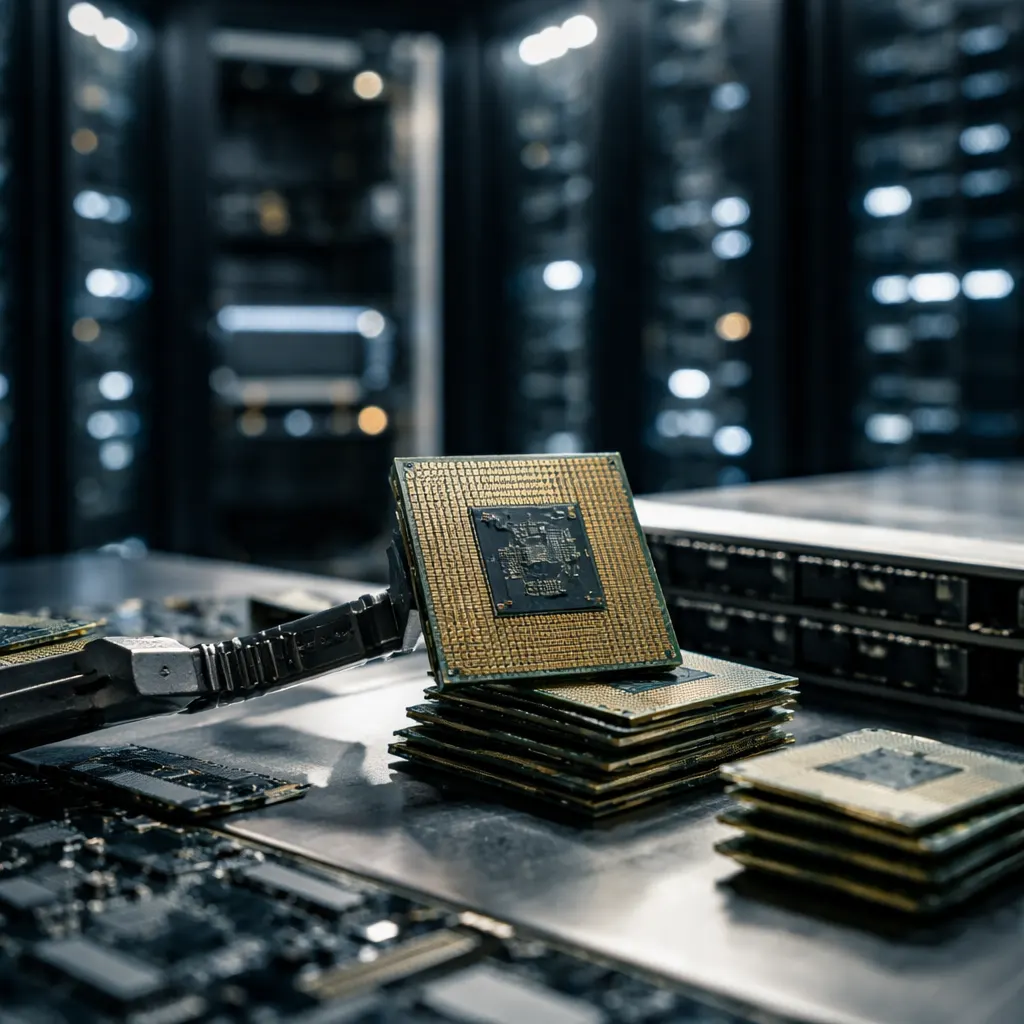
Lenders behind SpaceX's $40 billion chip financing deal asked that none of the purchased semiconductors be deployed for the company's orbital data center plans, according to a November 20 report in TechCrunch. The report highlights a critical financing obstacle facing the emerging space data center industry: chips installed in satellites orbiting 300 miles above Earth at 17,500 miles per hour can't be repossessed if operators default on their loans. This financing gap threatens to make space-based computing more expensive than ground-based alternatives, even as companies race to build orbital facilities.
The economics of terrestrial data centers rely heavily on debt financing, with cloud providers using chips as collateral to secure cheaper loans. If borrowers default, lenders can seize and resell the hardware. Older chips retain substantial value in this secondary market — some H100 models are selling for roughly half their original 2023 cost basis, while certain H200 configurations command the same prices they did at their 2024 introduction, according to Compute Credit Index Research cited in the report. This resale backstop reduces borrowing costs for traditional data center operators. The report notes it's unclear whether SpaceX agreed to the lenders' restriction on orbital chip deployment.
The report finds that SpaceX may not face immediate pressure from the financing constraint, as the company's terrestrial ground station compute deployment has proven profitable. On the company's most recent earnings call, CEO Elon Musk described redirecting engineers from the rocket team to speed up ground-based expansion, including taking on tasks like casting turbine blades for generators faster than existing suppliers. However, the report notes that open questions remain about securing land and power for continued data center buildout, with many potential projects encountering delays and local opposition. Musk stated at the beginning of 2026 that he expects space to become the "cheapest" location for data center operations within two to three years.
The financing disadvantage creates a potential competitive edge for Google, which is concentrating on launching its proprietary TPU chips through Project Suncatcher, the report states. SpaceX's orbital data center ambitions face additional hurdles beyond chip financing — the company's Starship rocket must achieve fully reusable flight before space-based computing economics become viable. In its most recent test flight, SpaceX failed to recover the booster stage but successfully landed the orbital stage back at its Texas launch facility. The report notes uncertainty around when the second stage will fly again or how costly refurbishment will be for a second mission. Even with operational Starship rockets, SpaceX and startups including StarCloud, Cowboy Space Corporation, Sophia Space, and Orbital will need to purchase chips at higher financing costs than terrestrial competitors. SpaceX and Tesla are collaborating on Terafab, their own U.S. chip foundry, but that project hasn't broken ground and will require years and billions of dollars before reaching production scale. The collision between space ambitions and earthbound financing structures may determine whether orbital computing remains a niche or scales into a true alternative, forcing the industry to invent new capital models or accept permanently higher costs for the ultimate high ground.