
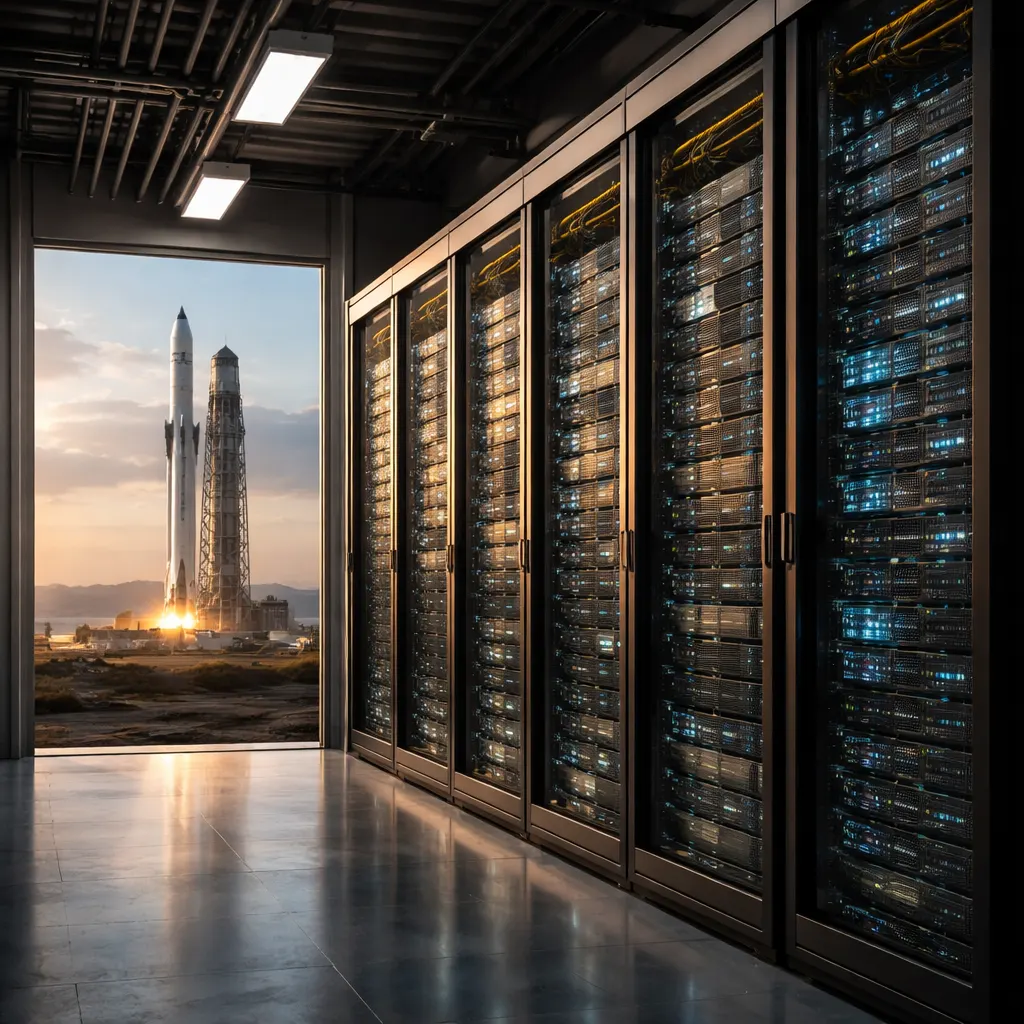
SpaceX's space operations generated less than $1 billion in revenue during the second quarter and accounted for just over 10 percent of total company income, according to the company's first quarterly earnings statement as a publicly traded entity. By revenue, the firm now operates primarily as a telecommunications provider and a compute rental business, with SpaceX itself remaining its largest rocket customer. The satellite internet service Starlink and the data center leasing operation drove the overwhelming majority of income, overshadowing the launch vehicle division that still carries the company's name.
Starlink, which SpaceX categorizes as "connectivity," brought in $4.2 billion in the quarter and was the only division that posted positive operating income, the earnings report reveals. The data center segment, marketed under the umbrella of artificial intelligence services, generated more revenue than the rocket business and sparked $15.8 billion in spending during the same period, focused exclusively on AI infrastructure. By comparison, both the space and connectivity sectors saw expenditures of just over $1 billion each. The neocloud operation, which leases bare-metal compute capacity to AI firms including Google, Anthropic, Reflection AI, and Cursor, now positions SpaceX as a direct rival to specialized providers like CoreWeave and Nebius.
Chief Financial Officer Bret Johnsen stated on the earnings call that existing contracts place the company on track to hit $100 billion in annualized revenue run rate, a projection that includes contributions from recently acquired AI firm Cursor. Musk went further, declaring that reaching "$100 billion ARR in December is not a question mark" and suggesting the actual figure might climb higher. According to the report, only 10 percent of the compute infrastructure SpaceX builds will serve Grok, the company's in-house AI product. The data center push originated when xAI struggled to operate the Colossus 1 facility in Memphis, encountering latency problems and bottlenecks from mixing newer and older chips, which led to the decision to rent capacity to outside customers instead.
The bare-metal compute rental model carries inherent risks that the company now must navigate: chips become obsolete, construction timelines slip, and compute functions as a commodity where providers compete mainly on price. As more data centers come online across the industry, available capacity rises and rental rates face downward pressure. SpaceX has filed an application with the Federal Communications Commission proposing an orbital data center constellation of up to 1 million satellites, though the submission lacks technical specifics on satellite dimensions or deployment schedules. The company also relies on Tesla as a major customer, purchasing $295 million in Megapack battery storage systems and multiple Cybertrucks during the quarter.
Insider lockup periods began expiring on August 6th, raising questions about how potential stock sales might affect share prices that had already been declining. Musk has claimed the public listing was motivated by plans to construct data centers in space, with an ultimate vision of building a mass accelerator on the Moon using chips manufactured by a Musk-owned producer called Terafab and assembled by a billion Optimus robots. The telecom division meanwhile outlined plans for a phone service intended to compete with AT&T, Verizon, and T-Mobile, though Musk's assertion that Starlink will deliver "a majority of the world's internet" remains unsubstantiated by deployment timelines or technical roadmaps. The financial reality shows a firm generating most of its money from satellite connectivity and compute rentals rather than launch services, a composition that diverges sharply from the public perception of a rocket-focused enterprise. The shift into capital-intensive infrastructure happens to provide Tesla with a substantial buyer for battery products at a time when Tesla's stock has fallen 25 percent since January, creating cross-company dependencies that blur the boundaries between Musk's separate ventures.