
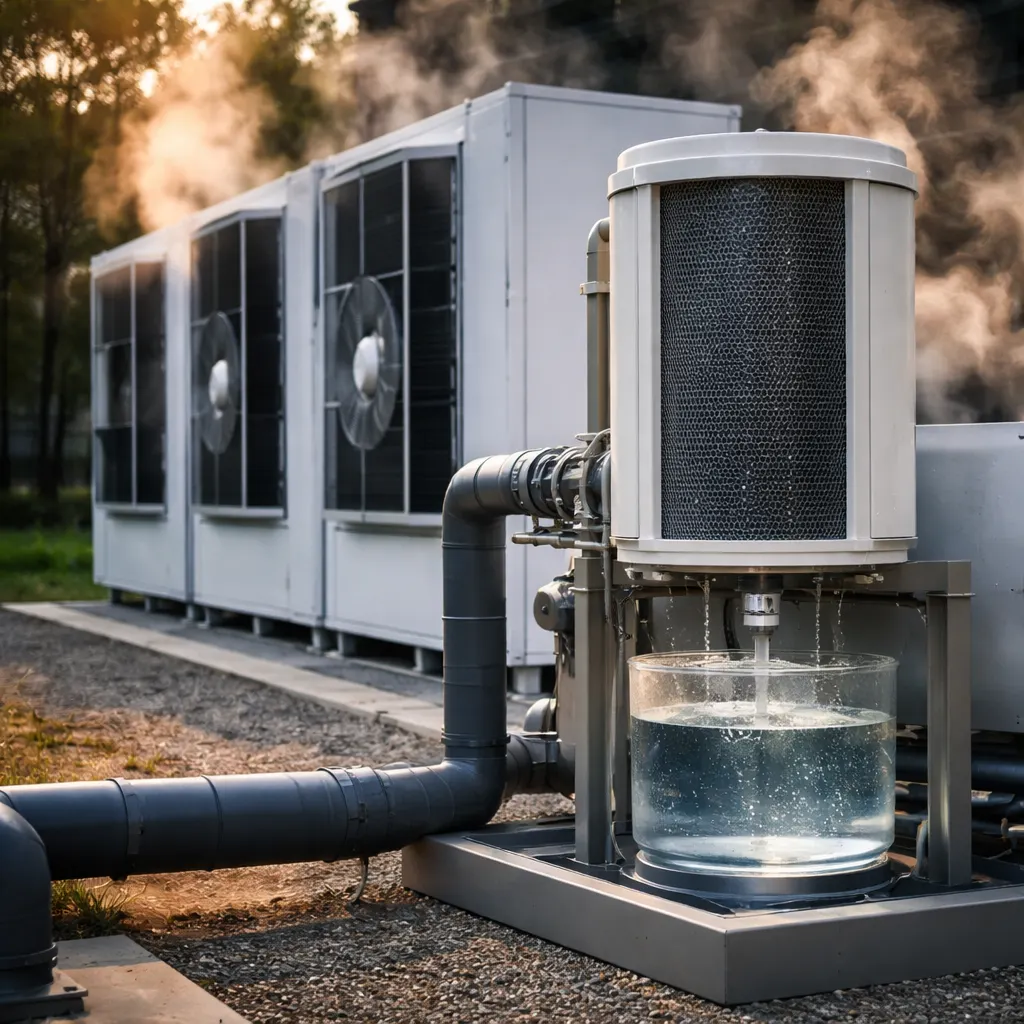
A California startup has demonstrated a machine capable of producing up to 300 liters of water daily by harvesting moisture from air using waste heat from data centers, according to a September 2026 report from WIRED. Atoco, based in Irvine, uses metal organic frameworks—materials that won founder Omar Yaghi the 2025 Nobel Prize for chemistry—to capture water molecules without electricity, needing only low-level industrial heat to extract and release the captured moisture. The technology addresses two critical challenges facing AI data centers: disposing of waste heat and securing millions of gallons of water needed for cooling systems.
The company's parking lot prototype runs on heat equivalent to a 20-kilowatt data center and operates even when relative humidity drops into the teens, releasing water with temperatures as low as 100 degrees Fahrenheit. Atoco has deployed five on-grid prototype trials with partners in the United States and the Gulf Cooperation Council, and the firm says it hopes to begin accepting orders for its first commercial product—capable of generating up to 1,000 liters daily—by the end of 2026. The metal organic frameworks function as molecular sponges with internal surface area so vast that a single gram could cover two football fields, creating microscopic spaces that hold water molecules which are then released through applied heat. Microsoft, Google, and Amazon Web Services have all pledged to become water positive—returning more water to communities than they consume—by 2030.
"Roughly 70 percent of the industrial waste heat is low-grade, unutilized, thrown into oceans or into the air," CEO Samer Taha told WIRED. "If you convert that waste heat to clean water using our technology, you're talking about trillions of liters of clean water." The company says it's already in discussions with major technology firms about deploying pilot projects at data centers, though it declined to name specific partners or pricing. Seth Cohen, dean of the School of Physical Sciences at UC Irvine who is not involved with Atoco, noted that while silica can also pull water from air, it holds less moisture and requires much higher temperatures to release it.
Atoco can produce water at a levelized cost of $5 per metric ton, making it competitive with older desalination plants, but newer facilities deliver water at $2 per ton or less—a target the company says it remains three to five years from reaching. The technology's reliance on external heat sources or electricity to extract water could complicate rural deployment in areas underserved by energy infrastructure, according to Cohen, who worked on metal organic framework projects at the Defense Advanced Research Projects Agency. Hyperscale data centers operate at orders of magnitude larger than the 20-kilowatt equivalent that powers Atoco's demonstration unit, presenting both opportunity and challenge as the startup works to scale production of commercial units that could deliver meaningful water volumes. Yaghi, who grew up as a Palestinian refugee in Jordan responsible for filling household containers when the delivery truck arrived every two weeks, described the technology's potential as "going from scarcity to abundance." The market dynamics remain uncertain, but data centers juggling heat disposal costs and water consumption pressures may prove more willing to pilot unproven technologies than risk-averse utilities would be.