
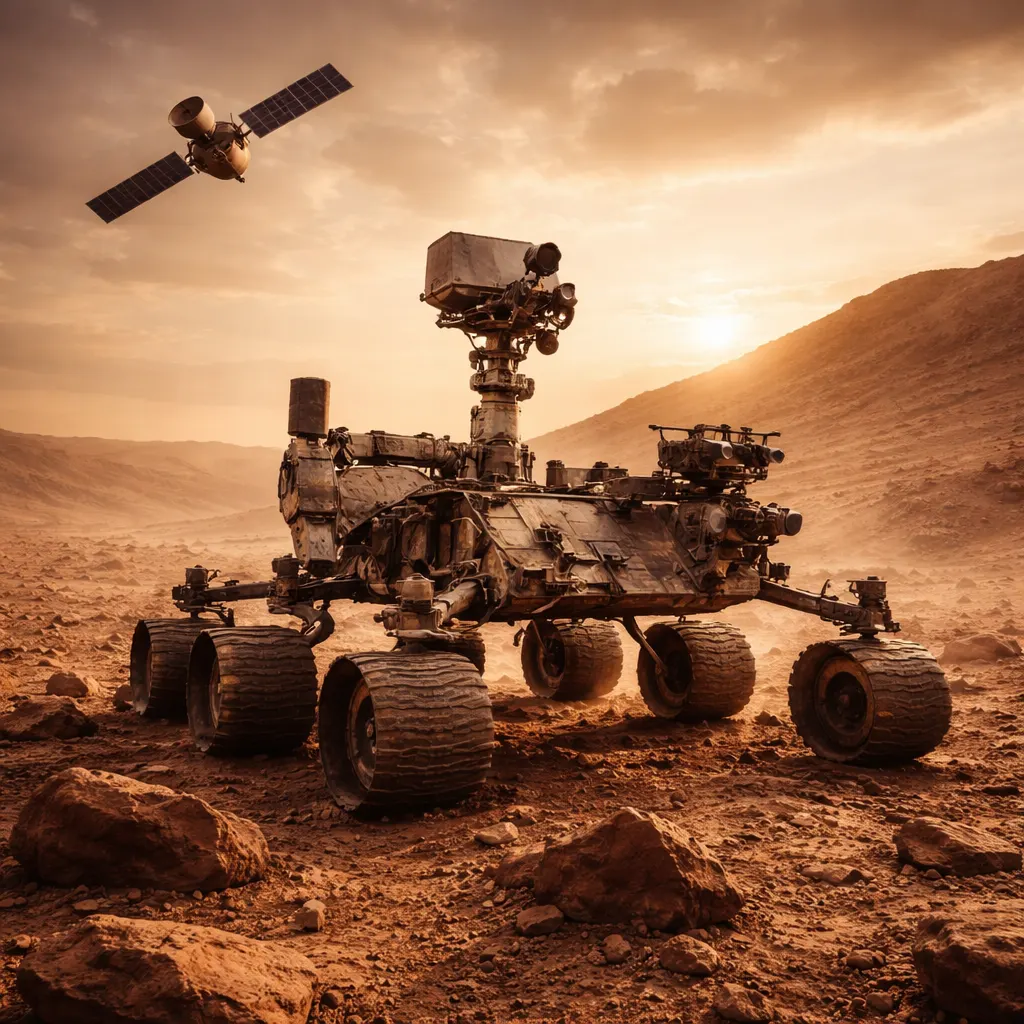
NASA's Perseverance rover and Odyssey orbiter both experienced significant technical failures within weeks of each other, according to a report published this week by The Register. The dual breakdowns have halted science operations on the rover and could potentially end the orbiter's mission entirely. The incidents mark a particularly difficult period for the agency's Mars exploration program, with communication failures on the surface and mechanical problems in orbit threatening operations that have lasted years beyond their original timelines.
The Odyssey orbiter entered safe mode between November 4th and 6th after one of its three remaining reaction wheels stopped spinning, according to the report. Engineers determined the wheel could still move when commanded, but if the spacecraft must rely on its backup hydrazine thrusters instead, only a few months of fuel remain. The orbiter, which reached Mars in October 2001 for a mission originally planned to last two and a half years, has now operated for a quarter of a century. Meanwhile, Perseverance detected problems with its primary radio on October 30, when expected "heartbeats" from the device failed to arrive. The rover automatically switched to its backup radio and entered safe mode, but engineers discovered the backup was operating at roughly half its expected power output. Both radios are now considered unusable until the issues can be resolved, forcing the rover to communicate via X-band transmissions through its high-gain antenna, which provides significantly slower data rates.
The spacecraft serves a critical role in NASA's Mars Relay Network and was responsible for transmitting the first images after landing from the Phoenix lander and the Spirit, Opportunity, and Curiosity rovers, the report notes. If the orbiter fails, the European Space Agency's Mars Express and Trace Gas Orbiter could absorb some of the workload, though NASA states that the Trace Gas Orbiter already transmits the most relay data from Mars to Earth. According to a former ESA insider quoted in the report, "MEX is a science mission that can do relay where TGO is a relay mission that also does science."
The technical challenges stem from hardware aging and unexpected component failures on systems operating far beyond their designed lifespans. Odyssey lost one of its four reaction wheels back in 2013, leaving it dependent on the three remaining units to maintain proper orientation—any further loss forces reliance on finite thruster fuel. For Perseverance, engineers must first restore the backup radio to working status before addressing the primary unit, the report explains. The rover's current X-band communication method provides enough bandwidth to maintain contact with Earth but can't support the data rates needed for science instruments and operations. The simultaneous failures highlight the brittleness of deep-space systems as they age, where redundancy can evaporate quickly and leave missions vulnerable to cascading problems.
Engineers are working to restore both spacecraft to full capability, though the timelines and outcomes remain uncertain. For Perseverance, the priority is bringing the backup radio back online, then tackling the primary unit to resume normal science work. Odyssey's fate depends on whether the problematic reaction wheel can be stabilized or whether the spacecraft will burn through its remaining fuel trying to compensate. If the orbiter can't be saved, NASA will lose not just a science platform but a critical relay node that other Mars missions depend on for transmitting data back to Earth. The agency faces difficult triage decisions about where to invest recovery efforts and how to prepare for potential mission losses that could ripple across its entire Mars program. Extended missions always carry the risk of sudden endings, but losing infrastructure that supports multiple active landers and rovers creates complications that go well beyond a single spacecraft's lifespan.