
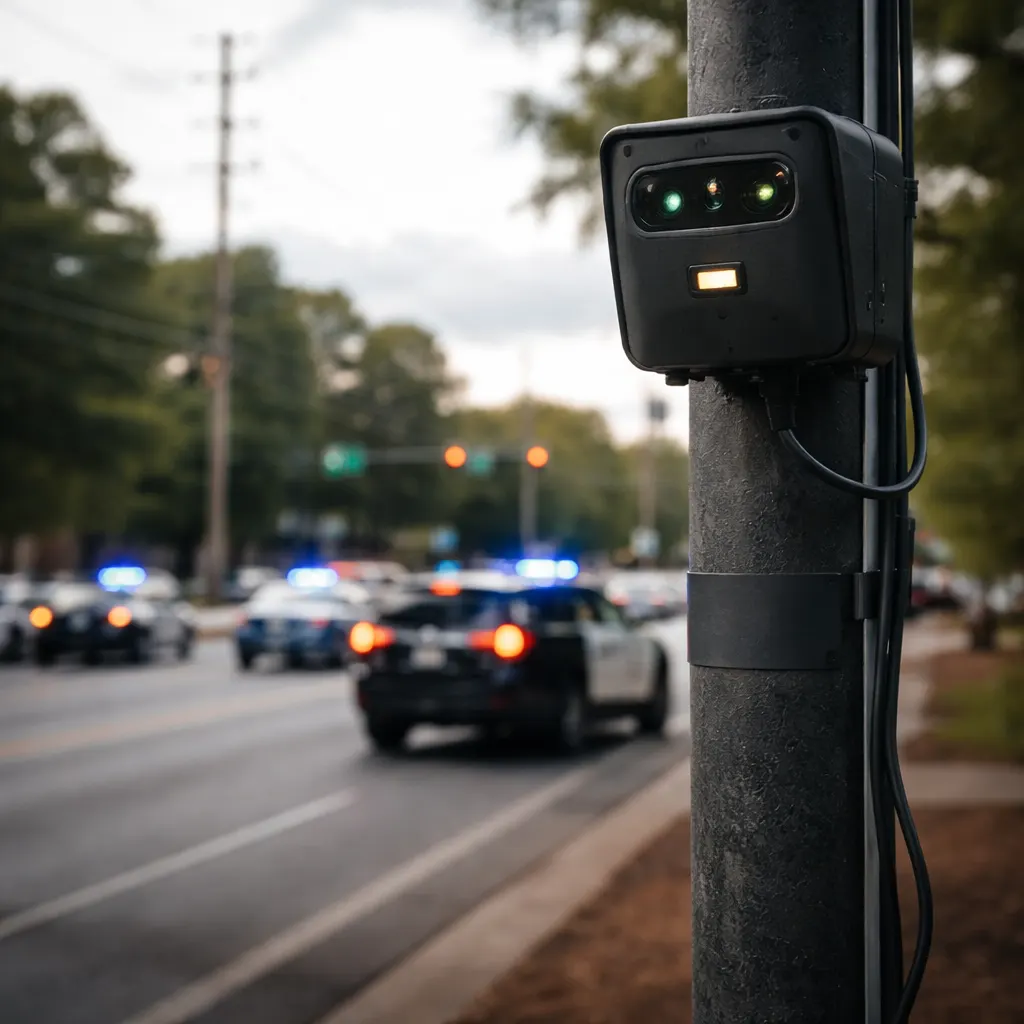
Surveillance cameras operated by Flock Safety in Alpharetta, Georgia, a prosperous suburb of Atlanta with roughly 67,000 residents, are feeding license plate data to more than 2,000 police departments, colleges, airports, and government agencies across the United States, according to public records obtained by WIRED. The findings illustrate how a single municipality's surveillance network can expand into a sprawling data-sharing system that reaches far beyond local law enforcement.
The agencies with access to Alpharetta's Flock camera data range from Morehouse College to Florida's Fish and Wildlife Commission, and include Medicare fraud investigators in Illinois, a drug task force operating in east-central Missouri, and the inspector general of a federal agency. In exchange, Alpharetta receives Flock data from more than 1,300 entities, spanning organizations like the prosecutor's office of Whitley County, Indiana, and the Metro Police Authority of Genesee County, Michigan. The suburb's data-sharing network has ballooned over the past year—since June 2025, the number of entities receiving data from Alpharetta police has climbed by roughly 42 percent, while the number of entities sending data to them has surged by approximately 125 percent. The Alpharetta Police Department also swaps Flock data with several agencies that have experienced recent incidents of officers misusing the technology, including Georgia's Bibb County Sheriff's Department, the Savannah Police Department, and the Dallas Police Department.
WIRED examined a collection of files on Flock's website that are delivered by its login pages to anyone who loads them. Some of the code analyzed by WIRED shows what a Flock administrator might view in their own interface—particularly in their settings and sharing preferences. An administrator can automatically distribute their agency's Flock data with any organization within a custom radius, within their home state, or within one or more additional states, or they can individually select organizations to share data with. Administrators can also restrict specific data that other organizations can access, such as live or archived videos, and can limit which organizations can request data from them—for instance, to organizations located in the same state or within a 50-mile radius.
The report explains that one of Flock's primary selling points is its network of customers—mainly, though not exclusively, law enforcement agencies. If a criminal suspect crosses city, county, or state lines, Flock tells its customers, a query can stop them from slipping through the cracks. While data sharing across agencies isn't new—a police department can share automatic license plate reader data with state-run fusion centers or regional High Intensity Drug Trafficking Area programs—Flock operates as a private company managing an extensive, interconnected ALPR network governed by rules and restrictions that differ dramatically from city to city. According to documents secured through public records requests from several other cities nationwide, Alpharetta isn't unique in maintaining an expansive and complicated data-sharing system, offering a powerful illustration of how widespread Flock's surveillance network has grown.
The report finds that if police departments don't closely monitor their settings for data requests and sharing within Flock's interface, they can inadvertently become nodes in a much larger surveillance network than they necessarily realize or comprehend. This can produce situations like that in Alpharetta, where residents and visitors are woven into a data-sharing network that has spread to more than 2,300 nodes. For organizations seeking to balance public safety with privacy protections, the challenge lies in understanding the full scope of surveillance ecosystems before committing to them. The question isn't whether technology can enable wider coordination, but whether communities have genuinely consented to the reach their local contracts ultimately create.