
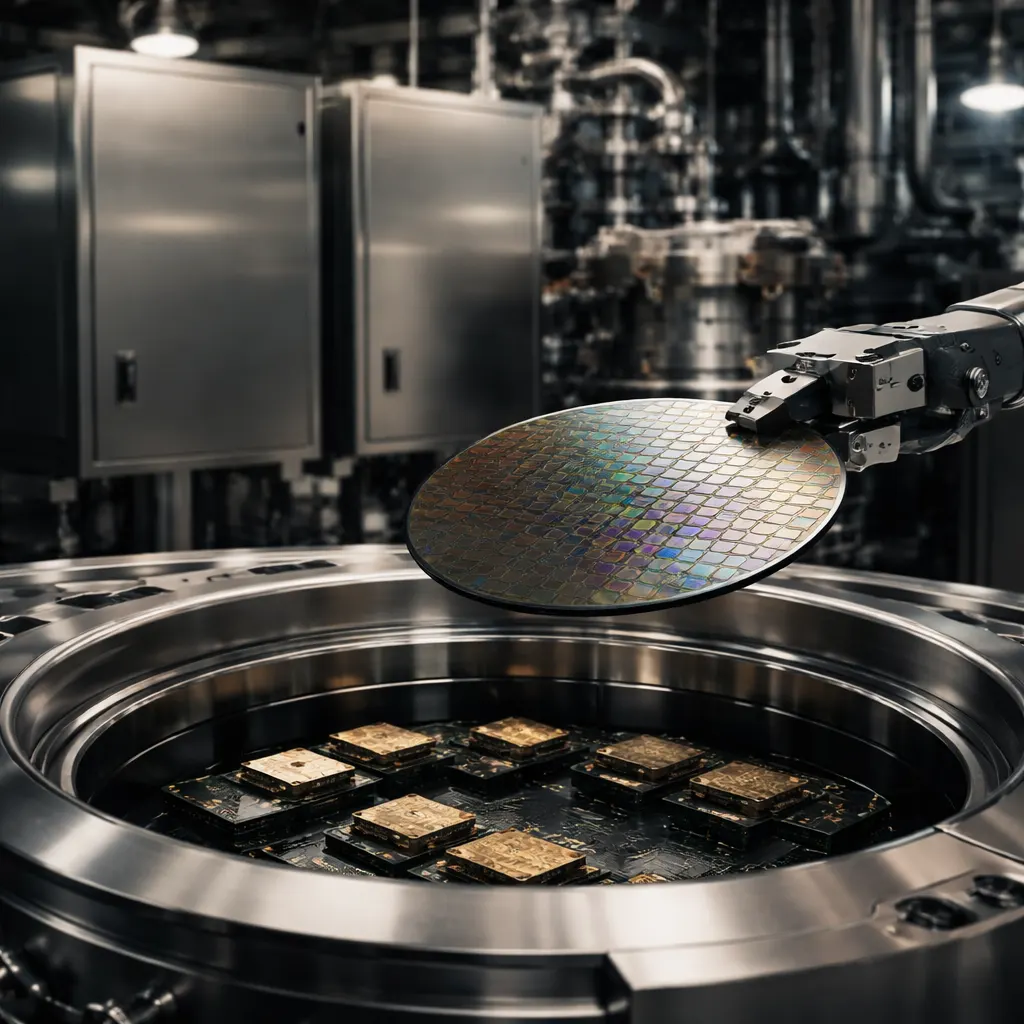
Fusion startup Helion has secured $175 million in federal funding to research, develop, and manufacture advanced semiconductors and power electronics for its fusion power plants, the company announced Thursday. The semiconductors currently used in Helion's systems lose roughly 5% to 10% of the electricity passing through them, and cutting that loss in half could double the power output of the entire fusion system, according to the company. Helion is racing to finish its first power plant, Orion, by 2028 to meet a deadline for supplying Microsoft with electricity from the grid.
The three-year award comes from the Department of Commerce under the CHIPS Act, a Biden-era law aimed at boosting semiconductor research, development, and manufacturing in the United States. Helion also announced a fresh $50 million private investment, though it didn't name the investor, bringing the company's total funding to more than $3.2 billion and making it the second-best-funded fusion startup. More than $100 million will be earmarked for semiconductor and advanced packaging research and development in Washington State, while approximately $80 million will support R&D efforts in Vermont for advanced semiconductor tooling, design, and process development with GlobalFoundries. The funding will help Helion build automated semiconductor module, packaging, and testing capacity to supply the fusion machine currently under construction, and the new production line in Washington State will be the first in the U.S. to manufacture a class of semiconductor used not just in fusion power but in manufacturing, wastewater treatment, medicine, and defense.
David Kirtley, co-founder and CEO at Helion, told TechCrunch that "there are no U.S. manufacturers right now that do it," describing the effort as "absolutely enabling going from zero to 100 for advanced, high-voltage, and pulsed semiconductors here in the United States." Kirtley acknowledged the R&D funded by the award won't reach Orion in time for the launch—federal contracts can take months to negotiate—but said the work promises to improve the efficiency of subsequent Helion power plants, which would boost their competitiveness in cutthroat electricity markets. Bill Frauenhofer, who leads semiconductor investment and innovation at the Department of Commerce, acknowledged in a press release that the award will help "convert and deliver power to critical applications in defense, grid transmission, and advanced energy generation."
Semiconductor efficiency is central to Helion's fusion approach, which harvests electricity directly from fusion reactions instead of using them to heat steam to spin a turbine. The startup is developing a reactor known as a field-reversed configuration: fusion fuel gets injected into both ends of an hourglass-like chamber, where it's heated to form plasma, then accelerated toward each other using magnetic fields. When the plasmas collide, another magnetic field compresses the ball further, raising the temperature above 100 million degrees Celsius. At those temperatures and pressures, atoms in the fusion fuel start fusing and releasing energy, pushing the plasma outward against the magnetic field, and that energy is captured by magnets and capacitors and converted into electricity—similar to how a hybrid car or EV recharges the battery by using electric motors to slow the vehicle. This approach, known as direct energy conversion, will help future reactors produce more power than they need to operate, a milestone any fusion power plant must reach to be commercially viable. Efficient power electronics are a key part of the process, and Kirtley said Helion plans to "take that to the next level here, increase the efficiency." The energy sector isn't the only place where advanced power electronics could make an impact: electric vehicles represent the broadest use today, consumer electronics could benefit though the size and power demands are lower, and the defense industry is likely to be another beneficiary as energy weapons have garnered fresh interest now that drones have swarmed battlefields and overwhelmed existing air defense weapons. Despite the potential for defense contracts, Kirtley said Helion remains focused on putting power on the grid, emphasizing "domestic energy supply, national security through energy dominance, and energy security." For companies chasing the fusion breakthrough, the distinction between making electricity more efficiently and making it at all remains the defining challenge. Whether semiconductors prove to be the bottleneck or simply one constraint among many will shape not just Helion's timeline but the credibility of the entire sector's commercial promises.