
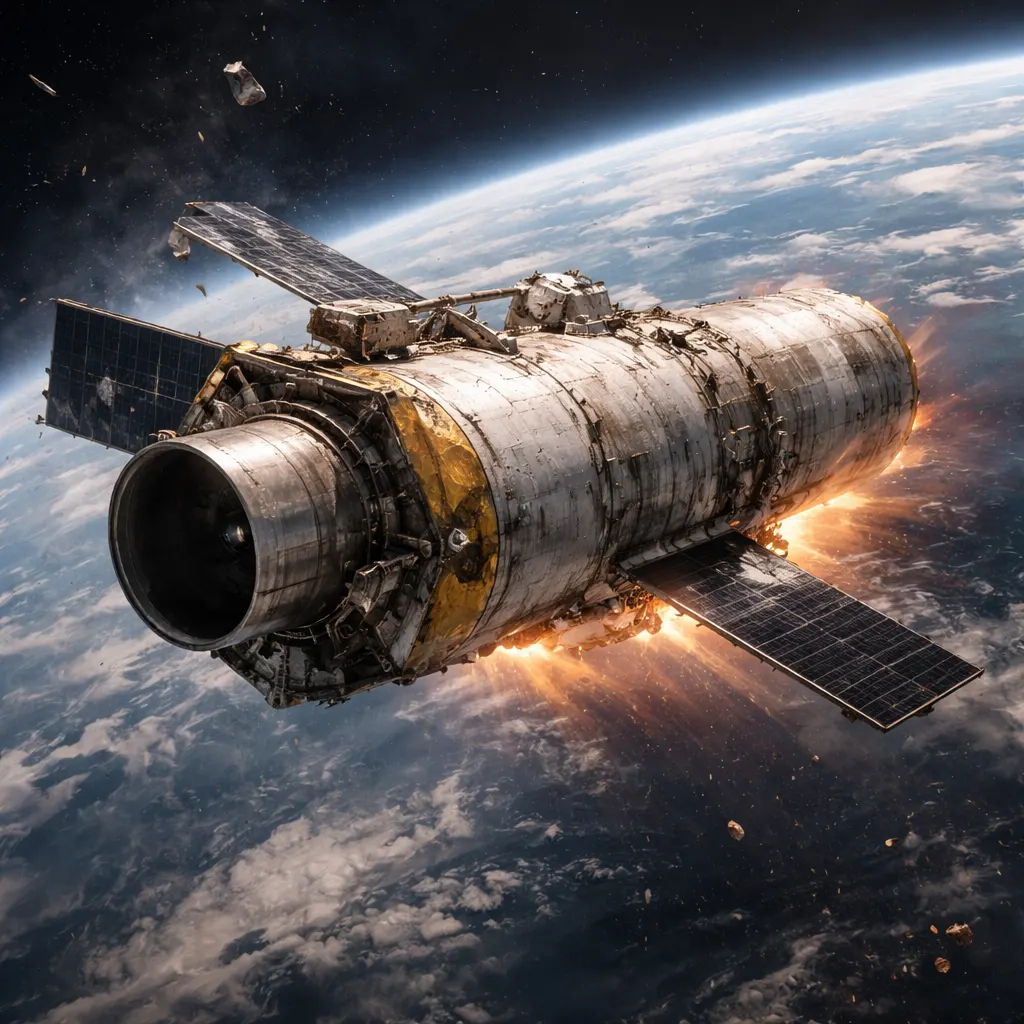
NASA has canceled its mission to rescue the Swift space observatory, a telescope that's been tracking gamma-ray bursts since 2004 and now faces reentry into Earth's atmosphere before the end of 2026. The agency announced Wednesday that problems with the rescue spacecraft's control system made it impossible to complete the planned maneuver to raise Swift's orbit. The observatory, originally designed for a two-year mission but operational for more than two decades, will continue its descent until it burns up in the atmosphere.
Swift lacks a propulsion system capable of meaningfully lifting its orbit, and atmospheric particles at its altitude exert continuous drag that slowly saps its energy and height with each pass around Earth. NASA knew the telescope had limited time remaining, with some projections suggesting it could stay aloft until the 2030s, but heightened solar activity in 2024 altered those forecasts. Energy from the sun warmed and expanded Earth's upper atmospheric layers, boosting the drag on the satellite and speeding its fall. Calculations eventually put its probable reentry before 2026 ends. The robotic LINK spacecraft, built by Katalyst Space Technologies and launched July 3, 2026, was meant to catch Swift with mechanical arms and use thrusters to lift it to a safer orbit. But LINK suffered failures in its attitude control system shortly after launch, the mechanism responsible for maintaining proper orientation and stability in space.
In a statement, NASA administrator Jared Isaacman said the decision stemmed from the spacecraft's control system troubles. "This is not the outcome we were working toward, but it does not change why this mission was worth attempting," Isaacman explained. LINK will no longer capture Swift or elevate its orbit, though the spacecraft will still approach the observatory to perform demonstrations of rendezvous, navigation, and close-proximity operations. Isaacman added that NASA "should be willing to move quickly and take smart risks when the potential return is worth it," noting the agency had warned from the start this was a high-risk effort. Swift wasn't built to be captured or serviced in orbit, while LINK was developed and launched on a tight timeline in response to the telescope's rapid decline.
Without intervention, Swift will keep losing altitude until it reaches denser atmospheric layers, where intense heating and aerodynamic forces will destroy much of the observatory during reentry. It's still too early to pinpoint exactly when or where this will happen, though NASA estimates it will likely occur before the year ends. The agency plans to extract lessons from LINK's rendezvous attempt and apply them to future missions focused on repairing, relocating, or extending satellite lifespans. According to Isaacman, the team "moved with extraordinary speed to give Swift a chance to carry out more science while advancing capabilities America will need for satellite servicing in the future." The failed rescue underscores a tension agencies face as aging spacecraft near their limits: balancing the cost and complexity of rapid intervention against the scientific value still extractable from instruments never designed for a second act. For commercial and government operators alike, the Swift episode may shape expectations around which orbital assets merit emergency servicing and which should be left to fall.