
ClearJet, an AI-powered logistics startup, has secured $25 million in Series B funding led by Edison Partners, bringing its total capital raised to $40 million since launching in 2022. The Austin-based company connects retailers with empty cargo space on commercial passenger flights to move e-commerce packages across the U.S., bypassing traditional parcel networks. Previous backers Venture53, Origin Ventures, SaltVC and SpringTime Ventures joined the round, adding to earlier investments from Sky VC and Tandem Ventures.
The startup's network now covers 95 U.S. airports and links retailers with major airlines and multiple final-mile delivery partners including FedEx, the U.S. Postal Service, DoorDash, Uber, OnTrac and Veho. ClearJet reports it's already profitable, with revenue more than tripling year over year and approaching nine-figure annual sales, according to founder and CEO Chris Guggenheim. The company moves over 30 million packages each year, still a small slice of the roughly 1.8 billion U.S. parcels it considers suitable for air transport. One early major retail client saw delivery times drop from seven days to five while saving $35 million in shipping costs, Guggenheim said. Global investment in supply chain management and logistics startups has hit $8.4 billion in 2026 so far, putting this year on track to exceed 2025's $9 billion total with more than four months remaining.
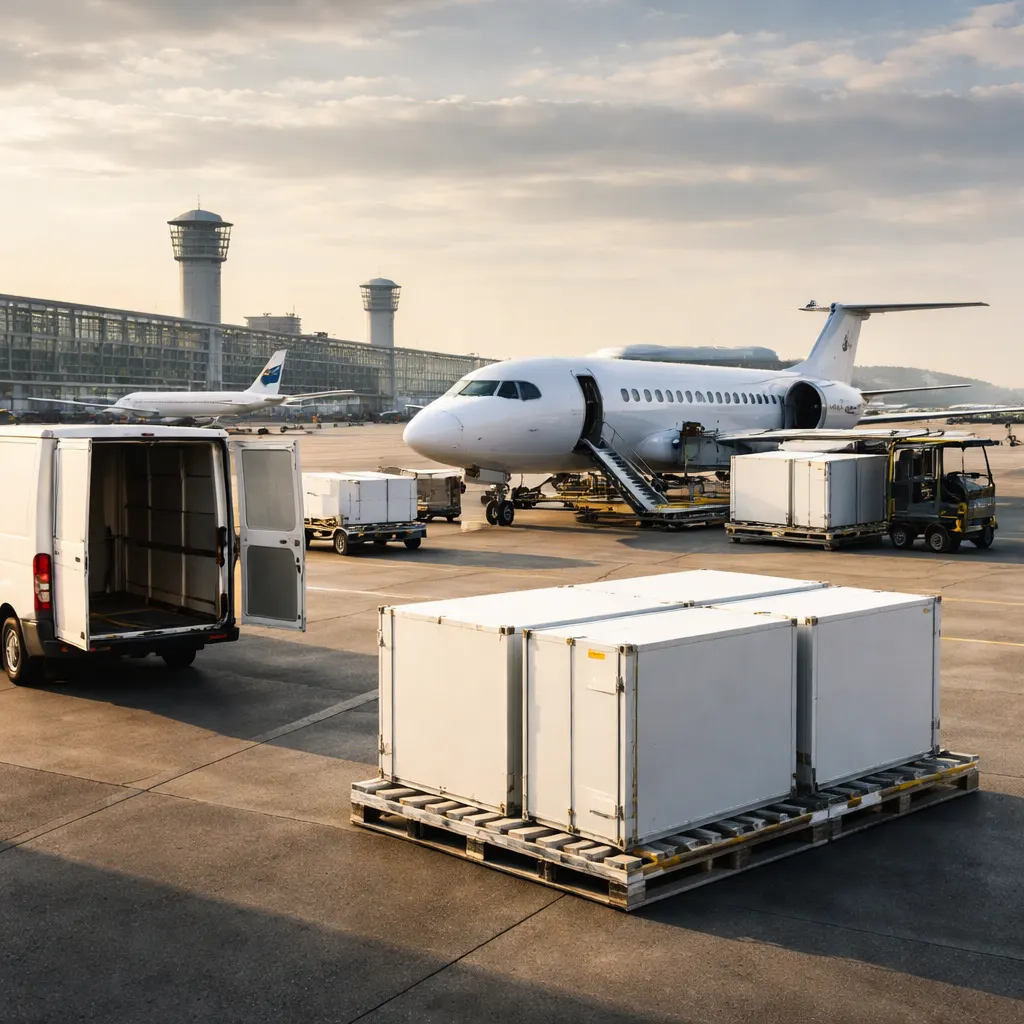
ClearJet's business model operates as what Guggenheim calls a "super carrier" that gives "all the power back to the retailer." The company claims its approach can slash shipping expenses by as much as 35% while accelerating deliveries by one to three days compared to conventional parcel services. Rather than owning aircraft or trucks, ClearJet taps available capacity on flights already traveling between cities, picking up packages, handling airport sorting and screening, placing them on commercial flights, then handing them to final-mile networks at their destination. "We're basically connecting with the already moving aircraft," Guggenheim explained. "These flights are going from A to B city. We're taking those same routes, and that's just why we're so fast."
Ryan Ziegler, who leads Edison Partners' vertical SaaS and AI practice, said his firm had watched supply chain businesses fail for years because they took an asset-heavy approach to middle-mile logistics. ClearJet's asset-light model, combined with its airline relationships, regional sorting infrastructure, regulatory licensing and technology platform, creates barriers that make the business hard to replicate, according to Ziegler. The company uses AI models to select each parcel's route based on cost, speed and location, and it's building AI agents to automate operational tasks like rating, booking, tracking and managing delivery disruptions—including rerouting packages through different cities or onto alternative flights when weather strikes. ClearJet launched formally in May 2023 after Guggenheim spent years as an e-commerce entrepreneur, eventually running One Live, which supported more than 2,000 Shopify Plus stores with over $1 billion in gross merchandise value. His frustration peaked in 2019 when UPS canceled his account with five days' notice after he'd spent $55 million with the carrier, prompting him to pitch airline executives on using passenger planes' unused cargo space for parcels.
The company plans to expand into returns and international shipping while growing its airport network and giving consumers real-time package tracking similar to DoorDash's visibility. ClearJet currently employs just under 50 full-time staff and hundreds of contractors operating seven days a week. Ziegler framed the investment as a bet on building infrastructure for a delivery market increasingly centered on direct-to-consumer shipments, calling it "an opportunity to actually create a category-defining business." The combination of profitability, tripled revenue growth and demonstrated cost savings for major retailers suggests ClearJet has proven its unit economics work at scale, according to Edison Partners. Asset-light infrastructure plays often stumble on execution complexity rather than market opportunity, but established carrier partnerships may determine whether margins hold as volume scales and competition for belly cargo intensifies.