
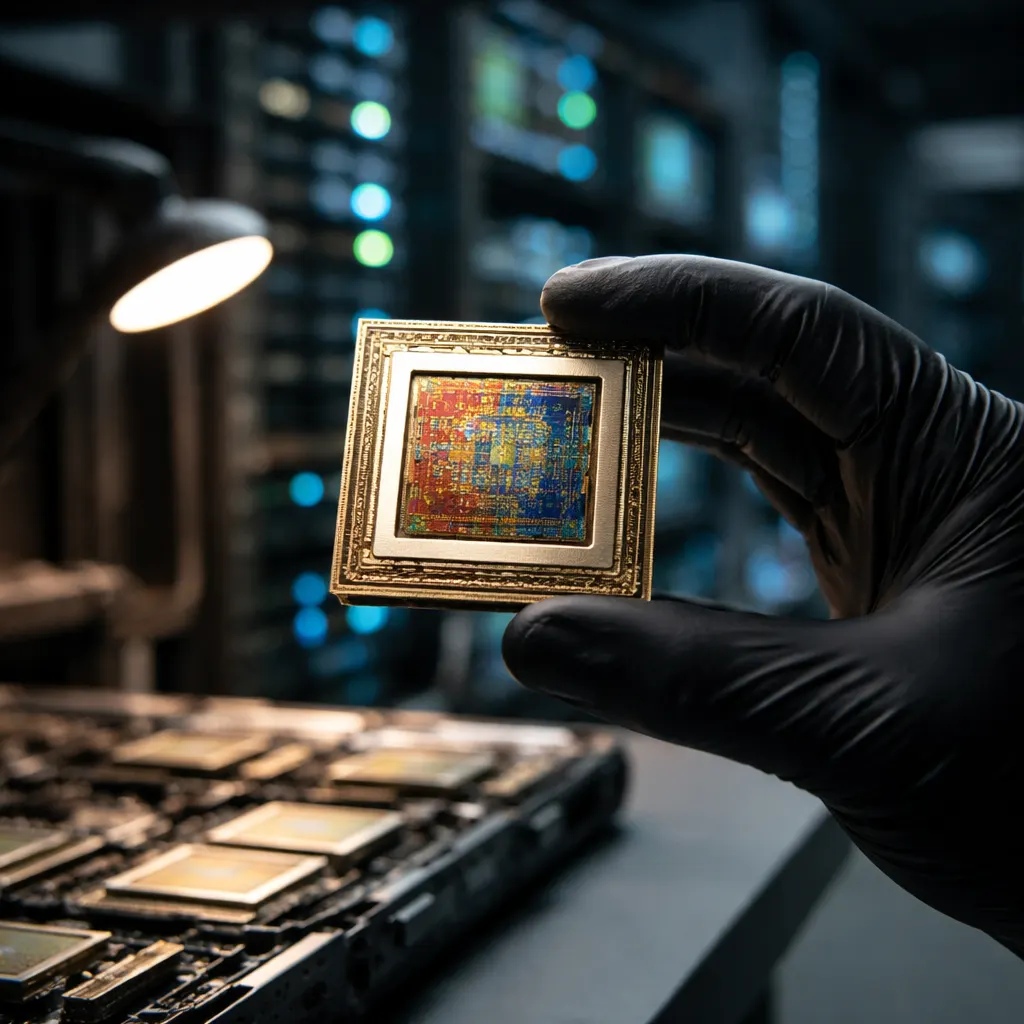
Meta has unveiled MTIA 300, its first custom accelerator built specifically for training ranking and recommendation systems, achieving a 3.9x reduction in communication time compared with an equivalent GPU cluster on a 150-billion-parameter recommendation model running across 40 accelerators. The chip represents a fundamental shift in how Meta approaches AI hardware, integrating networking and collective communication directly into the silicon rather than treating connectivity as external infrastructure. Unlike large-language-model training, where raw computational power typically dominates performance, recommendation workloads spend far more time shuttling data between accelerators, making network speed as critical as processing capability.
MTIA 300 addresses that bottleneck by embedding two network chiplets containing six custom 800 Gbps RDMA network interface cards each, delivering 1.2 terabytes per second of total I/O bandwidth without crossing a PCIe bus. The chip includes 16 dedicated message engines that handle communication independently of its main compute grid, including near-memory hardware for reduction operations. Meta reports this separation allows large matrix operations and collective communication to run simultaneously with less than 0.5% degradation in compute throughput, while the GPU architecture used for comparison showed degradation exceeding 20% when the two workloads overlapped. In production, Meta's collective-communication library reaches up to 940 gigabytes per second of communication bandwidth within a rack.
The communication pressure stems largely from embedding tables, which Meta says can contain more than 99% of a recommendation model's parameters. Training these models across hundreds of accelerators generates frequent AllReduce, AllToAll, and AllGather operations, creating a workload where the network can become as important as the compute itself. The company co-designed the hardware with HCCL, its collective-communication library, which compiles collective operations into subgraphs that MTIA 300's message engines can execute autonomously—once those instructions reach the accelerator, the host CPU is no longer involved in driving the communication.
MTIA 300 marks an expansion of Meta's broader custom-silicon programme, with the company already operating hundreds of thousands of MTIA accelerators for inference and planning four additional generations over the next two years spanning ranking, recommendation, and generative-AI workloads. Meta has expanded its partnership with Broadcom to co-develop future MTIA generations while continuing to source accelerators from AMD, NVIDIA, and other vendors as part of what it calls a portfolio strategy. That strategy reflects a wider shift among hyperscalers toward workload-specific AI silicon—Google has continued expanding its TPU programme, Amazon has grown its Trainium business, and Microsoft is developing successive generations of Maia accelerators as cloud providers look for alternatives to relying exclusively on general-purpose GPUs. Rather than treating networking as supporting infrastructure around the accelerator, Meta designed compute, communication hardware, and collective software together around a workload where moving data can be as important as processing it. The architecture suggests that future competition in AI infrastructure may hinge less on headline compute specs and more on how tightly companies can bind silicon to the specific communication patterns their workloads demand.