
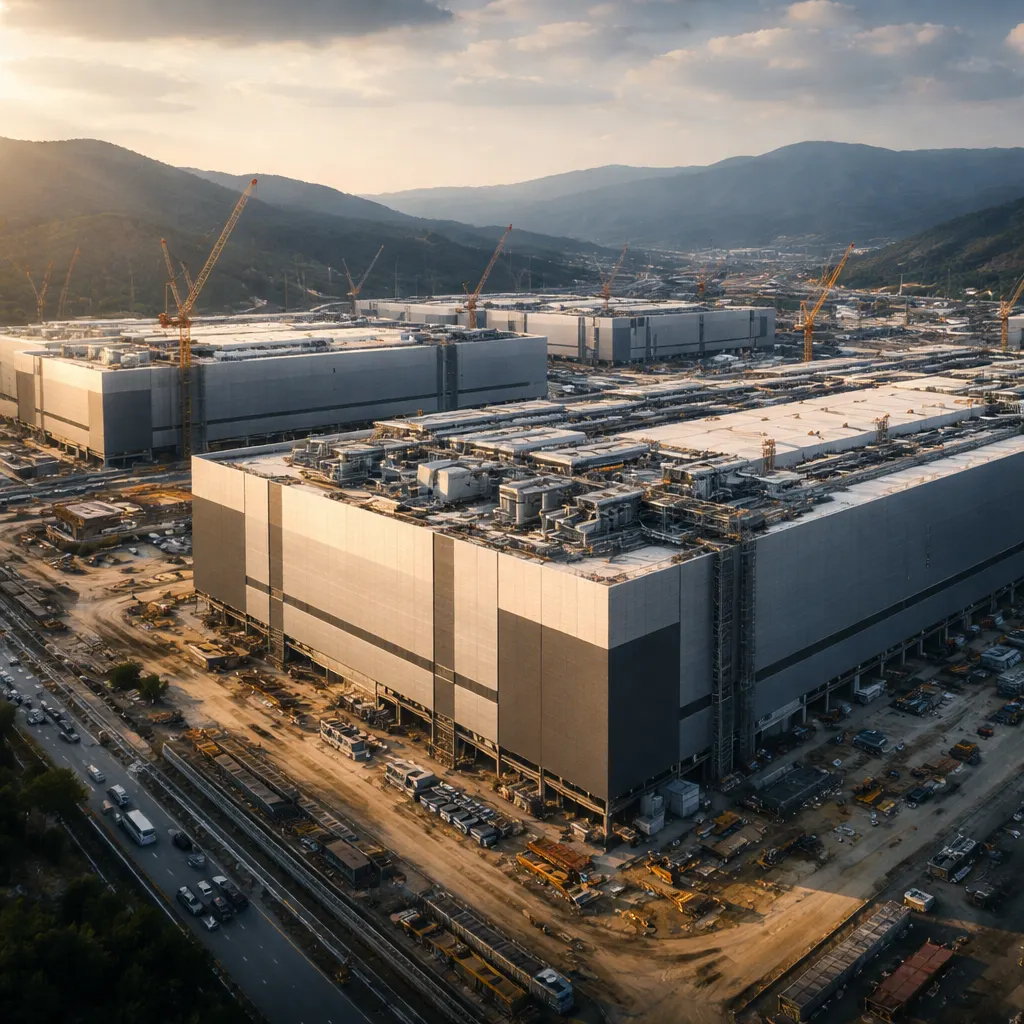
Samsung is constructing a massive new semiconductor manufacturing complex in Pyeongtaek, South Korea, to meet surging demand for the specialized memory chips that power generative AI models, according to a dispatch published by MIT Technology Review on October 20, 2026. The build-out represents the company's effort to regain its leading position in the global memory chip market after years of watching domestic competitor SK Hynix pull ahead in high-bandwidth models used in Nvidia's AI accelerators.
Three fabrication plants at the Pyeongtaek site already run continuously, while a fourth facility is currently coming online. Construction on a fifth fab was stopped during a decline in memory chip demand in 2024 but resumed when the AI boom caused demand to skyrocket. The manufacturing campus spans an area roughly equivalent to the size of New York City's Central Park, where thousands of construction workers move between job sites on scooters and motorcycles. Safety officer Choi Hye-rin, who oversees crews building cable ducts at the fourth fab, earns 140,000 won ($97) daily—a rate she describes as higher than competing construction sites for work that's relatively easy.
Samsung forecasts that demand for memory chips will keep climbing through 2028. The dispatch notes that for years the company observed SK Hynix advance ahead in the worldwide market for high-bandwidth memory that powers Nvidia's AI accelerators, while Taiwanese chipmaker TSMC has controlled the foundry business for manufacturing chips designed by other firms. According to Hye-rin, "You just keep coming back," reflecting her expectation that the boom will sustain employment for an extended period.
The Pyeongtaek expansion reflects how generative AI models depend on powerful graphics processing units, which require stacks of specialized memory chips packaged together with the processor. Samsung's decision to restart construction on the fifth fab after halting it during the 2024 memory slump shows how quickly the AI wave reversed industry fortunes. The urgency is visible across the construction site, where banners warn workers not to rush even when deadlines loom, and giant LED scoreboards announce winners of safety poem contests—yet the company's production timeline reveals pressure to catch up with rivals who moved faster on AI-optimized memory architectures.
The South Korean chipmaker's ability to execute this expansion at scale will determine whether it can close the gap SK Hynix opened in supplying the memory chips essential to training and running large language models. With construction workers like Hye-rin commuting from outlying districts at dawn and rental apartment banners lining streets near the fabs, Pyeongtaek is transforming from a farming city into a hub staking Samsung's claim in the AI infrastructure race. The company's bet is straightforward: memory demand won't just recover—it'll accelerate for years to come. Whether Samsung's vast capital investment and manufacturing prowess can overcome its rivals' head start will shape who controls the hardware layer beneath the AI economy, a contest where production scale matters but architectural innovation and customer lock-in often matter more.