
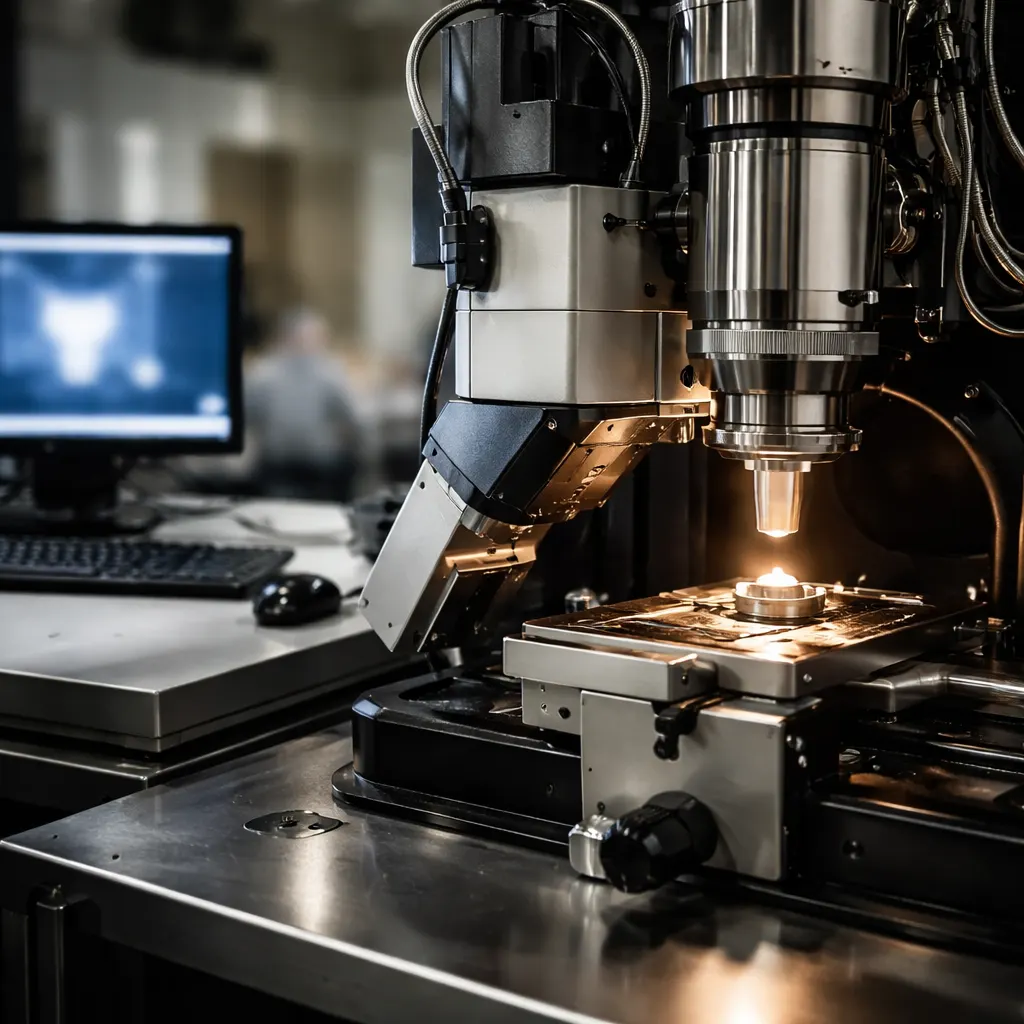
Scientists at Argonne National Laboratory have integrated an agentic AI platform into an X-ray nanoprobe beamline, producing a system that can zero in on areas researchers request through natural language commands. The lab announced this week that an experimental test run succeeded, with the device initially challenged to find the border between two zones on an integrated circuit chip simply by being told what to locate in everyday language. The accomplishment represents the second phase of a broader effort to transform how researchers interact with complex scientific instruments.
The microscope forms part of Argonne's 26-ID hard X-ray nanoprobe beamline, which employs a narrowly concentrated X-ray beam to carry out nanoscale imaging and measurements of sample materials. These instruments generate enormous volumes of data through a technique called ptychography, which gathers numerous diffraction patterns as X-rays pass through a sample. Contemporary X-ray experiments can produce millions of images during just a few hours of operation, and traditional ptychographic reconstruction and analysis typically requires hours or even days to complete. Argonne's AI system can now reconstruct images in real time as information streams in, a dramatic acceleration over conventional methods. The conversational AI added in the second phase allows researchers to simply ask the microscope to examine a region of interest rather than manually calculating how to direct the beam themselves, and the AI can independently handle data collection, processing, result analysis, and identification of additional areas worth investigating.
Mathew Cherukara, an Argonne computational scientist, said that microelectronics served merely as the example to demonstrate the technology, with the true accomplishment being the creation of a next-generation, AI-enhanced microscope capable of benefiting many scientific disciplines. Tao Zhou, another scientist at the lab, explained in a video that the chattier version of the microscope could unlock advanced scientific research for investigators who would gain from X-ray nanoprobe beamline science but lack the expertise to run such a complicated instrument. "This can be a game changer for a lot of users," Zhou remarked, noting that the interactive chat interface lets them conduct their scientific research and obtain excellent data without investing excessive time learning about the beamline components. Cherukara added that combined, these advances establish the foundation for self-driving microscopes, closed-loop experimentation, and automated defect-detection tools that promise to speed up discovery across fields spanning semiconductor manufacturing to advanced materials and national user facilities.
The project operates under the Trump administration's Genesis Mission, launched by President Trump in November 2025 and overseen by the Department of Energy, which seeks methods to apply AI in scientific research. Argonne is pursuing this work through the Synergistic Neutron and Photon Science - Intelligence (SYNAPS-I) project in partnership with Lawrence Berkeley National Laboratory, which leads the effort, while Brookhaven National Laboratory, SLAC National Accelerator Laboratory, and Oak Ridge National Laboratory also participate. The first phase of the project confirmed that AI could slash ptychographic image processing time, a success the lab reported in April, and the second phase's addition of natural language agentic AI has proven equally effective. Zhou suggested the new interface would help the lab attract many new users who previously couldn't access these capabilities, fundamentally changing who can conduct cutting-edge materials research. The shift from requiring specialized technical knowledge to simply conversing with an instrument in plain language could democratize access to facilities that have traditionally demanded months of training, potentially accelerating materials discovery in semiconductors, batteries, and other technologies where atomic-scale imaging reveals critical insights. For organizations investing in advanced manufacturing or materials R&D, the ability to tap expertise at national labs without building internal beamline proficiency may reshape how they approach nanoscale characterization altogether.