
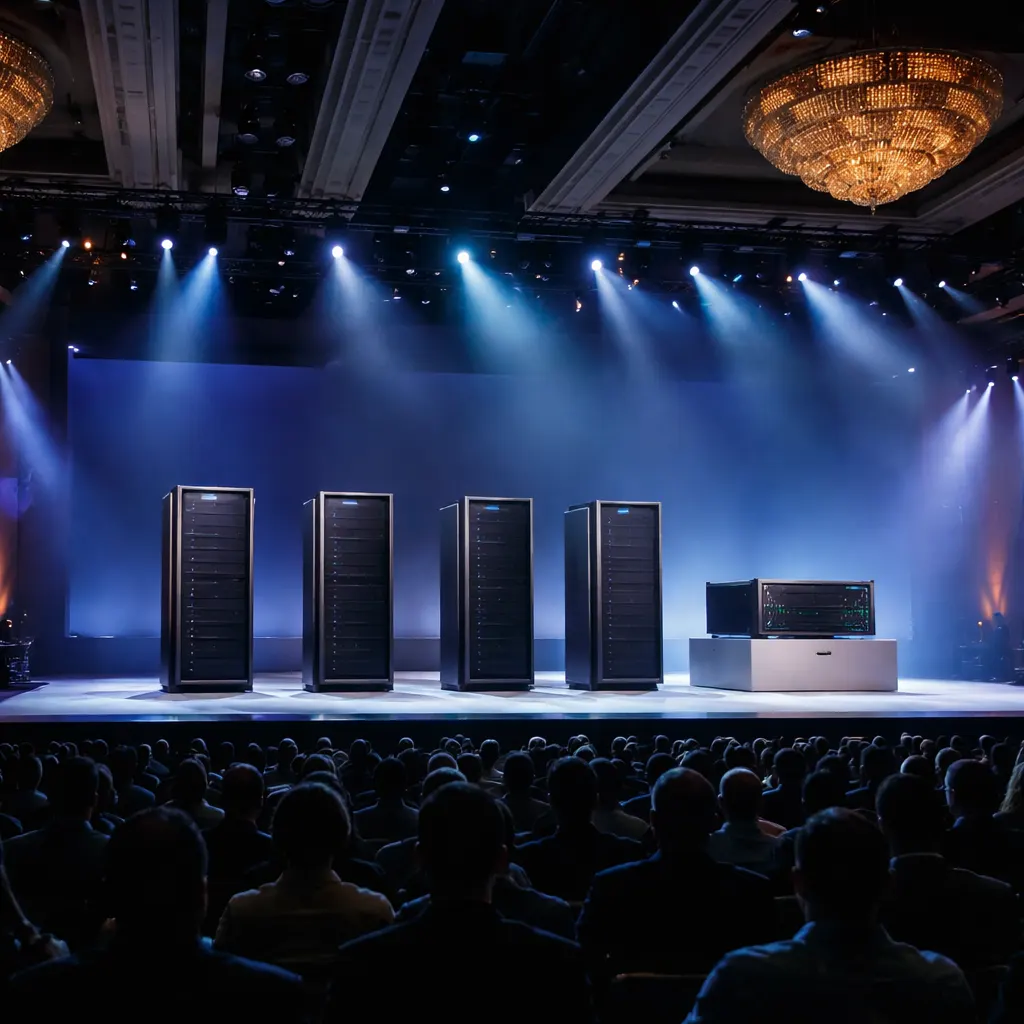
VMware by Broadcom launched its new AI Factory at VMware Explore 2026 in Las Vegas this week, combining the company's Cloud Foundation platform with client-chosen AI software and hardware accelerators. The Palo Alto, California-based cloud software company also rolled out three new private AI services designed to make artificial intelligence operational, governable, and cost-effective for enterprise clients, according to the announcement. Additionally, the firm validated five new AI models from Google, Nvidia, NEC, Alibaba Cloud, and Z.ai to run on its VCF platform for the first time.
VMware's AI Factory pairs VMware Cloud Foundation with certified VCF AI ReadyNodes from hardware partners including Cisco, Dell, HPE, Lenovo, and Supermicro. The three new private AI services include multi-tenant model sharing that allows VMware's Model Runtime to support secure AI model sharing between tenants or business units through isolated namespaces, eliminating redundant model deployments that waste GPU resources. The second service, AI Gateway, delivers unified model governance across on-premises and cloud settings through a single interface, enabling access to both cloud-hosted and locally-hosted models with features like intelligent prompt routing and token rate-limiting. The third service provides secure virtualized container spaces to isolate dynamically generated agent code execution, with a control layer that defines how agents are invoked and what tools they can access.
The newly validated AI models on VCF include Google DeepMind's latest open-source Gemma 4 model, Nvidia's Nemotron 3 family of multimodal models, NEC's cotomi AI model, Alibaba's Qwen 3.7-Max multimodal model, and Z.ai's GLM 5.2 open-source general language model. Chris Wolf, global head of AI and advanced services for the VCF division, stated that Broadcom is committed to giving enterprises the broadest set of AI models for their on-premises infrastructure, all validated on VCF. Krish Prasad, senior vice president and general manager of VCF, told CRN that the company's "innovate forward" mantra means delivering solutions before market crises hit, pointing to earlier innovations like memory tiering and GPU enablement that arrived before supply shortages emerged.
The launches address a fundamental shift in how enterprises need to manage AI infrastructure and autonomous agents. VMware's AI Factory automates hardware provisioning, software stack enablement, and end-to-end lifecycle management, delivering faster time to first model and predictable private cloud costs, according to Prashanth Shenoy, CMO and vice president of marketing for cloud platform, infrastructure, and solutions. On the security front, Broadcom unveiled AgentMinder, a central control plane for autonomous AI agents that independently verifies agent identity and authorizes each action against its declared mission and current risk level. Clayton Donley, vice president and general manager for Broadcom's Identity Management Security Division, explained that existing security models were built for human users, not autonomous digital employees capable of making independent decisions. The company also introduced TrueSource by Broadcom, a portfolio of commercially supported open-source software including Spring Enterprise, TrueSource Trusted Artifacts for secure builds of Java, Python, and Node.js ecosystems, and TrueSource Data Services for PostgreSQL, RabbitMQ, MySQL, and Valkey data engines. By establishing policy-based controls and continuous authorization, these tools help enterprises scale agentic AI while maintaining security and compliance. The moves position VMware to capture enterprises seeking to bring AI workloads in-house rather than relying solely on cloud providers, potentially reshaping competitive dynamics as companies weigh data sovereignty against operational simplicity.