
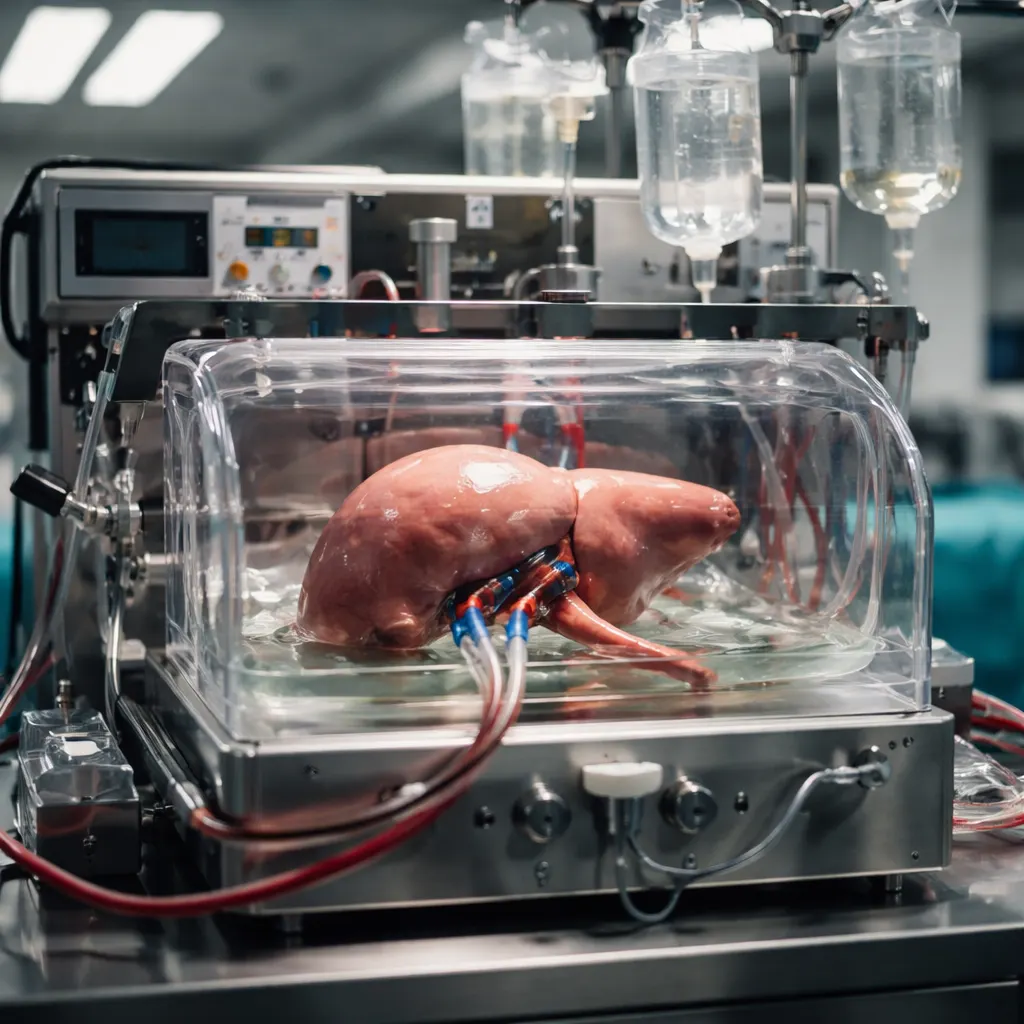
Donated livers hooked up to perfusion machines—devices that pump organs with nutrients and oxygen—became biologically younger by roughly 30%, according to new research shared with MIT Technology Review. The study, led by transplant surgeons and aging researchers at Mass General Brigham, used molecular "aging clocks" to measure the biological age of donated organs and found a striking reversal in livers kept on machines compared to those stored on ice. The findings offer molecular evidence for why organs from younger donors succeed at higher rates and may explain why perfused organs are less likely to fail after transplant.
The research team examined 245 samples from 122 donated livers, assessing biological age through chemical marks on DNA and gene activity patterns. When comparing livers held in cold storage to those perfused on machines at 34 degrees Celsius with oxygen and nutrients for six to 12 hours, the perfused organs showed consistently lower biological ages—even when the machine-treated livers were chronologically older or had less favorable characteristics. The effect persisted after transplantation: while all livers experienced a biological age increase once placed in a recipient's body due to transplant stress, the perfused organs maintained their younger biological profile. Samples were taken after storage periods of up to six hours and again about an hour after the organs were transplanted, giving researchers a window into molecular changes at multiple stages.
"Machine-perfused livers, in spite of being older or having other disadvantageous characteristics, had a biological age that was lower than [non-perfused] livers that were chronologically younger," Heidi Yeh, a transplant surgeon who led the work, told MIT Technology Review. The team found molecular shifts in cell pathways tied to inflammation and tissue structure, along with increased activity in systems that allow cells to clear out and recycle damaged components. Jesse Poganik, an aging researcher at Brigham and Women's Hospital who coauthored the study, said the work could improve organ utilization: "If [we] can improve the utilization of organs beyond what the current systems can do, then that's a win in my book."
The biological rejuvenation appears to stem from the perfusion process itself, which mimics conditions inside the body by supplying oxygen and nutrients while removing waste—a sharp contrast to traditional cold storage, where organs immediately start to degrade once removed from a donor. The molecular changes suggest that perfusion activates repair mechanisms at the cellular level, addressing damage that accumulates with chronological age. This could explain why organs from older donors—including those over 70 who suffered circulatory death, a scenario surgeons avoided just a few years ago—now succeed after machine treatment, transforming what would have been discarded organs into viable transplants.
Looking ahead, researchers hope to develop tests that determine transplant suitability based on biological rather than chronological age, and they're experimenting with drug treatments that might push biological age even lower. Perfusion currently costs around $80,000 to $100,000 per organ in the US and €10,000 in Germany—about a quarter of a transplant budget—prompting interest in therapies that could achieve similar molecular repair at lower cost. Any liver that doesn't come from a "perfect, young, brain-dead donor" would likely benefit from perfusion, Yeh noted, adding that the technology has completely reshaped transplant surgery over the past three years. For hospitals balancing cost against the prospect of salvaging organs that might otherwise go unused, the choice between immediate cold storage and machine intervention now carries measurable biological stakes. Perfusion devices may force a broader rethinking of how transplant centers evaluate organ quality, shifting from donor age alone toward molecular readiness markers that better predict post-transplant outcomes.