
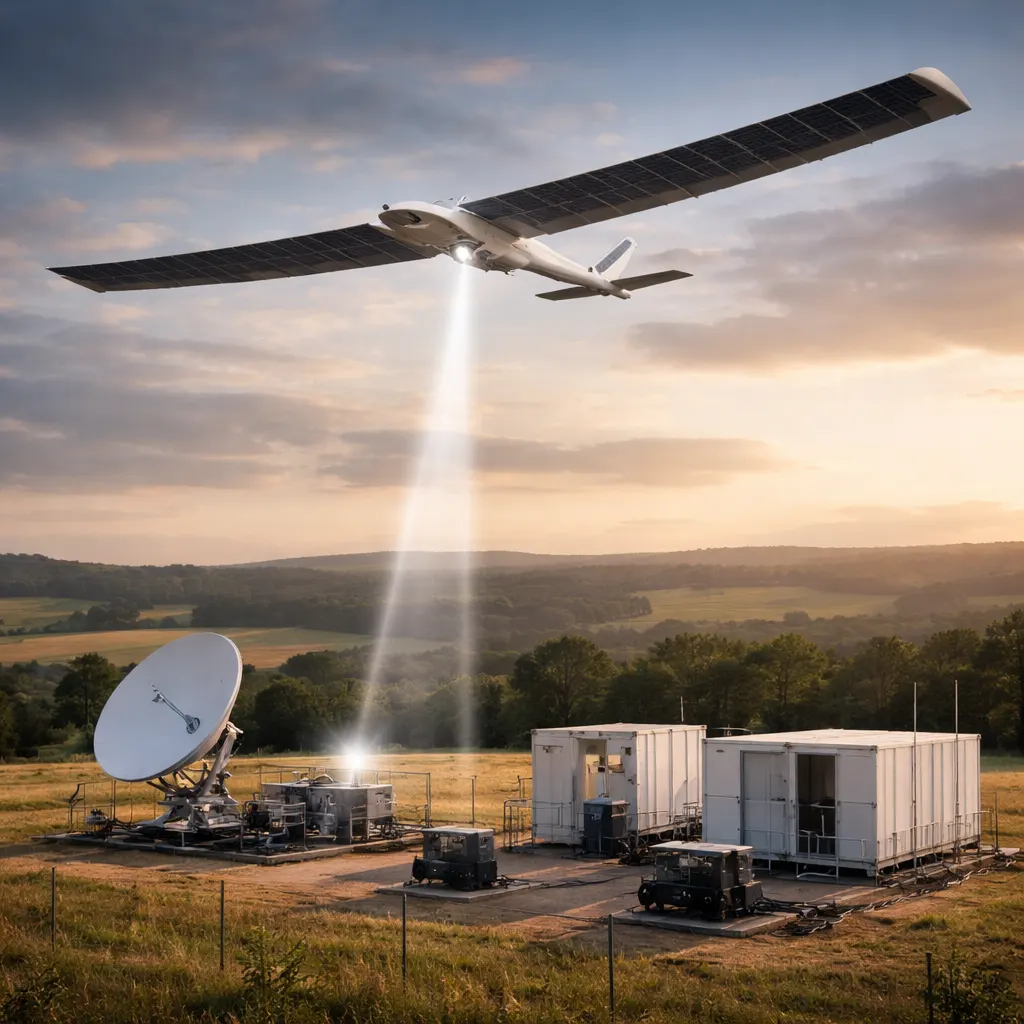
The UK's Advanced Research and Invention Agency (ARIA) is funding 18 projects aimed at delivering internet connectivity using high-altitude aircraft, including technologies that beam power from the ground to keep them airborne. The science and technology body, modeled after America's DARPA but operating with a smaller budget, announced the initiative as part of its Enduring Atmospheric Platforms program. The goal is to create alternatives to orbital satellites for bringing connectivity to underserved areas of the UK and other parts of the world.
ARIA is distributing £70 million ($94 million) across three and a half years to address the power and reliability challenges of sustained operations in the stratosphere. Success will be measured by whether any aircraft can continuously supply 300 watts of power to a communications payload for an entire week while holding position above the UK. The projects are organized into three technical areas: TA1 covers enabling technologies, TA2 focuses on system integration and testing, and TA3 addresses deployment and communications. Among the funded efforts is Carousel from aerospace startup Menapia, which plans to build a constellation of high-altitude multi-rotor aircraft capable of routine operations at altitudes up to 20 kilometers (12 miles), forming a persistent "canopy" over the UK. Another project, Enduring Drone Networks by VFP Aerospace, aims for continuous presence through a relay team of units that cycle between their service altitude and ground stations for recharging, targeting a production cost of £50,000 ($67,000) per drone.
The enabling technologies category includes several innovative approaches to sustained flight in the stratosphere. Hypanode Ltd is developing a fuel cell power system designed to deliver 20 times more energy than current battery technology. Scalable Laser Ltd is working on laser-based power beaming technology that pairs high-power laser diodes with advanced photovoltaic receivers, while Space Solar Engineering Ltd is exploring radio frequency power beaming to deliver continuous power to high-altitude pseudo-satellites (HAPS). The University of Bath is pursuing what it calls Stratospheric Navigation and Gravity (STRAT-NAV), which seeks to extend aircraft endurance by allowing them to predict and exploit atmospheric gravity waves—ripples created when air is forced upward by weather fronts or hills and then pulled back down by gravity. "This research expands the UK's leadership in high-altitude platforms to become the place where this industry is designed, built, and scaled," says Rico Chandra, ARIA's program director for Enduring Atmospheric Platforms.
ARIA explains that satellites have traditionally been the default method for reaching users or communities that terrestrial networks don't serve well, but their distance and orbits create physical limits on what they can deliver. High-altitude pseudo-satellites operating in the stratosphere could overcome these constraints by flying closer to the ground while still covering large areas. The agency is backing what Chandra describes as "bold ideas, from fixed-wing solar aircraft to designs nobody predicted, including aircraft that fly on spinning wings instead of propellers." ARIA operates as a non-departmental public body sponsored by the Department for Business, Innovation, Science and Trade, funding teams of scientists and engineers pursuing cutting-edge research. The agency was recently spared from being asked to make savings ahead of the UK government's Spending Review last year, despite broader budget pressures across government departments. If successful, the program could establish the UK as a global hub for stratospheric platform development and manufacturing. The real test will be whether unconventional power delivery methods can prove reliable enough to compete with established satellite infrastructure, potentially reshaping how remote connectivity is delivered worldwide.