
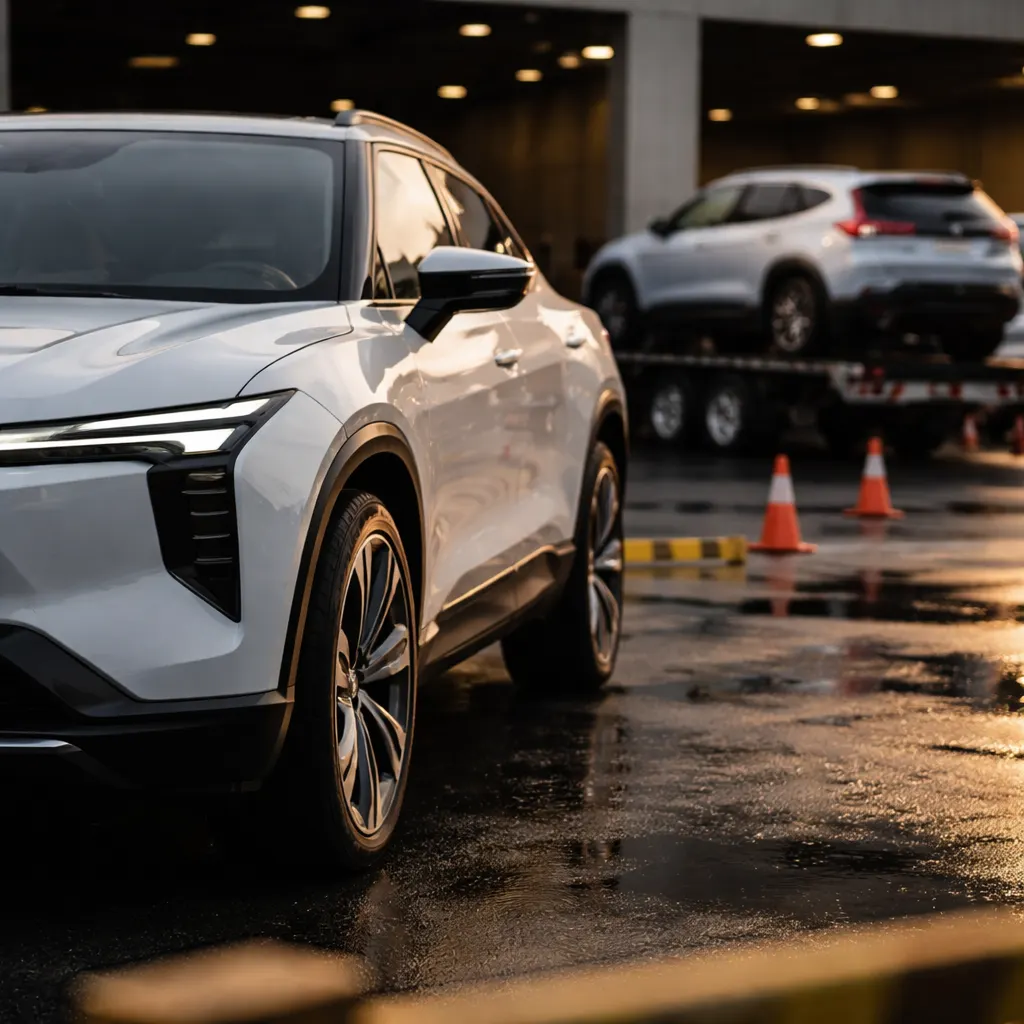
General Motors electric vehicles, including models produced jointly with Honda, are now under intensified examination by federal safety regulators following hundreds of incidents, more than 20 crashes or fires, and at least six injuries, according to a report published by TechCrunch on August 24, 2026. The National Highway Traffic Safety Administration announced Monday it's escalating its investigation to an engineering analysis—the highest level of probe the agency conducts and typically a precursor to ordering a recall. The brake issues also affect several non-electric models, including the Chevy Colorado, GMC Canyon, and Buick Enclave and Envision, with more than 1 million vehicles potentially impacted.
NHTSA's Office of Defects Investigation launched its inquiry in April 2024 after receiving complaints from 2023 Cadillac Lyriq owners. Early reports typically described drivers encountering a "Brake System Failure" warning when starting their vehicle or after stopping completely. GM carried out "several internal investigations" and traced the problem to fractures in the spindle of its "eBoost" brake-by-wire system, according to the agency. However, regulators continued receiving reports describing an "immediate loss of brake assist" while drivers were actively braking to decelerate, which the agency said "could result in extended braking distance, which increases the risk of a crash or injury." In one incident, a 2025 Lyriq driver reported losing brakes while attempting to enter a parking spot in front of a store, with the vehicle jumping the curb and crashing through the storefront, ending up "mid-way in the store, amidst the furniture and store structure." Another driver of a 2024 Blazer EV said they had to "deliberately steer the vehicle into a concrete curb" to slow down and prevent a "catastrophic intersection collision."
"The safety of our customers is the highest priority for the entire GM team," the automaker stated. GM said it takes the reports seriously and conducted a comprehensive investigation, determining the alleged condition doesn't present an unreasonable risk to motor vehicle safety, and pledged continued cooperation with NHTSA's ongoing investigation. The safety regulator stated Monday that it needs to conduct additional analysis of the potential for failures in the eBoost system, noting the newer complaints were "inconsistent with GM's description of a spindle failure."
The eBoost system debuted in 2019 and was gradually introduced across additional models in subsequent years. The technology eliminates a conventional mechanical connection between the brake pedal and braking system, replacing it with an electronic link that allows GM to adjust brake "feel" across different driving modes. GM installed eBoost on its highest-volume electric vehicles, including the Blazer EV, Equinox EV, Cadillac Lyriq, Honda Prologue, and Acura ZDX—the latter two produced through a Honda joint venture. The abandoned Cruise Origin autonomous vehicle, which lacked a steering wheel or pedals, also utilized the eBoost system before GM discontinued it in 2024. The escalation to an engineering analysis signals regulators view the brake-by-wire failures as potentially widespread and serious enough to warrant the agency's most rigorous technical scrutiny before determining whether a formal recall order is necessary. For automakers increasingly adopting electronic brake systems to enable software-defined vehicle features and regenerative braking in electric powertrains, the outcome of this investigation could reshape how these technologies are validated and monitored throughout their service life.